
Why short-term roles appear on your CV: a 2026 guide

Short-term roles are defined as any position held for less than twelve months, and they appear on your CV because they represent genuine professional experience. Whether the work was a fixed-term contract, a temporary assignment, or a project-based engagement, each role carries skills, contacts, and outcomes worth documenting. Research confirms that 85% of jobs are filled through networking. That figure alone makes every short role worth considering, because each one expands your professional circle. The real question is not whether to include brief positions, but how to present them so recruiters see purpose rather than instability.
Why short-term roles appear on your CV and what they signal
Short-term job history appears on a CV for several legitimate reasons: fixed-term contracts, project work, redundancy, career exploration, or industry-specific norms such as seasonal roles in hospitality or construction. These are not red flags. They are a reflection of how modern employment actually works.
The distinction that matters is between intentional career building and erratic job-hopping. A candidate who took a six-month contract to gain sector experience, then moved to a related role, tells a coherent story. A candidate who left four permanent roles in two years without clear progression raises a different question. The CV format and the language you use determine which story a recruiter reads.
Recruiters in 2026 assess career narrative and measurable outcomes, not tenure length alone. A short role where you delivered a specific result carries more weight than a long role described only by its job title and dates.

What employers really think about short-term roles
Hiring managers distinguish clearly between job-hopping and deliberate career building. Successful candidates show adaptability and contribution across roles, not instability. That distinction is made at the level of how your CV is written, not simply how long each role lasted.
Recruiters look for three things when they see a short tenure:
- A clear label. Was this a contract, a temporary post, or a fixed-term role? Ambiguity creates doubt.
- A tangible outcome. What did you deliver during that time? Numbers, projects, and results answer this directly.
- A logical sequence. Does each role connect to the next in some way, even loosely?
Transparency builds trust. Listing roles clearly with accurate dates and labels such as “fixed-term contract” or “temporary” reduces recruiter confusion and signals professionalism. Hiding dates or vague descriptions do the opposite.
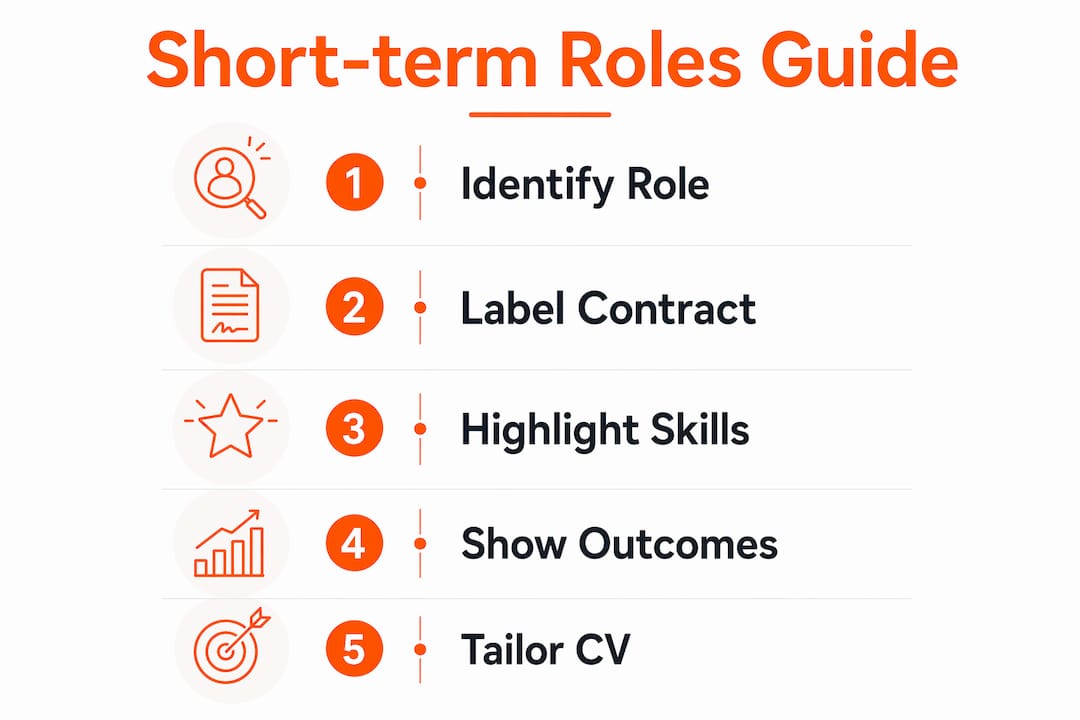
Pro Tip: If a role was contract-based, write “(Fixed-Term Contract)” directly after the job title. This one addition removes ambiguity before a recruiter even reads the bullet points.
How to present short-term roles effectively on your CV
Presentation is where most job seekers lose confidence. The instinct is to apologise or over-explain. The correct approach is neutral, outcome-focused language that treats each role as a professional chapter with its own contribution.
- Label every short role accurately. Write “Temporary,” “Contract,” or “Fixed-Term Contract” next to the job title. This is the single most effective formatting change you can make.
- Include accurate dates. Write the month and year for both start and end dates. Omitting months to hide a short duration is a common mistake that recruiters notice immediately.
- Group multiple short contracts. If you completed several short assignments in the same field, group them under a heading such as “Contract Engagements” or “Portfolio Career.” This avoids the appearance of instability and simplifies recruiter review.
- Write outcome-focused bullet points. Each bullet should describe what you achieved, not what you were responsible for. “Reduced onboarding time by three days by redesigning the induction checklist” is stronger than “Responsible for onboarding.”
- Drop apologetic language. Phrases like “left due to contract end” or “role was unfortunately short-lived” weaken your CV. Neutral, professional language maintains credibility. Save any explanation for the cover letter or interview.
Pro Tip: Use SparkCV’s CV tailoring checklist to verify that each short role is framed around the skills and outcomes most relevant to the job you are applying for.
How short-term roles can actually strengthen your CV
The impact of temp jobs on a CV is frequently underestimated. Short-term work builds skills faster than many permanent roles because it drops you into new environments with immediate expectations. You adapt, deliver, and move on. That cycle, repeated across several roles, produces a candidate with genuine range.
The career advantages of short-term and contract work include:
- Skill diversification. Temporary assignments allow professionals to explore new industries, acquire new skills, and fill employment gaps productively. A marketing professional who spent four months in a SaaS start-up gains product knowledge that a purely agency-side career would not provide.
- Network expansion. Each short role adds new colleagues, managers, and clients to your professional network. Given that 85% of jobs are filled through networking, every temporary position is also a pipeline of future opportunities.
- Demonstrated agility. Employers in fast-moving sectors actively value candidates who have worked across multiple environments. Adapting quickly to different teams, tools, and cultures is a skill in itself.
- Gap prevention. Short-term roles keep your employment record continuous during a job search, which matters to ATS screening systems that flag unexplained gaps.
The value of contract work on a CV is not just what you did. It is the proof that you can enter an unfamiliar situation and produce results quickly.
When should you leave a short-term role off your CV?
Not every short role belongs on your CV. Selective inclusion creates a focused document rather than a comprehensive employment log. The goal is a highlight reel, not a full transcript.
Very short or unrelated temp roles can be excluded provided no unexplained gaps are left behind. A two-week warehouse role taken during a career break adds nothing to a software engineering application. Removing it tightens the CV without misrepresenting your history.
The test for inclusion is relevance. Ask two questions: Does this role demonstrate a skill or outcome relevant to the job I am applying for? Does removing it create a gap that needs explaining? If the answer to both is no, leave it out.
When a pattern of short roles does need addressing, the cover letter is the right place. A single, confident sentence explaining that your career has included project-based and contract work, followed by what that experience produced, is far more persuasive than a cluttered CV. SparkCV’s guide on writing a cover letter for career transitions covers exactly this approach.
Pro Tip: If you are unsure whether to include a role, check whether it adds a skill, a result, or a contact relevant to your target job. If it adds none of these, remove it.
How SparkCV helps you present short-term roles with confidence
Short-term roles require more careful framing than permanent positions, and getting that framing right across every application takes time.
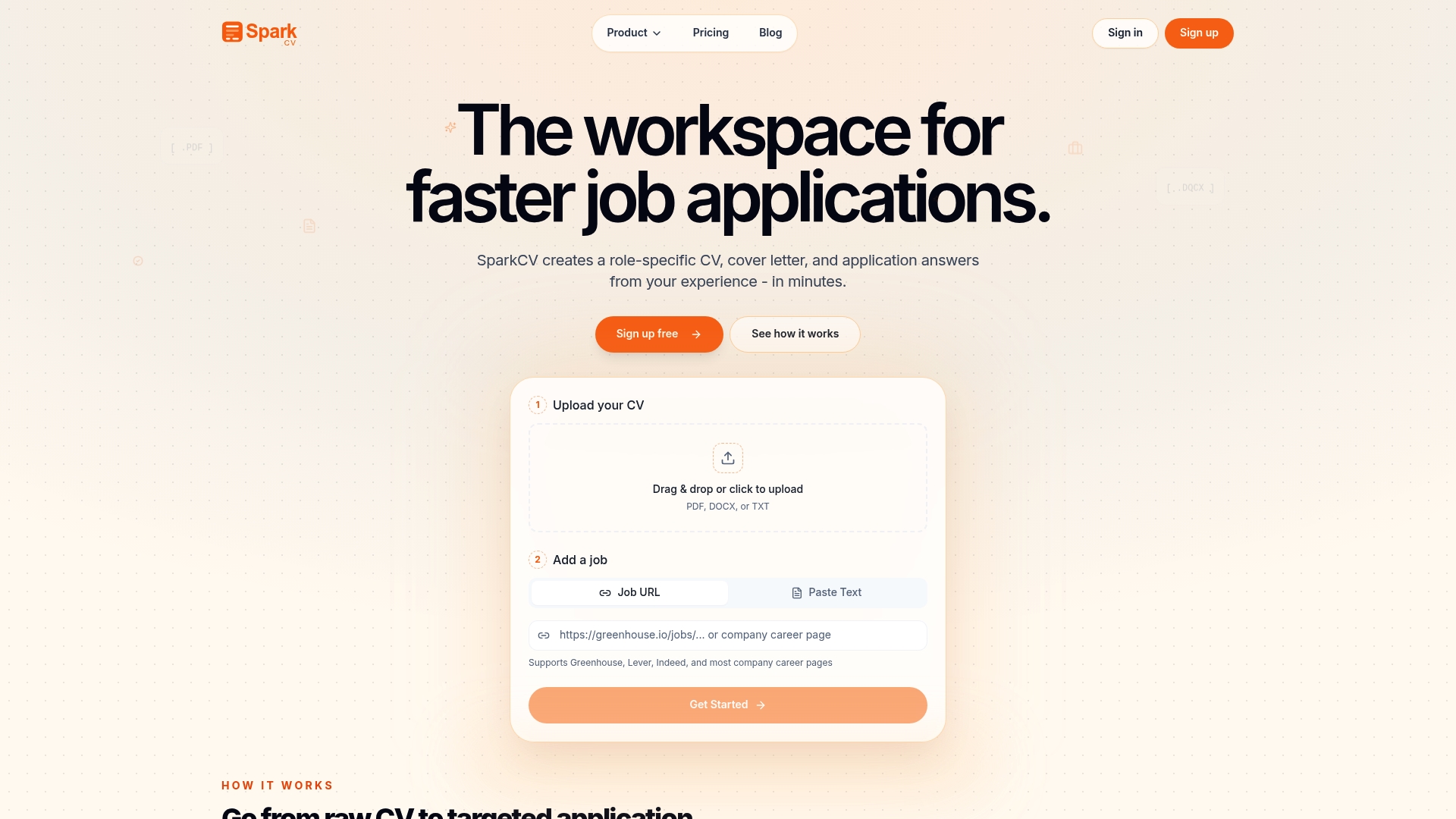
SparkCV analyses your existing CV and the job description, then generates a tailored version that positions your experience, including contract and temporary work, in the language recruiters and ATS systems respond to. The platform’s keyword matching and gap analysis tools identify which skills from your short roles are most relevant to each application. You get a polished, ATS-friendly CV in minutes, not hours. Use SparkCV to tailor your CV for each role and make every position in your history count.
Key takeaways
Short-term roles strengthen your CV when you label them clearly, focus on outcomes, and present them as part of a deliberate career narrative rather than a series of disconnected events.
| Point | Details |
|---|---|
| Label every short role | Add “Contract,” “Temporary,” or “Fixed-Term” after each job title to remove recruiter doubt. |
| Focus on outcomes | Write bullet points around results and deliverables, not job duties or tenure length. |
| Group multiple contracts | Use headings like “Contract Engagements” to present several short roles without clutter. |
| Omit irrelevant roles carefully | Remove very short, unrelated positions only when doing so leaves no unexplained gap. |
| Use networking value | Every short role expands your professional network, which drives the majority of job placements. |
FAQ
Do short-term roles look bad on a CV?
Short-term roles do not look bad when they are labelled clearly and supported by outcome-focused bullet points. Hiring managers distinguish between erratic job-hopping and deliberate contract or project-based work.
How do I explain short roles on my CV without apologising?
Use neutral language and focus on what you delivered. Avoid phrases like “left due to contract end” on the CV itself; save any context for the cover letter or interview.
Should I include every temporary job on my CV?
No. Exclude very short or unrelated roles that add no relevant skill or outcome, provided their removal does not create an unexplained employment gap.
How do I group multiple short contracts on my CV?
List them under a single heading such as “Contract Engagements” or “Portfolio Career,” then detail each assignment beneath it with dates, role title, and key outcomes.
Does short-term work help with ATS screening?
Yes. Short-term roles that include relevant keywords and accurate dates pass ATS filters effectively. Omitting dates or using vague descriptions increases the risk of being filtered out before a recruiter sees your application.
Recommended reads
Keep exploring






Hear more from SparkCV
Leave your email for new articles, onboarding invites, and launch news.
We’ll only use this for SparkCV emails, and you can unsubscribe any time.