
Music teacher cover letter: examples and template

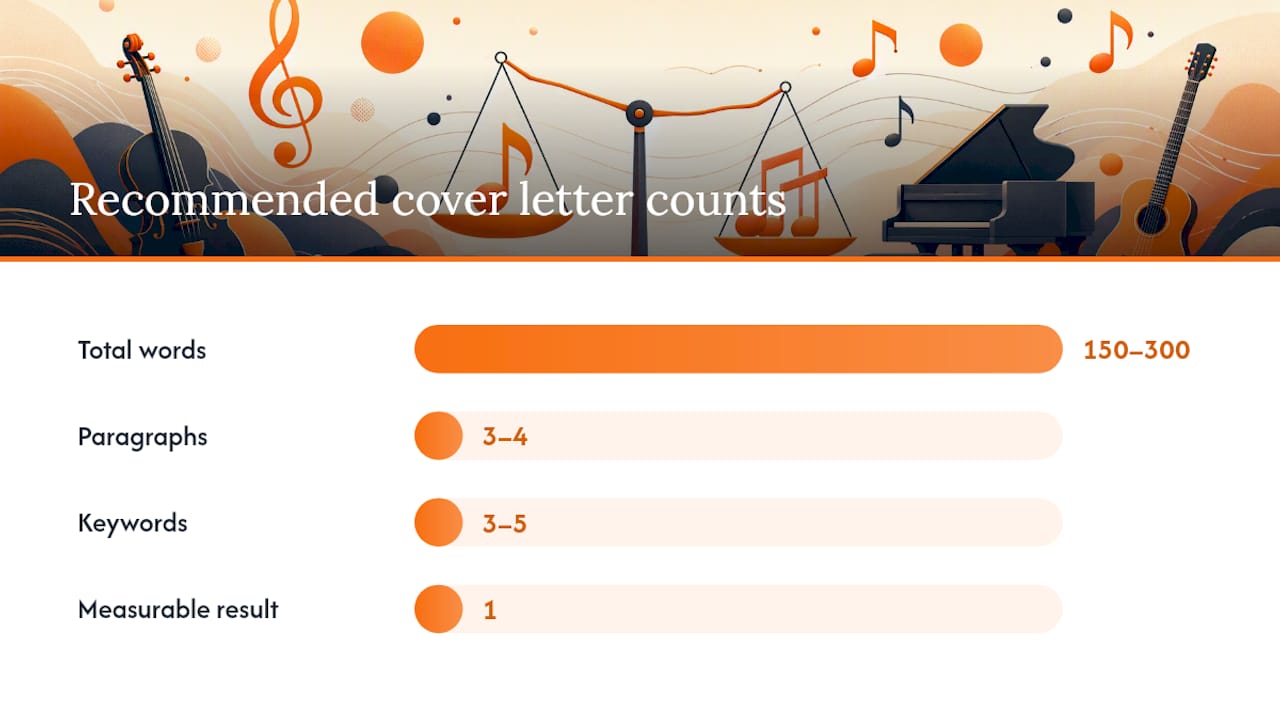
A successful music teacher cover letter is short, job specific, and built around proof rather than passion statements. It should run a short length suitable for hiring managers, fit on one page, and use a professional header that matches your CV. The goal in every sentence is the same: connect one or two real teaching achievements to what the job advert actually asks for, then name your certification and ensemble experience so the reader doesn’t have to hunt for it.
Structure it in three or four short paragraphs: an opening hook naming the role and one matching qualification, one or two evidence paragraphs with a measurable result, and a brief closing with a call to action. Here’s a BLUF sentence you can adapt directly:
Before you send anything, run this checklist:
- Header matches your CV’s name, contact details, and formatting.
- Word count sits between 150 and 300.
- At least one measurable achievement appears (exam results, ensemble size, retention rate).
- The closing states your availability and asks for an interview.
Key Takeaways
A strong music teacher cover letter stays under 300 words, mirrors the job advert’s language, and proves fit through one measurable teaching result rather than a passion statement.
| Point | Details |
|---|---|
| Keep it short and structured | Aim for 150 to 300 words across three or four paragraphs: hook, evidence, closing. |
| Lead with proof, not passion | Name one measurable result, such as ensemble growth or a festival rating, in your opening or middle paragraph. |
| Mirror the job advert | Extract three to five keywords from the posting and repeat them naturally in your hook and closing. |
| Address gaps briefly | Cover career changes or employment gaps in a single confident sentence, then move on. |
| Speed up drafting with SparkCV | SparkCV extracts your CV achievements and the advert’s keywords to generate a tailored, ATS-friendly first draft. |
Table of Contents
- What do hiring managers look for in a music teacher cover letter?
- How do you structure a music teacher cover letter?
- Sample music teacher cover letters you can adapt
- How do you tailor your letter for the job posting and ATS?
- What mistakes should you avoid, and how do you proofread?
- How SparkCV speeds up your music teacher cover letter
- Frequently asked questions
- Sources
What do hiring managers look for in a music teacher cover letter?
Hiring panels skim for evidence, not enthusiasm. They want to see pedagogy in action: how you plan a curriculum, manage a classroom of twenty five instruments at once, and lead ensembles that perform in public. Certifications matter too, particularly K to 12 music education credentials, because they answer a compliance question before it’s even asked.
Generic phrases like “I love music and want to inspire students” tell a panel nothing. A sentence naming your ensemble’s exam results or a concert you organised tells them everything.
Specificity beats sentiment every time. Indeed’s guidance on music teacher applications recommends matching your wording to the job advert and backing claims with action verbs and measurable outcomes rather than adjectives.
- Classroom management strategy, named specifically (routines, behaviour systems, differentiated instruction).
- Ensembles or sections led, with size or achievement noted.
- Certifications listed early, ideally in the opening paragraph.
- One extracurricular result: a recital, musical production, or competition placing.
How do you structure a music teacher cover letter?
Every paragraph in your letter has one job. Here’s the breakdown, with lines you can adapt straight away.
- Opening paragraph. Name the role, where you saw it advertised, and one line matching a key requirement from the posting. Example: “I’m writing to apply for the Choral Director position advertised on your school’s website, having spent four years building a 60 voice choir program from scratch.”
- Middle paragraph(s). Give one or two concrete examples of teaching impact, ensembles directed, or measurable results, and name any technology or programme you used. Example: “I introduced SmartMusic into weekly rehearsals, which cut individual practice-tracking time in half and helped raise our regional festival rating from Silver to Gold.”
- Closing paragraph. State your availability, note the attached CV, and sign off formally. Example: “I’d welcome the chance to discuss how my ensemble experience fits your programme’s goals. My CV is attached, and I’m available for interview at your convenience.”
Sentence starters worth keeping on file:
- For a student teacher: “During my student teaching placement, I co-taught vocal and instrumental classes and supported IEP accommodations for…”
- For a subject specialist: “As a specialist in brass pedagogy, I redesigned the beginner curriculum to…”
- For an ensemble director: “Under my direction, the marching band grew from 25 to 60 members over two seasons…”
Pro Tip: Take your strongest CV bullet point and cut it down to one sentence that leads with the result, not the task. “Directed spring musical” becomes “Directed a 45 student spring musical production that sold out three consecutive nights.”
Sample music teacher cover letters you can adapt
Sample A: early career student teacher
Dear Ms. Alvarez,
I’m writing to apply for the General Music Teacher position at Lincoln Elementary, advertised on your district careers page. During my student teaching placement, I co-taught vocal and instrumental classes for grades 3 to 5 and supported IEP accommodations using differentiated instruction, an approach documented in university music education placement records. I used EarTrainer and SmartMusic to track individual progress and built classroom routines that kept transitions between instrument stations under two minutes. I’d welcome the opportunity to bring that same structure to your program and am happy to support after school ensembles as needed.
Sincerely, [Your Name]
Short version: “Recent music education graduate with hands on student teaching experience in vocal and instrumental co-teaching, classroom technology, and IEP support, seeking to bring proven classroom routines to [School Name].”
Sample B: experienced choir and band teacher
Dear Dr. Kim,
I’m applying for the Director of Choral and Instrumental Music role at Westfield High. Over several years at Roosevelt High, I grew the concert choir significantly, led the ensemble to top ratings at state festival, mentored student teachers, and organised an annual spring tour that raised substantial funds for the music department. I’d bring that same combination of curriculum leadership and event organisation to your program.
Sincerely, [Your Name]
Short version: “Experienced choral director with a record of ensemble growth, festival results, and touring leadership, ready to lead Westfield’s music program forward.”
How do you tailor your letter for the job posting and ATS?
Pull three to five keywords straight from the advert before you write a word. Look for the instruments named, the pedagogical approach mentioned (Orff, Kodály, project based learning), and any certification requirement. SEEK’s cover letter guidance recommends mirroring this language directly rather than paraphrasing it, since applicant tracking systems scan for exact matches.
- List the advert’s top five keywords in a notes document before drafting.
- Place your strongest keyword match in the opening hook, not buried in paragraph three.
- Repeat one keyword naturally in your achievement sentence.
- Keep formatting plain text friendly. Avoid tables, columns, or graphics if the application system requests a .doc or .pdf upload.
- Save a final keyword in your closing line if it fits naturally.
Pro Tip: If you’re short on time, a tool like SparkCV can extract the advert’s keywords automatically and draft a first version matched to your CV, so your starting point already reflects the language the school used.
What mistakes should you avoid, and how do you proofread?
Generic phrasing is the most common failure. “I am passionate about music education” says nothing a hiring panel hasn’t read fifty times that week. Inconsistent dates, missing attachments, and paragraphs that run past five sentences all signal carelessness before anyone reads your qualifications.
- Read the letter aloud. Awkward phrasing reveals itself faster to the ear than the eye.
- Check every name, title, and school spelling twice.
- Confirm your CV and any requested attachments are actually included.
- Match your header exactly to your CV’s contact details and formatting.
- If you have an employment gap or are changing careers, address it in one sentence: “After three years teaching privately, I’m returning to a classroom setting to bring that individualised approach to a full ensemble programme.”
- End with one honest, specific line about why this school, not music teaching in general, drew your application.
How SparkCV speeds up your music teacher cover letter
Writing a tailored letter for every posting takes time you probably don’t have between lesson planning and rehearsals. SparkCV pulls the achievements already sitting in your CV and matches them against the exact keywords in a job advert, then drafts a cover letter structured the way this guide has laid out, ready for you to personalise.
The platform’s extraction technology reads your uploaded CV alongside the job description and generates a first draft in minutes rather than the hour or two a from scratch letter usually takes. For music teacher applications specifically, that means your ensemble numbers, certifications, and student outcomes get carried across automatically instead of retyped for every school.
Four things worth trying:
- Automated keyword extraction from the job posting itself.
- A template library exported in ATS-friendly formats.
- Quick customisation for each new application without starting from a blank page.
- Export options that keep your header and formatting consistent with your CV.
Treat the generated draft as a strong starting point. Read it aloud, check the specifics, and adjust the tone so it still sounds like you before you hit send. You can try SparkCV on your next application and see how quickly a tailored draft comes together.
Frequently asked questions
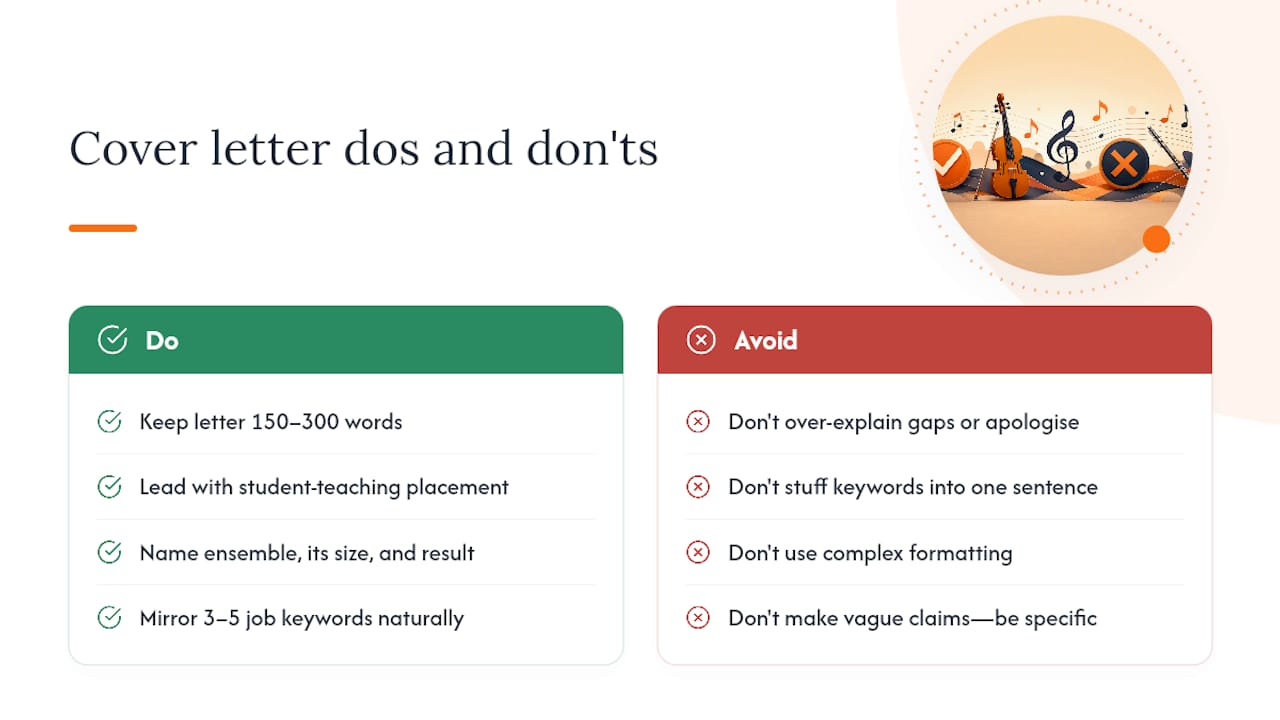
How long should a music teacher cover letter be? Keep it to 150 to 300 words and one page. Hiring panels reviewing dozens of applications favour letters that make their case quickly.
What should I include in a music teacher cover letter if I’m a recent graduate? Lead with your student teaching placement, the instruments or age groups you taught, and any classroom technology you used, such as SmartMusic or EarTrainer. Mention willingness to support extracurricular ensembles even without formal experience leading one.
Do I need to mention specific ensembles or concerts I’ve directed? Yes. Naming a specific ensemble, its size, and a result such as a festival rating or sold out performance gives hiring managers concrete evidence rather than a general claim of experience.
How do I make my cover letter ATS-friendly without sounding robotic? Mirror three to five keywords from the job advert naturally across your opening, achievement sentence, and closing, and keep formatting plain enough for text based uploads. Avoid stuffing every keyword into one sentence.
Should I address an employment gap or career change in my cover letter? Address it in one confident sentence explaining the shift, then return focus to your relevant skills and teaching goals. Avoid over-explaining or apologising for the gap.
Can I use a template for my music teacher cover letter? Yes, a template speeds up the writing process, but every letter still needs specific details from the job advert and your own achievements. Tools such as SparkCV can generate a tailored first draft that you personalise before sending.
Sources
Recommended reads
Keep exploring






Hear more from SparkCV
Leave your email for new articles, onboarding invites, and launch news.
We’ll only use this for SparkCV emails, and you can unsubscribe any time.