
Types of cover letter structures: your 2026 guide

Cover letter structures are distinct formats designed to present your qualifications and fit for a role in the most persuasive way possible. Choosing the wrong format costs you interviews. Choosing the right one signals to hiring managers that you understand the role, the company, and how to communicate. This guide covers eight proven types of cover letter structures, when to use each one, and how to match your format to your industry and tone.
Types of cover letter structures and when to use them
One template never fits all applications. Different cover letter formats serve different purposes, and knowing which to deploy is the first real advantage you have over other candidates. Here are the eight main structures you need to know.
1. Traditional three-paragraph structure
The traditional three-paragraph format introduces yourself, sells your skills, and closes with a clear interview request. It is the safest choice for formal industries like finance, law, and government. Hiring managers in these sectors expect convention, and deviating from it can read as a lack of professionalism. If you are unsure which format to use, start here.

2. T-format structure
The T-format uses a two-column table to match job requirements on the left with your specific skills on the right. This format is particularly effective for technical, project-based, or skills-heavy roles where precise alignment to the job description matters. It makes it immediately obvious to a recruiter that you meet the stated criteria. It also performs well with ATS screening because it mirrors the exact language of the job posting.
3. Storytelling or narrative structure
Storytelling cover letters open with a short narrative that illustrates your passion or alignment with a company’s values, rather than a formal introduction. This approach works best in creative sectors, non-profit organisations, and mission-driven companies where personality and cultural fit carry real weight. A candidate applying to a B-Corp, for example, might open with a specific moment that shaped their commitment to sustainability. The risk is length. Keep the story tight and relevant, or it reads as self-indulgent.
4. Bullet point structure
The bullet point format replaces dense paragraphs with a short opening, a list of quantifiable achievements, and a brief closing. Bullet points improve scannability and focus recruiters on key metrics without requiring them to read lengthy prose. This structure suits technical roles, data-driven positions, and any job where results matter more than narrative. If you are applying for a software engineering or financial analyst role, this format lets your numbers do the talking. You can explore how bullet point formats support project-based applications in more detail.
5. Problem-solution structure
The problem-solution format opens by identifying a specific challenge the company faces, then positions you as the person who can solve it. This approach is best suited to strategic, leadership, and consultancy roles where demonstrating commercial awareness is part of the job. It requires research. You need to understand the company’s current situation well enough to name a real problem, not a generic one. Done well, it is one of the most memorable cover letter styles available.
6. AIDA structure
AIDA stands for Attention, Interest, Desire, and Action. This persuasive framework, borrowed from marketing, structures your letter to capture attention with a strong opening, build interest with relevant experience, create desire by showing your value, and close with a direct call to action. It is the natural choice for sales, marketing, and business development roles where your ability to persuade is itself a demonstration of the skill being hired. Recruiters in these sectors recognise the structure and respond positively to it.
7. Personal connection structure
The personal connection format leads with a mutual contact, a shared professional event, or a specific reason you are drawn to the company beyond the job itself. It is most effective when you have a genuine network link or have done deep research into the company’s culture. This structure signals cultural fit before the recruiter has read a single qualification. For roles at smaller companies or startups, where team cohesion matters as much as technical ability, this approach can be decisive.
8. Hybrid or modular structure
The hybrid format combines elements from multiple structures. You might open with a brief narrative, follow with a T-format skills table, and close with a direct call to action. This approach suits experienced candidates who need to demonstrate both personality and precise skills alignment. It requires more effort to execute well, but it is also the most tailored of all cover letter formats. Use it when you have a strong understanding of what the employer values and the confidence to build something bespoke.
Which structure works best by industry and role
Matching your cover letter format to the right sector makes a measurable difference. The table below compares the eight structures across four key dimensions.
| Structure | Best industry | ATS-friendly | Human appeal | Complexity |
|---|---|---|---|---|
| Traditional three-paragraph | Finance, law, government | High | Moderate | Low |
| T-format | Tech, engineering, project management | Very high | Moderate | Medium |
| Storytelling or narrative | Creative, non-profit, mission-driven | Low | Very high | Medium |
| Bullet point | Data, technical, results-driven | High | Moderate | Low |
| Problem-solution | Leadership, consultancy, strategy | Moderate | High | High |
| AIDA | Sales, marketing, business development | Moderate | High | Medium |
| Personal connection | Startups, small business, culture-led firms | Low | Very high | Medium |
| Hybrid or modular | Senior or cross-functional roles | Moderate | High | High |
ATS systems focus on keyword matching, but human reviewers seek personality and cultural fit. The most effective approach is to choose a structure that satisfies both. For most roles, the T-format or bullet point structure handles ATS screening, while a warm tone and a specific opening line handle the human reader. When changing careers, your cover letter structure needs to work even harder to reframe your experience.
How to choose the right tone and structure for your application
Choosing your cover letter tone should be based on three sources: the company website, the job description, and employee posts on LinkedIn. The four tones are Professional, Warm, Direct, and Creative. Each fits a different organisational culture, and getting this wrong undermines even the best-structured letter.
A Professional tone suits regulated industries and large corporates. A Direct tone works for startups and fast-moving environments where brevity signals competence. A Creative tone is reserved for roles where originality is the product. When you are uncertain, default to Warm. It balances professionalism with human connection and works across the widest range of employers. Nonstandard tones like Direct or Creative do not negatively affect ATS screening, since tone only becomes relevant once a human reviewer reads the letter.
Combining tone with structure multiplies your impact. A storytelling structure with a warm tone is a strong pairing for a non-profit role. A T-format with a professional tone is the right combination for a compliance position at a bank. Think of structure as the skeleton and tone as the voice.
Pro Tip: Read three to five recent posts from employees at your target company on LinkedIn before writing. The language they use to describe their work tells you exactly which tone will feel native to that culture.
Tips for making your cover letter more effective
Effective cover letters tell a story rather than simply listing skills. They are marketing documents that connect your experience directly to the employer’s needs. Beyond structure and tone, these practical steps improve every application.
- Keep your letter to one side of A4, use a professional font such as Calibri or Georgia at 11pt, and maintain standard margins. For physical submissions, 24 to 32 lb cotton paper makes a tangible difference to first impressions.
- Run your draft through Grammarly or Hemingway Editor to catch errors and improve readability before submitting.
- Mirror the exact language of the job description to improve keyword matching and ATS compatibility.
- Save a modular template for each structure type so you can customise quickly without starting from scratch.
- Include at least one quantifiable achievement per application. Numbers give recruiters something concrete to remember. Check your CV tailoring checklist to align your cover letter with your CV before submitting.
Pro Tip: Tailor the first two sentences of every cover letter to the specific role. Generic openers are the most common reason cover letters are dismissed before the second paragraph.
Key takeaways
The most effective cover letter structure is the one that matches both the employer’s industry and the tone of their culture, not the one that feels most familiar to write.
| Point | Details |
|---|---|
| Structure choice matters | Match your format to the industry and role, not personal preference. |
| T-format leads on ATS | Two-column skill matching mirrors job descriptions and scores well with ATS tools. |
| Tone amplifies structure | Pair your chosen format with the right tone to maximise impact on human reviewers. |
| Warm tone as default | When uncertain, the Warm tone works across the broadest range of employers and cultures. |
| Tailor every application | Generic cover letters underperform. Customise the opening and key achievements for each role. |
Let SparkCV build your tailored cover letter in minutes
Writing a cover letter from scratch for every application takes time most job seekers do not have. SparkCV analyses your existing CV and the job description, then generates a cover letter that matches the right structure, tone, and keywords for that specific role.
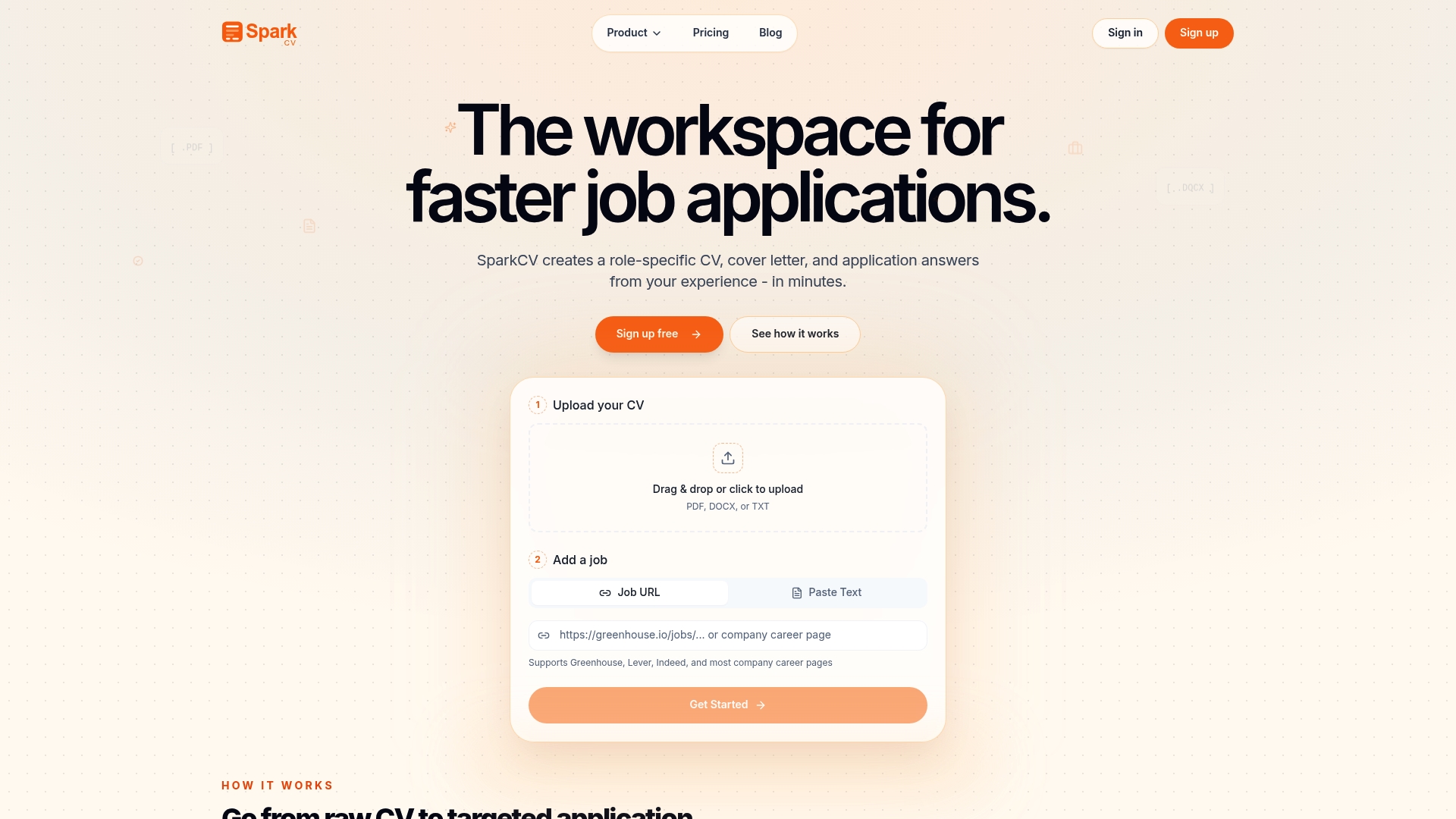
You get a polished, ATS-friendly letter in minutes, not hours. SparkCV selects the most effective format based on the job type, mirrors the language of the job posting, and tailors your achievements to what the employer is actually looking for. Whether you need a T-format letter for a technical role or a narrative structure for a creative position, SparkCV handles the heavy lifting. Start your application today and see the difference a properly structured cover letter makes.
FAQ
What is the best cover letter structure for most jobs?
The traditional three-paragraph structure is the safest default for formal industries, while the T-format performs best for technical and skills-heavy roles. When in doubt, combine a clear structure with a Warm tone for broad appeal.
How long should a cover letter be?
The most effective cover letters are no longer than one side of A4. Anything longer risks losing the reader’s attention before you reach your strongest points.
Does cover letter format affect ATS screening?
Structure itself does not block ATS screening, but formats like the T-format and bullet point structure improve keyword density and alignment with job descriptions, which improves your score.
When should I use a storytelling cover letter?
Use a narrative structure for creative, non-profit, or mission-driven roles where cultural fit and personality carry significant weight in the hiring decision.
Can I use the same cover letter structure for every application?
No. Mastering multiple structures and tones tailored to company culture is the key to consistent success across different sectors and seniority levels.
Recommended reads
Keep exploring





Hear more from SparkCV
Leave your email for new articles, onboarding invites, and launch news.
We’ll only use this for SparkCV emails, and you can unsubscribe any time.