
Graduate cover letter step by step: 2026 guide

A graduate cover letter is a concise, tailored document that connects your skills and enthusiasm directly to a specific role. Most recruiters spend only 30 seconds on initial screening, so your letter must earn attention fast. The standard format runs 250–400 words across 3–4 paragraphs. Get the structure right and you give yourself a genuine advantage over graduates sending generic applications. This guide walks you through every stage, from research to final proofread, using the approach UK employers expect in 2026.
What research do you need before writing your cover letter?
Preparation is the single biggest difference between a generic letter and one that gets shortlisted. Employers expect candidates to spend 30–45 minutes researching a company before writing. That time pays off directly in the quality of your tailoring.
Start with the job description. Read it line by line and note every skill, responsibility, and value the employer mentions. These become the keywords and themes you mirror in your letter. LinkedIn is useful for finding the hiring manager’s name, the team structure, and recent company news. The company website reveals its mission, culture, and any recent projects or announcements worth referencing.
This research feeds your “Why Them” paragraph, the section where you explain why this specific employer appeals to you. Tailored references to company culture and recent initiatives demonstrate genuine interest and set you apart from candidates who write the same letter for every application.
- Check the company’s LinkedIn page for recent posts, hires, and announcements.
- Read the “About Us” and “Values” pages on the company website.
- Search for recent news coverage of the organisation.
- Note any specific projects, clients, or initiatives mentioned in the job advert.
- Identify the hiring manager’s name so you can address the letter personally.
Pro Tip: Save your research notes in a separate document before you start writing. Referring back to specific details as you draft each paragraph keeps your letter focused and genuinely tailored.
How to structure a graduate cover letter: section by section
A well-structured cover letter follows a clear, predictable format. Recruiters scan for this structure, so deviating from it creates friction. The table below shows each section, its purpose, and the recommended word count.
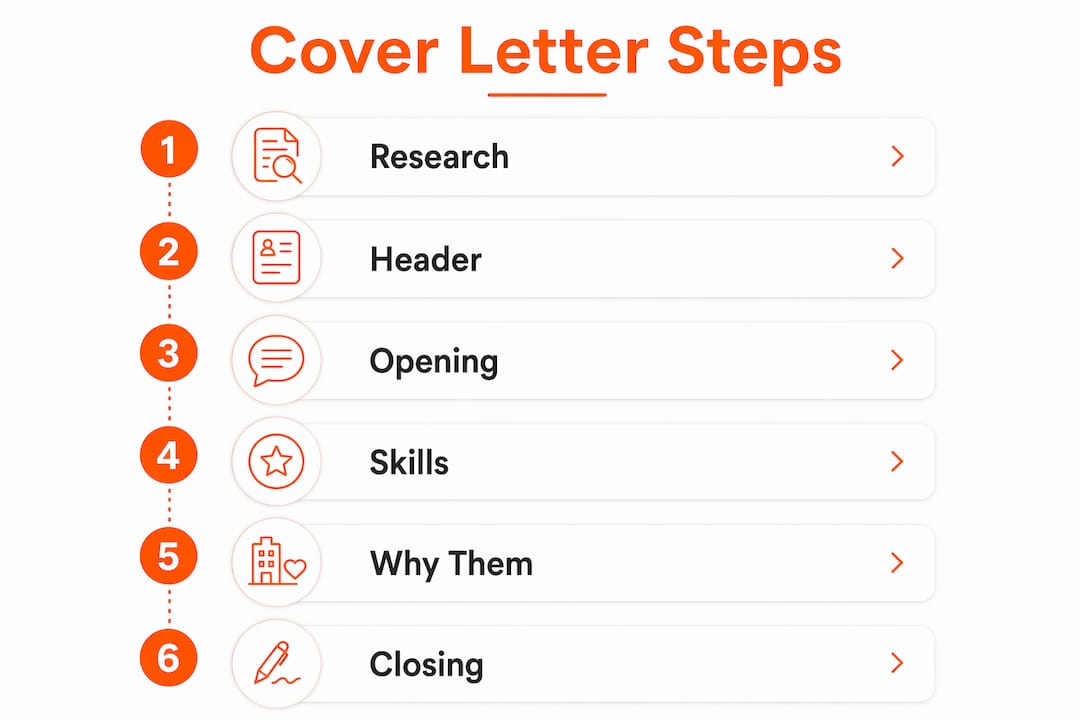
| Section | Purpose | Target words |
|---|---|---|
| Header and salutation | Contact details, date, and named greeting | 20–30 |
| Opening paragraph | State the role, source, and a compelling hook | 50–70 |
| Skills paragraph | Match your experience to the job requirements | 80–100 |
| “Why Them” paragraph | Show company knowledge and motivation | 60–80 |
| Closing paragraph | Express enthusiasm and include a call to action | 40–60 |
Header and salutation
Place your name, email, phone number, and LinkedIn URL at the top. Add the date and the employer’s address below. Addressing the letter to a named person shows initiative and attention to detail. Use “Dear [Name],” when you have a name. Use “Dear Hiring Manager,” only as a last resort.
Opening paragraph
Your opening must do two things immediately: name the role and give the recruiter a reason to keep reading. Generic opening lines such as “I am writing to apply for…” are routinely ignored. Instead, lead with a specific statement about why you are the right fit or what draws you to this particular role. Mention where you found the vacancy and give one sentence of relevant background.
Skills paragraph
This is where you prove you can do the job. Match your strongest experiences directly to the requirements listed in the job description. Use concrete examples from university projects, part-time work, or internships. Specific examples with measurable impact are far more persuasive than vague claims. “I led a four-person team to deliver a 3,000-word research report two weeks ahead of deadline” is stronger than “I have good teamwork skills.”

“Why Them” paragraph
This paragraph answers one question: why this company, not just any company? Reference something specific, a recent campaign, a product launch, a stated value, or a piece of company news you found during your research. Connecting your career goals to the employer’s mission gives the letter genuine colour beyond what your CV already shows.
Closing paragraph
End with confidence. Restate your enthusiasm for the role, confirm your availability for interview, and thank the reader for their time. In UK practice, use “Yours sincerely” when you have addressed the letter to a named recipient and “Yours faithfully” for a generic salutation.
Pro Tip: Keep the total letter to one A4 page. If it spills onto a second page, cut the weakest sentence in each paragraph first.
How do you highlight transferable skills as a graduate?
Transferable skills are the abilities you have built outside formal work experience, and they are exactly what entry-level employers look for. The key is connecting each skill directly to a requirement in the job description, not listing skills in isolation.
Focus on four core areas that appear in most graduate job adverts: analytical thinking, written and verbal communication, teamwork, and the ability to manage your own workload. Each one can be evidenced from university life. A dissertation demonstrates research and independent thinking. A group presentation demonstrates communication and collaboration. A part-time retail or hospitality role demonstrates customer focus and time management.
Avoid vague phrasing. “I am a strong communicator” tells a recruiter nothing. “I presented findings from a six-month research project to an audience of 40 academics and received a distinction” tells them everything. For more on which soft skills matter most to employers, the SparkCV blog covers the topic in depth.
- Replace “good at teamwork” with a specific group project outcome.
- Replace “hard worker” with a deadline you met under pressure.
- Replace “passionate about marketing” with a campaign or project you contributed to.
- Mirror the exact keywords from the job description to pass ATS screening.
Pro Tip: Run a gap analysis before you write. List every skill the job description asks for, then tick off which ones you can evidence. Any gaps are worth addressing briefly in your letter, framing them as areas you are actively developing.
Common mistakes that weaken a graduate cover letter
The most common mistake graduates make is submitting the same letter for every application with only the company name changed. Recruiters notice immediately. Letters that lack company-specific references read as generic and are far less likely to progress.
- Repeating your CV word for word. Your cover letter adds context and personality. It does not summarise your CV.
- Using a vague opening line. Lead with something specific and compelling, not a formulaic sentence.
- Ignoring the word count. A letter over 400 words loses impact. Cut ruthlessly.
- Skipping the proofread. Spelling or grammar errors can result in immediate rejection. Use Grammarly or a trusted reader before sending.
- Forgetting a call to action. Always close by inviting the recruiter to contact you for an interview.
Formatting matters too. Use a consistent font such as Arial or Calibri at 11pt, keep margins at 2.5cm, and avoid tables or graphics inside the letter body. A clean, readable layout signals professionalism before the recruiter reads a single word.
Pro Tip: Read your letter aloud before sending. If a sentence sounds awkward when spoken, rewrite it. This catches clunky phrasing that a spell-checker misses.
Key takeaways
A well-researched, tightly structured graduate cover letter, running 250–400 words and tailored to a specific role and employer, gives you the strongest possible chance of passing initial screening.
| Point | Details |
|---|---|
| Research before writing | Spend 30–45 minutes on company research to inform every paragraph. |
| Follow the four-section structure | Header, opening, skills, “Why Them,” and closing each serve a distinct purpose. |
| Use specific examples | Replace vague skill claims with concrete outcomes from university or work. |
| Mirror job description keywords | ATS systems filter for exact terms, so use the employer’s own language. |
| Proofread with a tool | Grammarly or a peer review catches errors that cause immediate rejection. |
How SparkCV helps you write a stronger graduate application
Writing a tailored cover letter for every application takes time, especially when you are applying to multiple roles at once. SparkCV analyses your existing CV and the job description together, then generates a tailored cover letter and CV version aligned to that specific role.
The platform uses keyword matching and ATS-friendly formatting to make sure your application reflects what the employer is actually looking for. You can also use SparkCV to generate tailored answers to application questions, saving hours on lengthy graduate application forms. For graduates who want to get more interviews without spending days on each application, SparkCV is worth trying. Sign up free and generate your first tailored cover letter in minutes.
FAQ
How long should a graduate cover letter be?
A graduate cover letter should be 250–400 words, structured across 3–4 paragraphs, and fit on one A4 page.
Should I address my cover letter to a specific person?
Yes. Addressing the letter to a named hiring manager shows initiative and improves recruiter perception. Check LinkedIn or the company website to find the right name.
What is the difference between a cover letter and a CV?
Your CV lists your experience and qualifications. Your cover letter explains why you want this specific role and how your skills match the employer’s needs, adding personal context your CV cannot convey.
How do I show transferable skills with no work experience?
Draw on university projects, dissertations, society roles, and volunteering. Use the CV tailoring checklist from SparkCV to map your experiences to the job requirements before writing.
What sign-off should I use on a UK cover letter?
Use “Yours sincerely” when you have addressed the letter to a named person. Use “Yours faithfully” when you have used a generic salutation such as “Dear Hiring Manager.”
Recommended reads
Keep exploring






Hear more from SparkCV
Leave your email for new articles, onboarding invites, and launch news.
We’ll only use this for SparkCV emails, and you can unsubscribe any time.