
What is a functional resume format: a complete guide

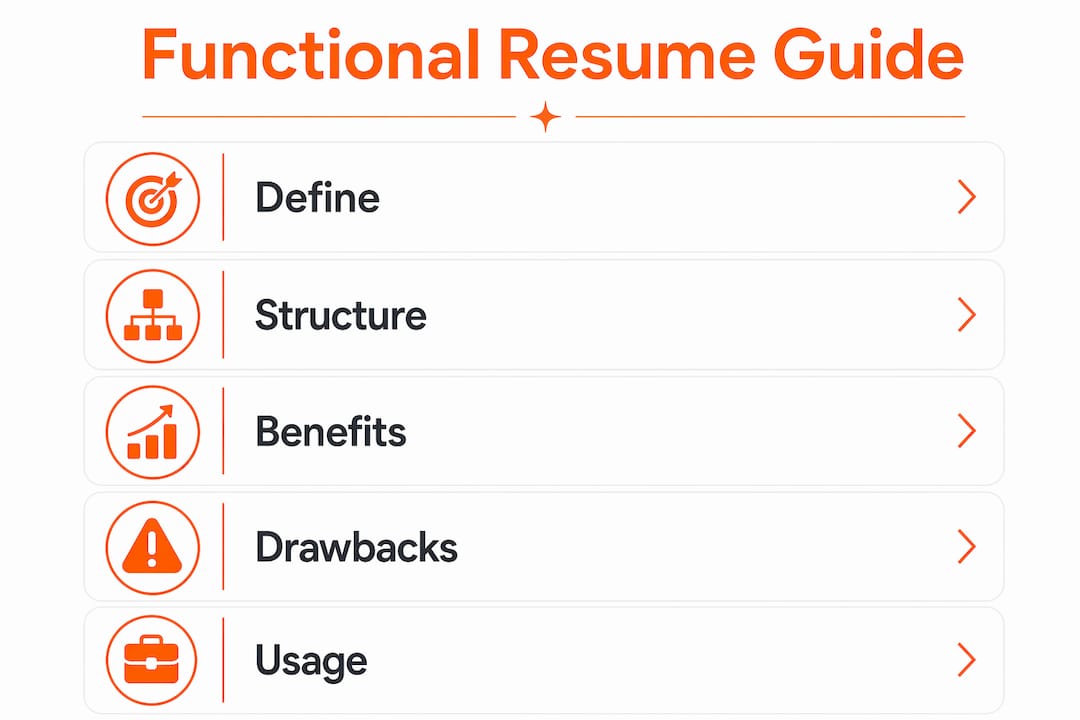
A functional resume format is defined as a CV structure that organises your qualifications by skill categories rather than by chronological work history. Also called a skills-based resume, it places your most relevant competencies at the top, showing hiring managers what you can do from day one. This format suits job seekers who want to highlight transferable skills, measurable achievements, and core strengths rather than a linear list of job titles and dates. If your skills are a stronger selling point than your employment timeline, this guide explains exactly how to use that to your advantage.
What does a functional resume format look like?
A functional resume is structured with contact information and a professional summary at the top, followed by a large skills section, a condensed work history, and an education section at the bottom. This layout is the opposite of the chronological format, where job titles and dates lead the page.

The skills section is the centrepiece. It groups your abilities into 3–5 skill categories, each supported by 3–4 bulleted accomplishments. Typical categories include Technical Skills, Leadership Skills, Creative Skills, and Administrative Skills. Each category should reflect talents directly relevant to the role you are targeting.
The work history section still appears, but it is kept brief. You list job titles, employers, and dates without expanding on duties. Education sits at the bottom, and you can choose whether to include graduation dates depending on how they position you.
- Contact header: Name, phone, email, and LinkedIn profile
- Professional summary: 2–3 sentences framing your value for the specific role
- Skill categories: 3–5 themed groups, each with 3–4 impact-focused bullet points
- Work history: Employer names, job titles, and dates only
- Education: Degree, institution, and optionally the year
Pro Tip: Write your professional summary last. Once your skill categories are complete, you will know exactly which two or three strengths to highlight upfront.
Who benefits most from a functional resume?
The functional format is recommended for job seekers whose skills are a stronger asset than their job chronology. It works particularly well in five situations.
- Recent graduates. You may have limited paid work experience, but internships, university projects, and volunteer roles all contain transferable skills worth showcasing.
- Career changers. If you are moving from teaching into corporate training, for example, your communication and curriculum design skills are directly relevant. A skills-based layout makes that connection obvious.
- Job seekers with employment gaps. Returning to work after caring responsibilities, illness, or redundancy is common. Grouping skills by category shifts attention from the gap to your capabilities.
- Freelancers and contractors. Short, varied contracts can look fragmented in a chronological format. A functional layout lets you present the consistent skills you applied across multiple clients.
- Professionals with non-linear experience. Volunteer work, side projects, and unpaid roles all count. A skills-based structure lets you include this experience without it looking out of place.
The format is not ideal for every job seeker. If you have a strong, unbroken record in one field, a chronological or hybrid format will likely serve you better.
How to write a functional resume that convinces hiring managers
Strong functional resumes are built on specific, measurable achievements rather than generic job duties. The difference matters because hiring managers read dozens of CVs and generic descriptions blend together.
- Quantify every bullet point. Instead of writing “handled outbound calls,” write “completed 100+ outbound calls daily with a 20% conversion rate.” Numbers give your claims credibility and make them memorable.
- Align skill categories with the job description. Read the job posting carefully and mirror its language. If the role asks for “stakeholder management,” use that exact phrase as a category or within a bullet point. This supports keyword matching and improves your chances with applicant tracking systems (ATS).
- Keep work history present and honest. List every role, even briefly. Omitting jobs entirely raises more questions than a short tenure does.
- Write a focused professional summary. Your summary gives context to the skills section. State your professional identity, your strongest competency, and the type of role you are targeting in two to three sentences.
- Tailor every application. A functional CV that is not tailored to the specific role loses most of its advantage. Adjust your skill categories and bullet points for each job you apply for.
Pro Tip: Use the CV tailoring checklist from SparkCV to cross-reference your skill categories against the job description before you submit.
Proofreading matters more with this format than most. Because the skills section carries so much weight, a typo or vague bullet point undermines the entire document.
What are the drawbacks of a functional resume format?
The functional format has real limitations, and being aware of them helps you use it more effectively.
- Recruiter scepticism is common. Many recruiters associate the format with attempts to hide employment gaps. Transparency and keyword alignment are critical to countering this perception.
- ATS systems can struggle with it. Some applicant tracking systems are calibrated for chronological formats. A skills-based layout may cause your CV to be parsed incorrectly or ranked lower.
- Chronological context is missing. Without clear dates and progression, it can be harder for hiring managers to verify your experience or understand your career trajectory.
- Interviews require confidence. The format only changes how your history is presented. You must be ready to discuss your full employment timeline clearly and confidently when asked.
A functional resume is not a cure-all for employment gaps. It changes the presentation of your history, not the history itself. Prepare honest, clear answers about your timeline before every interview.
If you are concerned about ATS compatibility, a hybrid format that combines a skills summary with a full chronological work history offers a practical middle ground.
How to decide if this format is right for your job search
Choosing the right CV format comes down to an honest assessment of your situation. Work through these steps before you commit.
- Map your employment history. Note any gaps, short tenures, or career changes. If these are likely to distract from your strengths, a skills-based layout reduces that risk.
- Identify your strongest selling points. If your skills and achievements are more impressive than your job titles, a functional structure puts the right information first.
- Research industry norms. Some sectors, such as finance and law, have strong preferences for chronological formats. Creative industries and technology roles tend to be more flexible.
- Consider a hybrid approach. A hybrid resume opens with a skills summary and then follows with a full chronological work history. This satisfies both ATS requirements and recruiter expectations. You can find guidance on highlighting transferable skills effectively in either format.
- Plan your cover letter and interview answers. Your CV format is one part of your application. A well-written cover letter that addresses your career context directly complements whichever format you choose. SparkCV’s application question tool can help you prepare honest, focused answers about your background.
The format you choose should reflect your actual strengths. If your skills genuinely outweigh your job history as evidence of your ability, a functional or hybrid layout makes that case clearly.
Key takeaways
A functional resume format is most effective when your skills and achievements are stronger evidence of your ability than your chronological work history.
| Point | Details |
|---|---|
| Skills-first structure | Group abilities into 3–5 categories, each with 3–4 quantified bullet points. |
| Best suited candidates | Career changers, recent graduates, freelancers, and those with employment gaps benefit most. |
| Keyword alignment matters | Mirror the job description’s language to pass ATS screening and show direct relevance. |
| Transparency is non-negotiable | Always include a condensed work history and be ready to discuss your timeline in interviews. |
| Hybrid format as alternative | Combine a skills summary with a full chronological history if ATS compatibility is a concern. |
SparkCV can help you build a stronger functional CV
Structuring a skills-based CV from scratch takes time, especially when you need to tailor it for each role. SparkCV analyses your existing CV and the job description together, then generates a focused, ATS-friendly version in minutes.
SparkCV’s keyword matching identifies which skills to prioritise for each application, so your categories reflect exactly what the employer is looking for. The platform also generates cover letters and tailored answers to application questions, giving you a complete, consistent application rather than a CV in isolation. If you are ready to present your skills with clarity and confidence, build your CV with SparkCV and see the difference a well-structured, targeted application makes.
FAQ
What is the main difference between a functional and chronological resume?
A chronological resume lists your work history in date order, most recent first. A functional resume groups your experience by skill category, placing competencies before job titles.
Can a functional resume pass ATS screening?
It can, but only if your skill categories and bullet points closely mirror the keywords in the job description. A hybrid format is safer if ATS compatibility is a priority.
Should I include dates on a functional resume?
Include dates in your work history section, even briefly. Omitting dates entirely can increase recruiter suspicion rather than reduce it.
How many skill categories should a functional resume have?
Three to five skill categories is the standard. Each category should contain 3–4 bullet points that demonstrate measurable results relevant to the target role.
Is a functional resume format suitable for all industries?
Not universally. Finance, law, and academia typically expect chronological formats. Creative, technology, and non-profit sectors are generally more open to skills-based layouts.
Recommended reads
Keep exploring






Hear more from SparkCV
Leave your email for new articles, onboarding invites, and launch news.
We’ll only use this for SparkCV emails, and you can unsubscribe any time.