
How to present diverse skills concisely on your CV

Presenting diverse skills concisely on your CV means selecting the most relevant abilities from your background and displaying them clearly for each specific role. Recruiters spend seconds scanning a CV before deciding whether to read further. Applicant Tracking Systems (ATS) filter applications before a human ever sees them. Getting your skills section right is not optional. It is the difference between an interview and a rejection.
How to identify the most relevant skills from your diverse background
The first step is reading the job description carefully and noting every skill it mentions. Do not rely on memory. Copy the exact phrases used, because ATS platforms prioritise literal matches from job descriptions when scanning CVs. “Stakeholder management” and “managing stakeholders” are not the same to an ATS.
Skills fall into three categories, and knowing the difference helps you prioritise:
- Hard skills are technical and measurable. Examples include Python programming, financial modelling, or GDPR compliance.
- Soft skills describe how you work. Examples include communication, adaptability, and problem-solving.
- Transferable skills apply across roles and industries. Transferable skills such as adaptability, teamwork, and organisation are especially useful when changing careers.
Once you have categorised your skills, cross-reference them against the job description. Keep only the skills that appear in the posting or are clearly implied by the role’s responsibilities. Discard the rest for this application.
Scanning multiple job postings for the same role title reveals patterns. If eight out of ten postings mention “data analysis,” that skill belongs on your CV for that role. If only one mentions “Adobe InDesign,” it is a lower priority unless the role is design-focused.
Pro Tip: Keep a running skills inventory in a simple document. List every skill you use at work, with a brief note on how you applied it. Updating it monthly takes five minutes and saves hours when you next apply for a role.
How should you structure your skills section for clarity?
A dedicated skills section is the most effective way to highlight skills in your CV for both recruiters and ATS. Place it after your professional summary and before your work experience, or immediately after your experience if you are a senior professional. The position signals what you want the reader to notice first.

The ideal skill count sits between 8 and 12 items. Listing 8–12 relevant skills balances thoroughness with conciseness and avoids keyword stuffing. Too few looks underqualified. Too many looks unfocused.
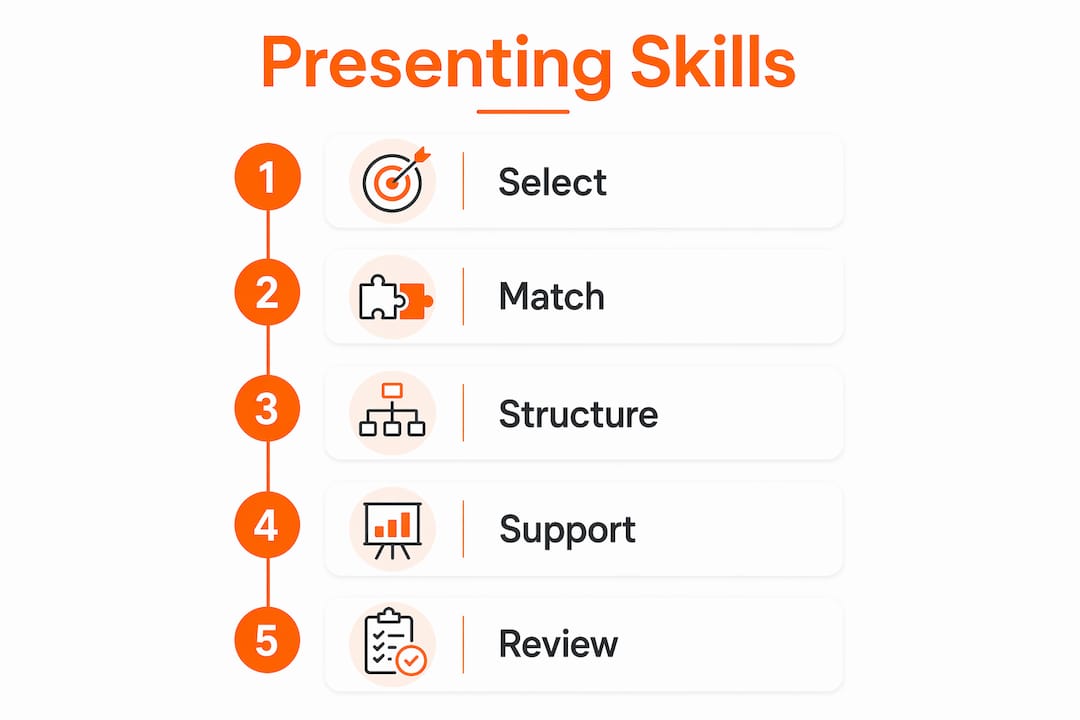
Use this structure to organise your skills section:
| Format option | Best used when | Example |
|---|---|---|
| Simple bullet list | Most roles; ATS-safe | • Project Management • Data Analysis |
| Category groupings | Broad skill sets; senior roles | Technical: Python, SQL / Leadership: Team Management |
| Proficiency levels | Technical or specialist roles | Advanced: Excel / Intermediate: Tableau |
Simple bullet lists are the safest format because they are easy for both recruiters and ATS to scan. Category groupings work well when you have genuinely distinct skill clusters, such as technical skills alongside languages or leadership competencies.
Pro Tip: Use the exact phrases from the job description in your skills section. If the posting says “cross-functional collaboration,” use that phrase, not “working across teams.” Exact keyword matches are the fastest way to improve your ATS score.
Avoid standard section headings that differ from what ATS expects. “Core Competencies,” “Key Skills,” and “Skills” are all recognised. “What I Bring to the Table” is not.
How to back up your skills with evidence elsewhere in the CV
A skills section lists what you can do. Your work experience section proves it. The two must work together. Recruiters look for evidence that the skills you claim are real, and recruiters will validate skills during interviews.
Use the S-A-R format (Situation, Action, Result) to write brief accomplishment statements that validate your skills without lengthening the CV unnecessarily:
- Identify the situation. Describe the context in one clause. “Following a system migration…”
- State your action. Name the skill you used and what you did. “…I led a cross-functional team of six to rebuild the reporting workflow…”
- Quantify the result. Add a measurable outcome. “…reducing monthly reporting time by three hours.”
Highlighting 2–3 core skills upfront in your professional summary signals fit to a recruiter within seconds. Choose the skills most central to the role, not the ones you are most proud of personally.
Soft skills are harder to list credibly. Do not write “excellent communicator” in your skills section without evidence. Instead, weave the evidence into your experience descriptions. “Presented quarterly results to a board of 12 directors” demonstrates communication far more convincingly than the phrase alone. For more on making soft skills count, the SparkCV guide on soft skills in your CV covers this in detail.
Keep every accomplishment statement to one or two lines. If you cannot explain the result briefly, the example is too complex for a CV.
Common mistakes that weaken your skills presentation
Most CVs fail not because of missing skills but because of poor editing. The most common mistakes are avoidable with a clear checklist.
- Listing irrelevant skills. Including every skill you have ever used clutters the section and dilutes the relevant ones. Each application needs a tailored list.
- Using vague phrases. “Good communicator” and “team player” tell a recruiter nothing. Replace them with specific, job-relevant phrases from the posting.
- Failing to validate skills with examples. A skill listed without any evidence in your experience section is a claim without proof.
- Ignoring ATS rules. Graphics, tables with merged cells, and unusual fonts can cause ATS to misread or skip your skills section entirely. Stick to plain text formatting.
- Copying the same skills section to every application. A generic list rarely matches any job description well. Tailoring takes ten minutes and significantly improves your results. The SparkCV CV tailoring checklist is a practical starting point for each application.
For a broader view of how skills listings translate to online professional profiles, guidance on skills on LinkedIn applies many of the same principles as your CV.
Pro Tip: After drafting your skills section, read it as a recruiter who has never met you. Ask: “Can I verify any of these claims from the experience section?” If the answer is no for more than two skills, revise.
SparkCV makes tailoring your skills section faster
Tailoring your skills section for every application is the right approach. Doing it manually for ten applications a week is time-consuming.
SparkCV analyses your existing CV alongside the job description and identifies the skills gap between what you have listed and what the role requires. It generates a tailored CV version with ATS-compatible keyword matching built in, so you are not guessing which phrases to use. Job seekers who use SparkCV get focused CV versions, cover letters, and tailored application answers in minutes rather than hours. Sign up at SparkCV and produce your first tailored application today.
Key takeaways
Presenting your skills concisely on a CV requires selecting the right skills, using exact job-description keywords, and validating each claim with evidence in your work experience section.
| Point | Details |
|---|---|
| Match exact keywords | Use phrases from the job description word for word to pass ATS filters. |
| Limit your skills list | Aim for 8–12 relevant skills per application to avoid keyword stuffing. |
| Validate with evidence | Back every listed skill with a brief accomplishment statement in your experience section. |
| Tailor every application | A generic skills section rarely matches any job description well enough to stand out. |
| Format for ATS | Use plain bullet lists and standard headings so ATS can read your skills correctly. |
FAQ
How many skills should I list on my CV?
List 8–12 skills per application. Too few looks underqualified; too many looks unfocused and risks keyword stuffing.
Should I use the exact wording from the job description?
Yes. ATS systems prioritise literal phrase matches, so “Project Management” performs better than “managing projects” if that is the phrase used in the posting.
Where should I put my skills section on my CV?
Place it after your professional summary for most roles. Senior professionals often place it after their work experience, where the evidence speaks first.
How do I show soft skills without just listing them?
Demonstrate soft skills through accomplishment statements in your work experience section rather than listing them as standalone items. “Presented findings to a board of 12” proves communication; the phrase alone does not.
Do I need a different skills section for every application?
Yes. Tailoring your skills section to each role’s job description is the single most effective concise CV tip for improving both ATS scores and recruiter interest.
Recommended reads
Keep exploring






Hear more from SparkCV
Leave your email for new articles, onboarding invites, and launch news.
We’ll only use this for SparkCV emails, and you can unsubscribe any time.