
Align your CV to current job-market trends: practical steps

The most important changes are ATS-friendly formatting, a skills-first layout, keywords mirrored from the job description, and bullet points that lead with measurable results. These four areas matter because most applications now pass through applicant tracking system (ATS) software before a human ever sees them, and hiring has shifted towards skills-based screening rather than years-of-experience filters. AI tools have also raised the baseline: recruiters see more polished drafts than ever, so An unverified AI draft can actually hurt credibility if the claims don’t hold up under questioning.
Here’s what to do in the next 30 minutes:
- Convert your CV to a simple, single-column layout with standard section headings.
- Pull several exact phrases from a target job posting and check they appear somewhere in your CV.
- Rewrite your top bullet points to lead with a measurable outcome.
- Move a short skills section near the top, above or beside your work history.
Key Takeaways
Aligning a CV to current hiring trends means combining ATS-friendly formatting, skills-first structure, tailored keywords, and verified, quantified achievements.
| Point | Details |
|---|---|
| Format for parsing first | Use single-column layouts, standard headings, and safe fonts so ATS software reads your CV correctly. |
| Mirror the job description | Pull exact-match terms for titles, tools, and certifications; paraphrase behavioural traits instead. |
| Quantify every achievement | Lead bullets with a result-first formula and a number wherever one exists. |
| Verify AI-assisted drafts | Treat AI as a drafting aid only; confirm every claim is something you can defend in an interview. |
| Speed up tailoring with SparkCV | SparkCV generates ATS-friendly, job-specific CVs and cover letters from your existing CV and a target posting. |
Table of Contents
- How to align your CV to current job market trends
- How to tailor your CV to a specific job description
- How do you turn job duties into measurable achievements?
- How do you format a CV so ATS and recruiters can both read it?
- Which skills should you highlight for today’s hiring trends?
- What outdated CV habits should you drop now?
- How can you use AI to write your CV without hurting your credibility?
- Strategies for addressing employment gaps or career changes in the CV
- Including relevant certifications and continuous learning courses
- Updating LinkedIn profile to align with CV and market trends
- Incorporating in-demand soft skills alongside technical skills
- If you want faster, safer tailoring
- Frequently asked questions
- Sources
How to align your CV to current job market trends
Print this list, paste it into a notes app, or keep it open in a second tab while you edit.
- Save a plain-text version. Paste your CV into a basic text editor. If headings, dates, or bullet points scramble, an ATS will likely misread them too.
- Match your job title language. If the posting says “Senior Data Analyst” and you were a “Senior Analyst, Data,” align the wording where it’s truthful to do.
- Add a five-to-eight-line skills block. List tools, platforms, and methods, not soft adjectives.
- Rewrite three bullets with numbers. Percentages, dollar figures, team sizes, or time saved all count.
- Trim your summary to three lines. State your role, your specialism, and one measurable outcome.
Pro Tip: After any automated or AI-assisted edit, read every changed line aloud and ask whether you could defend it, unprompted, in an interview. If you can’t, rewrite it before it goes anywhere near a hiring manager.
How to tailor your CV to a specific job description
Tailoring isn’t about rewriting everything. It’s a targeted edit, and it starts with reading the job advert the way a recruiter wrote it, not the way you’d like it to read.
Run this three-step pass on any posting: highlight the repeated terms (tools, certifications, job title, required years of experience), map them against what’s already on your CV, then decide where each one belongs. Robert Half’s guidance on tailoring recommends researching the role first, then personalising your summary, skills list, and work history in that order, prioritising whatever the advert repeats most.
A generic summary reads like this: “Experienced marketing professional with a strong background in campaigns and content.” A tailored version, built against a posting for a “Growth Marketing Manager” requiring paid social and lifecycle email experience, reads: “Growth marketing manager with experience running paid social and lifecycle email campaigns, including programs that improved trial-to-paid conversion rates.”
Some elements should be mirrored exactly. Job titles, named tools (Salesforce, Google Analytics, SQL), and certifications belong in your CV in the same words the advert uses, because that’s how both ATS keyword matching and skim-reading recruiters detect a fit. Behavioural traits work differently: if a posting asks for someone “comfortable in ambiguity,” don’t paste that phrase in as a skill. Show it through a bullet point describing a project where the brief changed midway and you delivered anyway.
- Do use the advert’s exact terminology for tools, titles, and certifications.
- Do reorder your bullet points so the most relevant achievements sit first under each role.
- Don’t repeat the same keyword five times to game a scan. It reads as stuffing to a human reviewer and rarely fools modern ATS ranking either.
- Don’t claim a tool or certification you haven’t actually used, even if it’s in every line of the posting.
Pro Tip: Keep a master CV with every achievement you’ve ever logged, then build each tailored version by selecting from it rather than starting from scratch. It’s faster and it stops you inventing details under deadline pressure.
How do you turn job duties into measurable achievements?
Recruiters and ATS ranking algorithms both respond better to outcomes than to task lists. The simplest method is a Result-first formula: start the bullet with what changed, then explain how you did it.
Three quick before-and-afters:
- Marketing: Before: “Managed email campaigns.” After: “Ran weekly email campaigns to a 40,000-subscriber list, lifting open rates from 18% to 27%.”
- Operations: Before: “Oversaw inventory processes.” After: “Redesigned inventory tracking, cutting stockouts by 22% across three warehouses.”
- Engineering: Before: “Worked on backend systems.” After: “Rebuilt a checkout API that cut average load time from 2.1 seconds to 600 milliseconds.”
Lead each bullet with a strong verb: reduced, launched, negotiated, automated, scaled, resolved. Three templates worth adapting: “[Verb] [what], resulting in [metric].” “Led [project] from [starting point] to [outcome] in [timeframe].” “Cut [cost/time/error] by [amount] through [method].” Employers consistently favour quantified impact over duty lists in current hiring, and a career log makes it far easier to capture these numbers as they happen rather than reconstructing them months later.
How do you format a CV so ATS and recruiters can both read it?
Formatting choices that look clean on screen can quietly break parsing. Stick to single-column layouts, standard fonts like Calibri or Arial, and conventional headings (“Work Experience,” “Education,” “Skills”) rather than creative labels an ATS won’t recognise.
- Remove text boxes, tables, columns, and embedded graphics; these often get skipped or scrambled during parsing.
- Save a copy as plain text and read it back. If the order looks jumbled or headings vanish, your formatted version will likely parse the same way.
- Run your CV against the job description in a keyword checker or simply search for whether five to eight priority terms from the posting appear in your document.
- Check length against your experience: one page for under five years, up to two pages for senior or technical roles with extensive relevant history.
- Condense by cutting roles older than 10 to 15 years to a single line, rather than dropping detail from your most recent, most relevant positions.
Non-standard formatting is one of the most common reasons a strong candidate never reaches a recruiter’s inbox, regardless of how good the experience underneath actually is.
Which skills should you highlight for today’s hiring trends?
Hiring has moved towards skills-first evaluation, and a majority of recruiters now weigh demonstrated skills more heavily than job titles or years of tenure alone. That shift changes where skills sit on your CV, not just what you list.
A skills-first format puts a labelled competencies section directly under your summary, ahead of your work history. A hybrid format keeps chronological work history as the backbone but adds a short skills strip at the top of page one. Use skills-first if you’re changing industries or have gaps; use hybrid if your job titles already carry weight.
Digital and AI literacy now matter across most fields, not just technical roles. Evidence it concretely: “Built reporting dashboards in Power BI,” or “Used generative AI tools to draft and iterate campaign copy, cutting first-draft time by half,” rather than listing “AI” as a bare keyword.

Pro Tip: Back every skill you list with one line of proof elsewhere in the CV. A skill with no evidence anywhere else on the page reads as decoration, not capability.
What outdated CV habits should you drop now?
Several once-standard practices now work against you. Drop the photo (irrelevant to US employers and a legal grey area for many hiring teams); swap it for a LinkedIn link instead. Cut decorative graphics, icon-based skill ratings, and unusual fonts, since they tend to confuse ATS parsing more than they impress a reader.
- Remove the generic “seeking a challenging role” objective; replace it with a targeted three-line summary.
- Cut dense paragraph blocks; convert them into short, scannable bullets.
- Drop skill “meters” or star ratings; state the skill and back it with a result instead.
Employment gaps don’t need a dramatic explanation. One short line in your summary or a brief note under the relevant period, such as “career break for caregiving, 2024 to 2025,” is usually enough.
How can you use AI to write your CV without hurting your credibility?
Use AI for drafting speed and phrasing, never for inventing facts. Two rules keep this simple: let AI suggest structure, wording, and keyword phrasing, but never let it add a metric, project, or outcome you can’t personally verify. AI has raised the general quality bar for applications, which means hiring managers are now more alert to phrasing that sounds impressive but doesn’t survive a follow-up question in interview.
Keep a short source note beside any AI-suggested line, listing the real project or task it’s based on. Mark anything AI-generated for a second read before it goes out, rather than sending a first draft straight from the tool.
- Use AI to tighten wording, suggest verbs, and restructure bullets for clarity.
- Never let AI add numbers, dates, or claims you haven’t confirmed yourself.
- Run a plausibility check: read each bullet and ask, “Could I explain exactly how I achieved this, right now, out loud?”
Pro Tip: A workflow that works well: draft with AI, verify against your own notes or a career log, then do one final human read for tone and accuracy before you submit anything.
Strategies for addressing employment gaps or career changes in the CV
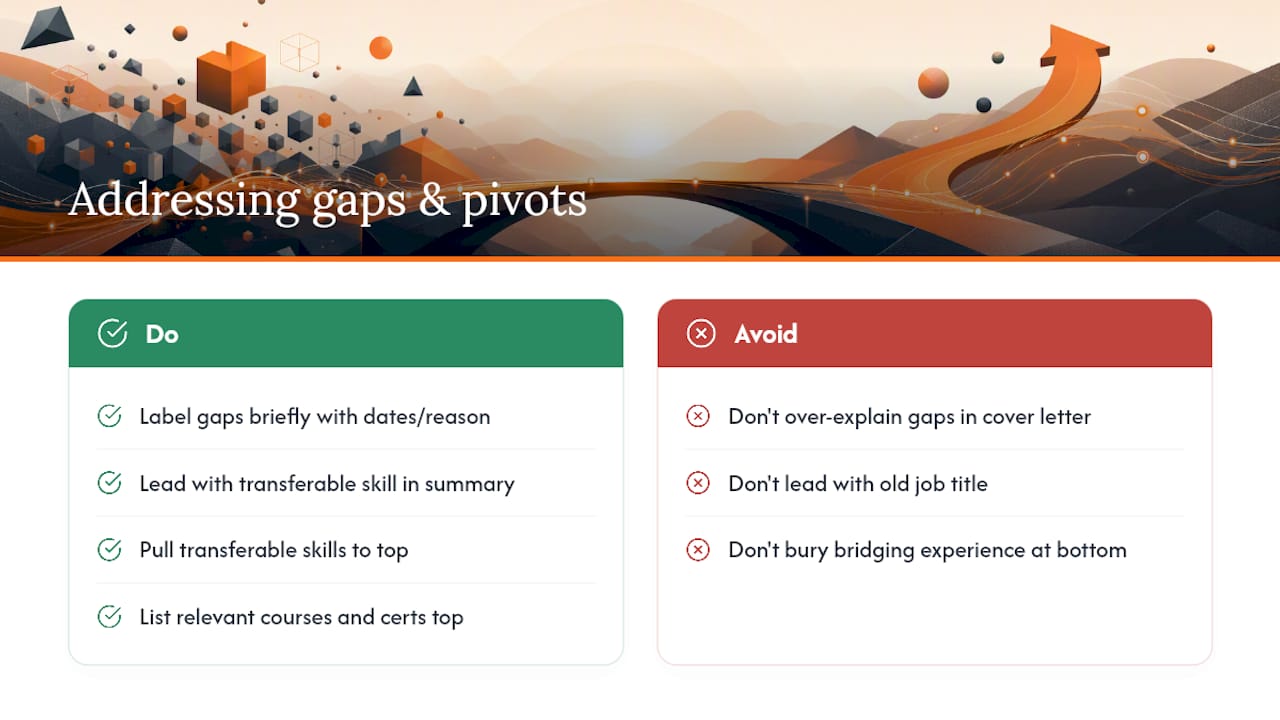
Gaps and pivots don’t need to be hidden. They need context, briefly stated, so a recruiter isn’t left guessing.
For a gap, one clause in your summary or a labelled line in your timeline usually does the job: “Career break, 2024 to 2025: family caregiving.” Avoid over-explaining in a cover letter unless the posting specifically invites it. Recruiters mainly want confirmation that the gap wasn’t a red flag, not a full narrative.
For a career change, your summary carries the heaviest weight. Lead with the transferable skill or outcome that connects your old field to the new one, not with your previous job title. Someone moving from teaching into corporate training might write: “Former secondary educator turned corporate trainer, skilled at translating complex material into structured, measurable learning outcomes for adult audiences.” That single line reframes years of classroom experience as directly relevant, rather than making the reader do that work themselves.
Your skills section should also shift emphasis. Pull forward the competencies that transfer (project management, stakeholder communication, data analysis) and place industry-specific jargon from your old field lower down or cut it entirely. If you’ve taken a course, certification, or done freelance work bridging the two fields, that belongs near the top of your CV, not buried at the bottom. A dedicated cover letter tailored for career transitions can carry the fuller story your CV doesn’t have room for.
Including relevant certifications and continuous learning courses
Certifications now do more work on a CV than they used to, particularly in fields where formal degrees matter less than demonstrated, current competence. A dedicated “Certifications” section, placed near your skills block or directly under your summary, gives recruiters and ATS scanners an easy target to match against job requirements.
List the certification’s full name exactly as issued, the issuing body, and the year earned. “Google Data Analytics Certificate, Google, 2025” reads better than a vague “data analytics training.” If a certification has an expiry or renewal cycle, such as many project management or cloud platform credentials, note the current status so a recruiter doesn’t have to ask.
Continuous learning matters even without a formal credential. A short line noting a completed course, workshop, or self-directed project signals that your skills are current, which matters most in fast-moving fields like data, marketing technology, and software development. Keep this section concise: three to six lines is usually enough, and prioritise anything that mirrors language in the job posting you’re applying against. A certification that doesn’t relate to your target role is better left off entirely rather than diluting the ones that do.
Updating LinkedIn profile to align with CV and market trends
Your CV and LinkedIn profile should tell the same story, using consistent job titles, dates, and headline achievements. Recruiters routinely cross-check both, and a mismatch, even an innocent one like a slightly different job title, can raise questions that cost you a conversation.
Start with your headline.
Update your skills section on LinkedIn to mirror the skills-first block on your CV, and request endorsements or recommendations that back the specific competencies you’re highlighting for your target roles. LinkedIn’s own data on skills-based hiring trends supports keeping this section current rather than treating it as a static list from years ago.
Finally, make sure your CV includes your LinkedIn URL in a clean, clickable format near your contact details, not buried at the bottom of the page. If a recruiter has to search for your profile, some simply won’t bother.
Incorporating in-demand soft skills alongside technical skills
Technical skills get you shortlisted; soft skills often decide who actually gets hired once two candidates look similar on paper. The mistake most job seekers make is listing soft skills as bare adjectives, “team player,” “excellent communicator,” with no evidence behind them.
Instead, weave soft skills into your achievement bullets rather than isolating them in a separate list. “Led a cross-functional team of eight through a compressed product launch, coordinating design, engineering, and marketing on a six-week timeline” demonstrates leadership and communication without ever using either word directly.
Employers are currently prioritising adaptability, collaboration across remote or hybrid teams, and communication clarity, particularly for roles where AI tools have changed day-to-day workflows. If your role involved adjusting to new tools or processes, say so explicitly: “Adapted campaign workflows after adopting a new project management platform, maintaining delivery deadlines throughout the transition.” A short guide to presenting transferable and interpersonal skills covers additional ways to make these qualities visible without resorting to empty adjectives.
Pair each soft skill claim with a concrete result where possible. It’s the same principle behind quantifying technical achievements: show, don’t declare.
If you want faster, safer tailoring
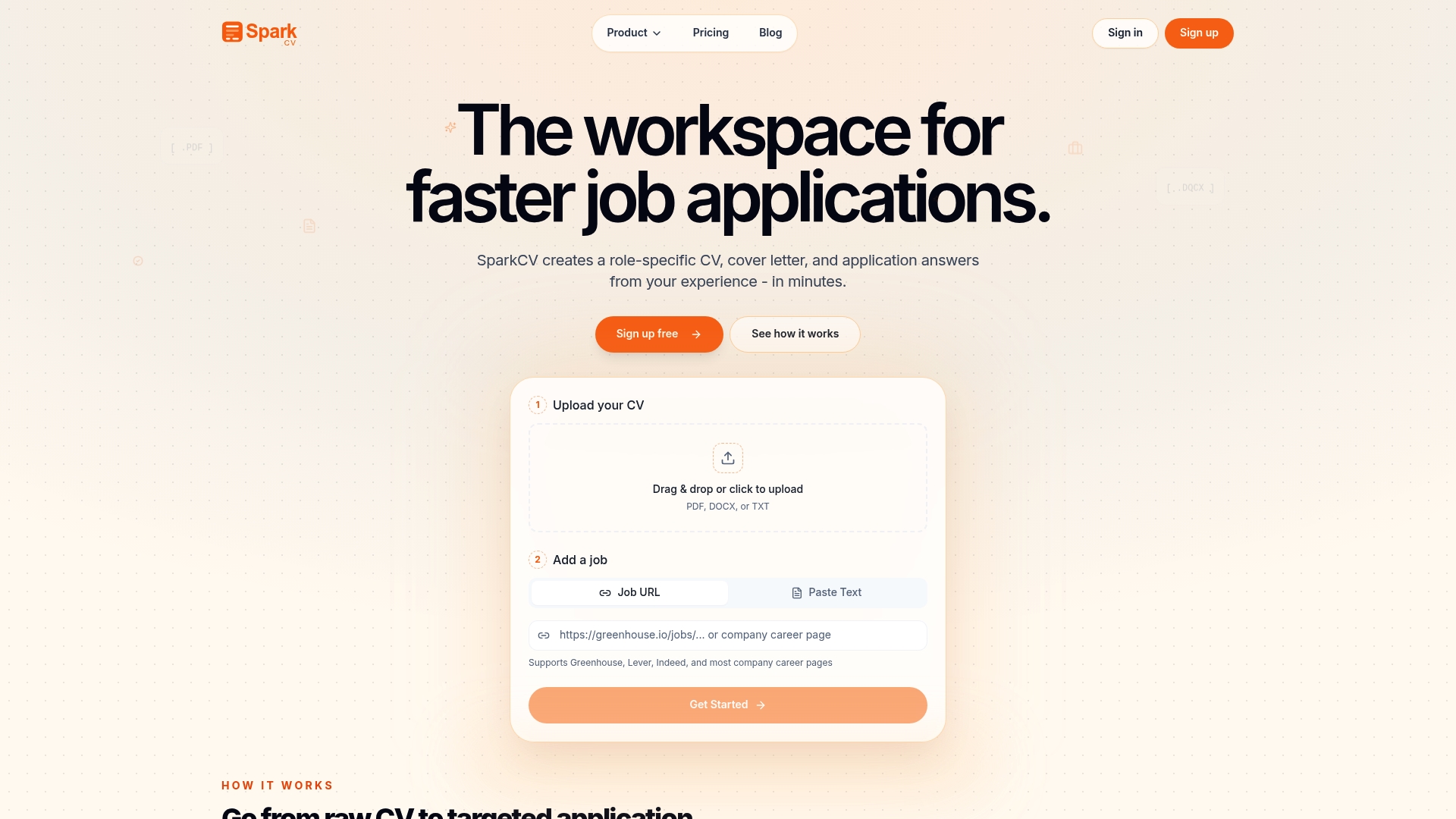
Every step above works, but doing it manually for every application takes time most job seekers don’t have. SparkCV was built around that exact problem. It reads your existing CV and a target job description, then generates a tailored, ATS-friendly CV, a matching cover letter, and drafted answers to application questions, all grounded in the experience you’ve actually logged rather than invented on the fly.
What that gets you in practice:
- A tailored CV built for a specific posting in minutes, not an afternoon.
- Keyword matching against the job description to support ATS compatibility.
- A what-changed report so you can see and verify every edit before you send it.
- Exportable templates and a career log that carries your measurable wins from one application to the next.
SparkCV offers monthly subscription access, single-use exports, and student pricing, so you can pick whichever fits how often you’re applying. If you’ve got an interview coming up and a job description in hand, start tailoring your CV with SparkCV and see the changes it makes before you submit anything.
Frequently asked questions
What does it mean to align your CV to current job market trends? It means restructuring your CV around what 2026 hiring actually rewards: ATS-friendly formatting, a skills-first or hybrid layout, keywords mirrored from each job description, and bullet points built around measurable outcomes rather than duty lists.
How often should I update my CV for current trends? Review your CV’s format and skills section every few months, but tailor the content, keywords, and top bullets for every individual application rather than sending one static version everywhere.
Do I still need a one-page CV? One page suits most candidates with under five years of experience. Senior or technical candidates with extensive relevant history can reasonably extend to two pages, provided every line still earns its place.
Should I remove my photo and personal details? Yes, for US applications. Drop the photo and replace it with a clean LinkedIn link; most US employers don’t expect a photo, and some hiring teams avoid them for legal reasons.
Can I use AI to write my whole CV? Use AI to draft structure and phrasing, but verify every fact, metric, and claim yourself before sending. An AI-generated line you can’t defend in an interview does more harm than a plainer, truthful one.
Sources
Recommended reads
Keep exploring






Hear more from SparkCV
Leave your email for new articles, onboarding invites, and launch news.
We’ll only use this for SparkCV emails, and you can unsubscribe any time.