
Write a cover letter for career transition

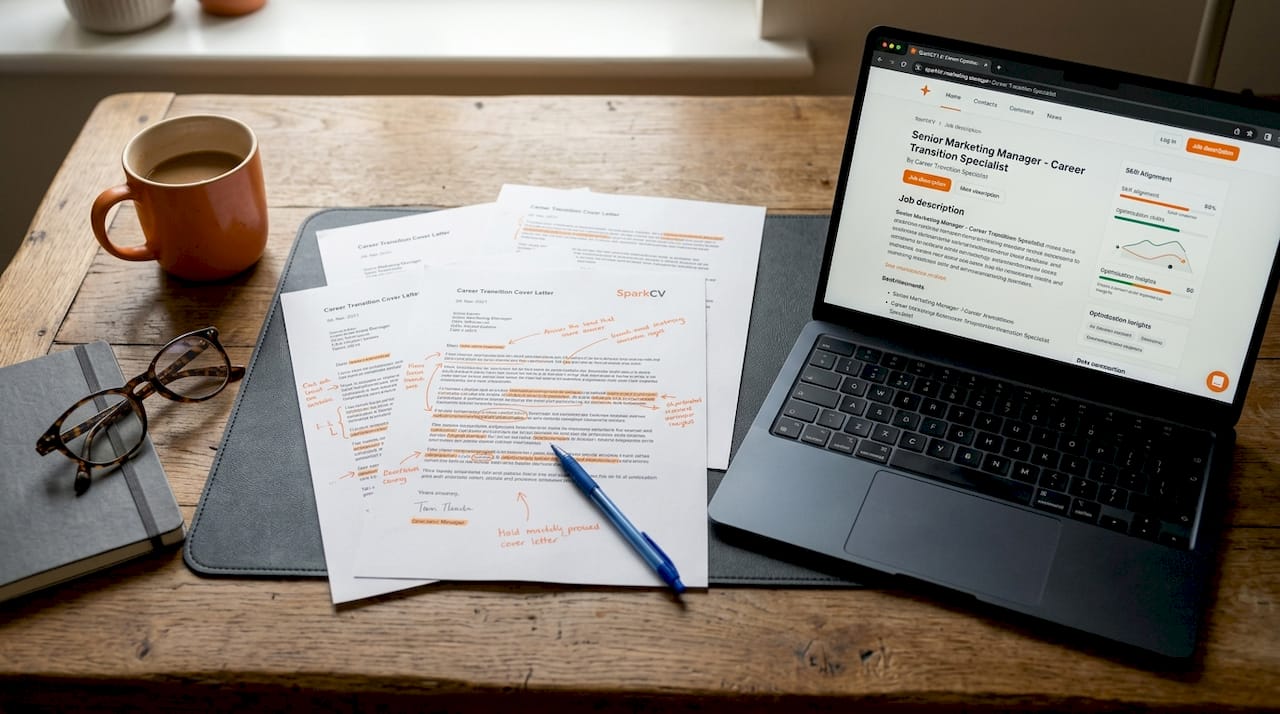
A career transition cover letter is a targeted document that explains why you are changing careers, maps your transferable skills to the new role, and reassures the hiring manager that your pivot is deliberate and well-prepared. Unlike a standard cover letter, it must do extra work: address questions about your background before the recruiter even thinks to ask them. The most effective letters combine honest motivation, concrete skill examples, and precise tailoring to the employer. Tools like Grammarly help with polish, but the substance must come from your own research and self-awareness.
What must a career change cover letter include?
A strong career-change letter must cover three non-negotiable elements: a clear explanation of why you are changing careers, evidence of value from education or transferable skills, and content tailored to the specific role and company. Miss any one of these and the letter reads as generic or unconvincing.
Here is what to include in each letter:
- Your career change objective. State what you are moving towards and why, not just what you are leaving behind. A career change objective aligned with your CV makes your application cohesive and purposeful.
- Relevant education or training. If you have completed a course, certification, or degree relevant to the new field, name it explicitly. This signals preparation, not impulse.
- Transferable skills with specific examples. Do not write “I have strong communication skills.” Write “I led weekly briefings for a 20-person team, distilling complex data into clear recommendations.” Specificity is what separates a compelling letter from a forgettable one.
- Tailored content. Reference the company by name, mention a product, initiative, or value that genuinely interests you, and connect it to your motivation for applying.
- Achievements, not duties. Your CV lists responsibilities. Your cover letter expands on what you actually achieved. Use this space to add context and results that a bullet point cannot capture.
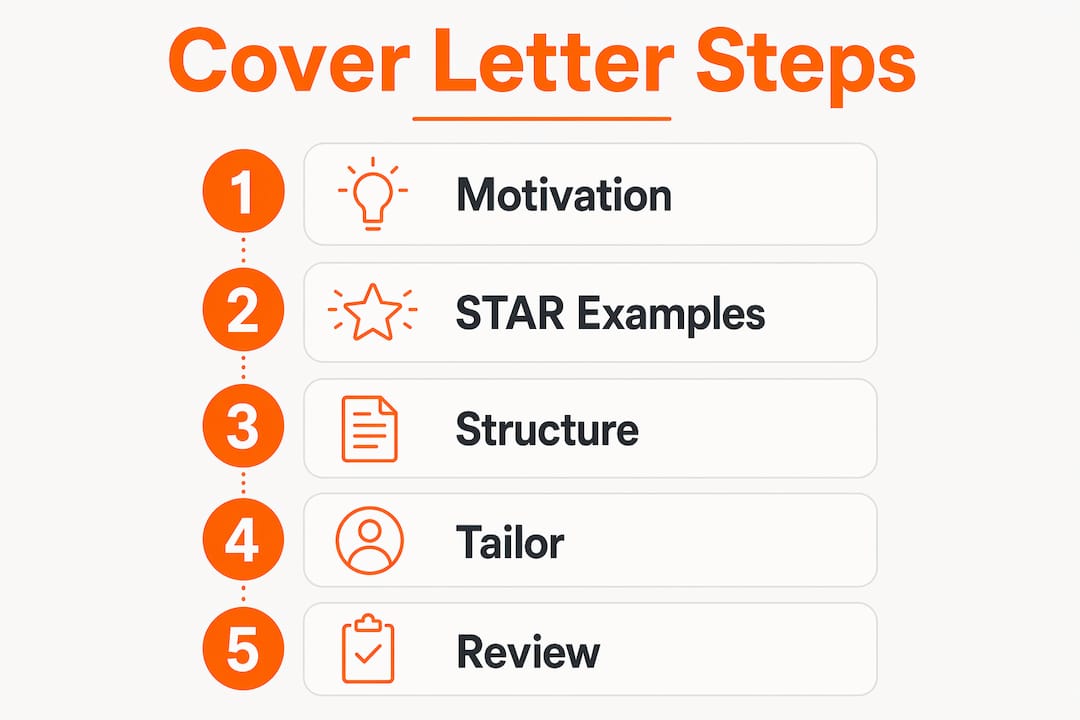
Pro Tip: Use your cover letter to track and articulate achievements using the STAR framework. Situation, Task, Action, Result gives each example a clear structure that hiring managers can follow quickly.
How should you structure a career transition cover letter?
Cover letters for career changers work best at 250 to 400 words, organised into three or four short paragraphs. That length is enough to make your case without testing the reader’s patience.
| Section | Effective approach | Ineffective approach |
|---|---|---|
| Opening paragraph | Name a specific reason for applying, tied to the company or role | “I am writing to apply for the position of…” |
| Middle paragraph(s) | STAR examples mapping past experience to job requirements | Vague claims: “I am a fast learner with transferable skills” |
| Closing paragraph | Reaffirm interest, request interview, provide contact details | “I look forward to hearing from you at your convenience” |
| Salutation | Address the hiring manager by name | “To Whom It May Concern” |
The opening paragraph is your most valuable real estate. Strong openings name a specific company observation, a relevant achievement, or a direct reason for applying. Avoid starting with your job title or a summary of your CV.
The middle section is where you use the STAR method. Concrete STAR examples show how your past experience applies to the new role far more persuasively than a list of adjectives. Aim for two or three focused examples rather than a broad sweep of everything you have ever done.
Pro Tip: Before you send, read the letter aloud. If a sentence sounds stiff or formal in speech, rewrite it. Tone consistency matters, and reading aloud catches awkward phrasing that silent proofreading misses.
How do you tailor your cover letter to the employer and role?
Tailoring is not optional for career changers. Mirroring the language of the job description in your letter improves perceived fit and makes it easier for recruiters to match your application to their requirements. This also helps with ATS keyword matching, which filters applications before a human reads them.
Follow these steps to tailor effectively:
- Research the company’s products, mission statement, and recent news. A reference to a specific initiative or value shows genuine interest, not a copy-paste application.
- Identify two or three key requirements from the job description and map each one to a specific example from your background.
- Use the same terminology the employer uses. If the job description says “stakeholder management,” use that phrase rather than “working with clients.”
- Avoid generic openings and vague claims. “I am passionate about this industry” tells the recruiter nothing. “I completed a six-month data analytics programme and applied those skills to reduce reporting time by 30% in my current role” tells them everything.
Pro Tip: Build modular cover letter sections that you can reassemble for different applications. Keep a strong opening, two or three STAR paragraphs, and a closing ready to customise. This saves time without sacrificing quality.
What do strong cover letter sentences look like for career changers?
The difference between a weak and a strong cover letter often comes down to individual sentences. Here are five sentence starters that work well for career changers:
- “After five years in [previous field], I have developed [specific skill] that directly applies to [target role] because…”
- “My decision to move into [new field] follows [specific trigger: course, project, or insight], which confirmed that…”
- “In my current role at [Company], I [action verb + result], demonstrating the [skill] your team requires for…”
- “I was drawn to [Company] specifically because of [named initiative or value], which aligns with my experience in…”
- “I would welcome the opportunity to discuss how my background in [area] can contribute to [specific team or goal].”
Compare these against weak alternatives:
| Weak phrasing | Strong phrasing |
|---|---|
| “I am a quick learner.” | “I trained as a UX researcher in three months and shipped a redesigned onboarding flow.” |
| “I have transferable skills.” | “My project management experience reduced delivery timelines by 15% across four cross-functional teams.” |
| “I am passionate about this role.” | “I completed the Google Data Analytics Certificate to prepare specifically for this transition.” |
Customise every sample to your own experience. Borrowed sentences that do not reflect your actual background are easy for experienced recruiters to spot.
Key takeaways
A career transition cover letter succeeds when it combines honest motivation, STAR-structured skill evidence, and precise employer tailoring in 250 to 400 words.
| Point | Details |
|---|---|
| Explain your motivation clearly | State why you are changing careers and what you are moving towards, not just away from. |
| Use STAR examples | Map two or three job requirements to specific, structured examples from your past experience. |
| Mirror the job description | Use the employer’s own language to improve keyword matching and perceived fit. |
| Keep it 250 to 400 words | Three to four focused paragraphs is the right length. Longer letters lose recruiter attention. |
| Tailor every application | Generic letters underperform. Name the company, the role, and a specific reason you applied. |
What I have learned from reviewing career transition letters
Career changers consistently make the same mistake: they apologise for their background instead of reframing it. A letter that opens with “Although I do not have direct experience in this field…” immediately puts the recruiter in a sceptical frame of mind. The better approach is to lead with what you bring, not what you lack.
The second pattern I notice is vague motivation. Recruiters want to understand why you are making this change now, and what specifically prepared you for it. “I have always been interested in marketing” is not a reason. “I spent two years managing social content for a non-profit alongside my main role, grew the audience by 40%, and decided to pursue this full-time” is a reason. The specificity signals preparation and reduces the recruiter’s uncertainty about your commitment.
The letters that perform best treat the cover letter as preparation for the interview, not just a gateway to it. When you write a career progression narrative that is honest and specific, you also clarify your own thinking. You arrive at the interview knowing exactly what to say about your transition, because you have already written it down clearly.
One more thing: do not underestimate the closing paragraph. Most people end with a passive “I look forward to hearing from you.” A confident, direct close, such as “I would welcome a conversation about how my background in operations can support your expansion plans,” leaves a stronger final impression and signals that you know what you want.
— Max
How SparkCV helps you write a stronger career transition letter
Writing a tailored cover letter for every application takes time, especially when you are changing careers and need to reframe your experience for a new field.
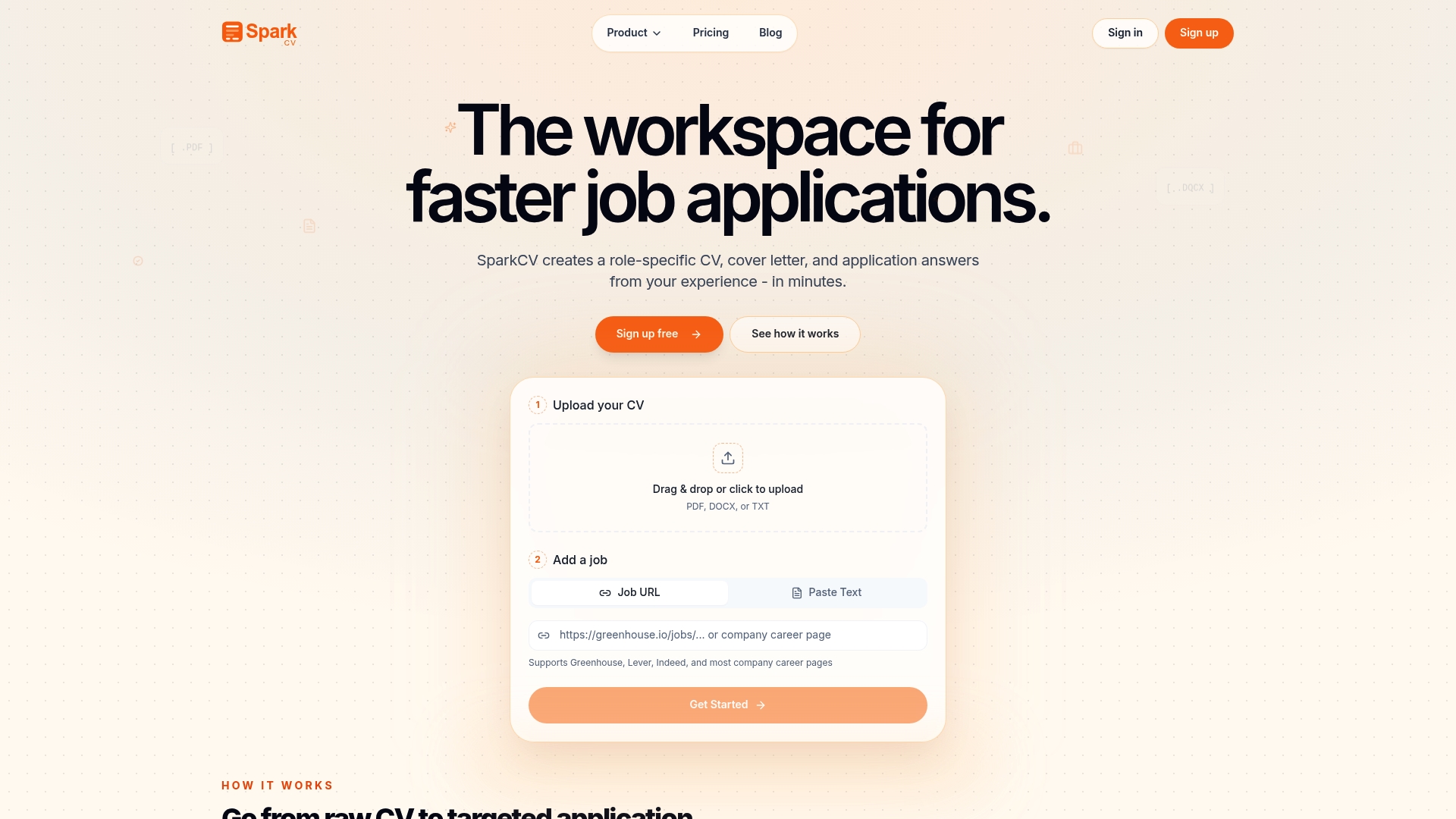
SparkCV analyses your existing CV and the job description, then generates a tailored cover letter aligned to the role’s specific requirements. The platform handles keyword matching and ATS-friendly formatting automatically, so you spend your time refining the letter rather than building it from scratch. SparkCV also helps you answer application questions that often accompany career change roles, giving you a complete, consistent application in minutes. If you are applying to multiple roles across different fields, SparkCV’s modular approach means each letter is targeted without starting over each time.
FAQ
What is a career transition cover letter?
A career transition cover letter is a document that explains your motivation for changing careers, highlights transferable skills, and tailors your experience to the new role. It addresses recruiter concerns about your background before they arise.
How long should a cover letter for a career change be?
Cover letters for career changers should be 250 to 400 words, structured in three to four paragraphs. This length is enough to make a compelling case without losing the reader’s attention.
Should I explain my career change in the cover letter?
Yes. Addressing your career change directly in the cover letter prevents hiring manager doubts and shows that your decision is deliberate and well-prepared.
How do I show transferable skills without sounding vague?
Use the STAR method: describe the Situation, Task, Action, and Result for each skill you claim. Specific STAR examples are far more persuasive than adjectives like “adaptable” or “motivated.”
Can I use the same cover letter for multiple applications?
You can use a modular structure with reusable sections, but each letter must be tailored to the specific company and role. Mirroring the job description language and naming the employer specifically is what separates a strong application from a generic one.
Recommended reads
Keep exploring






Hear more from SparkCV
Leave your email for new articles, onboarding invites, and launch news.
We’ll only use this for SparkCV emails, and you can unsubscribe any time.