
Why a career pivot needs a new CV: 2026 guide

A career pivot requires a new CV because your existing document is built around your previous career, not the one you are moving into. Recruiters and applicant tracking systems, known as ATS, scan for role alignment and relevant keywords within seconds. A CV optimised for your old field will fail ATS screening before a human ever reads it. Tools like SparkCV, platforms like LinkedIn, and guidance from Indeed all confirm the same principle: a new direction demands a new document. This guide explains exactly why career pivots need a fresh CV and how to build one that works.
Why a career pivot needs a new CV
Your old CV tells the story of who you were professionally, not who you are becoming. Focusing on transferable skills in a new career is the foundation of any effective CV update for a pivot. When a recruiter in your target field reads your document, they are looking for evidence that you can do the job, not a detailed history of a role that no longer applies.

The gap between your previous career and your new target is not a weakness. Presented correctly, your prior background becomes a strategic advantage. Employers value a past career framed as an asset rather than a liability, particularly when you can show how your experience solves problems in the new field.
ATS systems overweight the earliest elements of your CV. If your opening section still references your old job title and industry, the system deprioritises your application before a recruiter sees it. Front-loading target-role signals is not optional for pivot candidates. It is the difference between getting shortlisted and getting filtered out.
How do transferable skills shape your new CV?
Transferable skills are the competencies you have built in one context that apply directly in another. A project manager moving into product management brings stakeholder communication, deadline ownership, and risk assessment. A teacher moving into corporate training brings curriculum design, performance measurement, and group facilitation. These are not soft extras. They are the core of your pivot CV.
The key shift is moving away from a job-title-led CV towards a skills-and-achievements-led one. Your previous job titles may mean little in your new field. Your results and capabilities mean everything.
Here is how to identify and present transferable skills effectively:
- Audit your last three roles for outcomes, not just duties. “Managed a team” is a duty. “Reduced onboarding time by restructuring training materials” is an outcome.
- Map your skills to the job description of your target role. Use the exact language the employer uses. If they say “stakeholder engagement,” use that phrase, not “client communication.”
- Include soft skills strategically. Leadership, adaptability, and problem-solving are genuinely valued in career changers, but only when backed by a specific example.
- Remove skills that do not transfer. A CV cluttered with irrelevant technical knowledge signals misalignment, not depth.
Pro Tip: Run your CV through a keyword gap analysis against three job descriptions in your target field. Any term that appears in all three but not in your CV is a gap you need to close.
Which CV format works best for a career change?
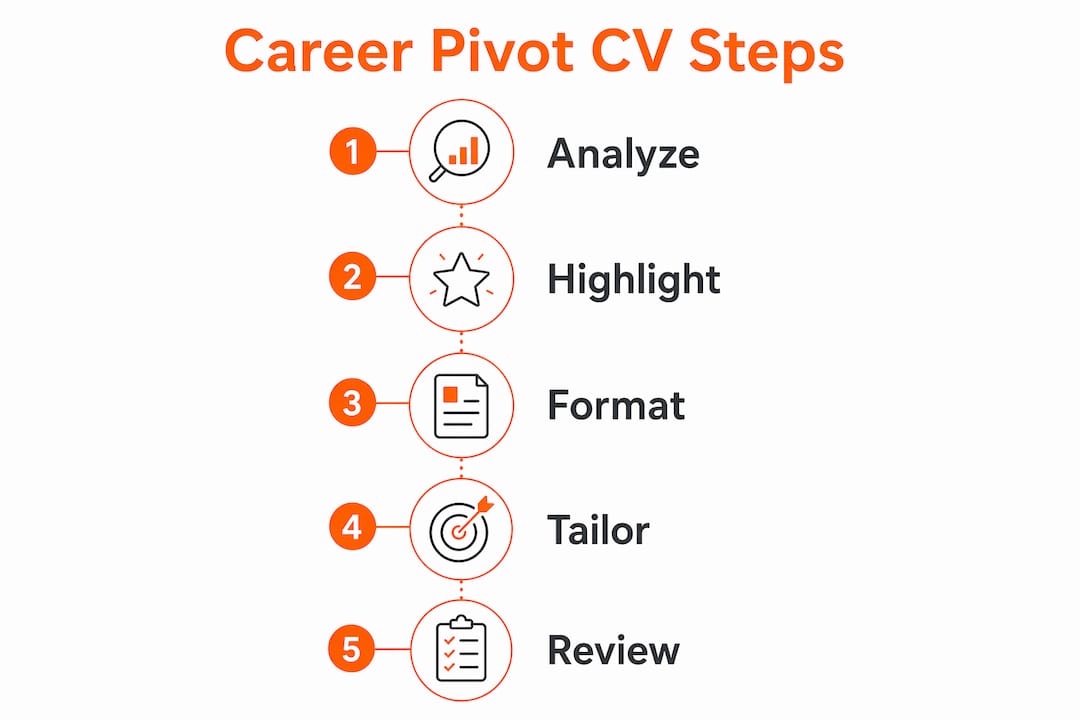
The format of your CV is not a cosmetic choice. It determines what a recruiter sees first and how ATS interprets your experience. For career changers, format is a strategic decision.
| Format | Structure | Best For |
|---|---|---|
| Chronological | Work history listed newest to oldest | Candidates with direct, linear experience in the target field |
| Functional | Skills grouped by category, minimal work history | Candidates with very limited relevant experience |
| Combination | Skills section first, followed by work history | Career changers with transferable skills and solid work history |
The combination CV format is the strongest choice for most career pivots. It front-loads your relevant competencies and achievements before your work history, which means both ATS and recruiters encounter your strongest material first. The chronological format, by contrast, leads with your old job titles and buries your transferable value.
A common mistake is updating CV content with new courses or projects while keeping the old chronological structure intact. Updating content without restructuring leaves irrelevant role terminology dominating the top of your document. The format and the content must change together.
Pro Tip: Place a dedicated “Core Competencies” or “Key Skills” section directly beneath your professional summary. This gives ATS a clean block of keywords to parse and gives recruiters an immediate snapshot of your value.
Why does tailored wording make or break a pivot CV?
Generic wording is the single biggest reason career change CVs fail. Always tailoring your CV to each specific job improves both ATS performance and recruiter engagement. This is not about rewriting your entire document for every application. It is about adjusting the language, emphasis, and examples to match each role.
Follow these steps to update your CV wording for a career pivot:
- Copy the job description into a text document. Highlight every skill, tool, and qualification the employer mentions. These are your target keywords.
- Compare against your current CV. Identify which keywords are missing and which sections could incorporate them naturally.
- Rewrite your bullet points to mirror the employer’s language. If the role requires “data analysis,” describe a time you analysed data, even if it was in a different context.
- Remove outdated information. Qualifications, tools, or roles from over ten years ago that have no relevance to your new field take up space and dilute focus.
- Add recent learning. Relevant certifications and courses demonstrate commitment to the new field and help close experience gaps. Include Google, Coursera, or LinkedIn Learning credentials if they align with the target role.
- Include volunteer work or freelance projects. If you have been building skills outside paid employment, these count. A marketing professional who has been managing social media for a charity has real, citable experience.
The importance of updating your CV regularly is not just about accuracy. It is about maintaining relevance as your skills and goals evolve.
How to write a compelling CV for a career transition
The professional summary at the top of your CV is your most valuable real estate. It is the first thing a recruiter reads and the section most likely to determine whether they continue. A strong opening summary should emphasise your transferable skills and signal your motivation for the new role clearly and confidently.
A weak summary for a career changer reads like a job title: “Experienced teacher with 8 years in secondary education.” A strong one reads like a value proposition: “Learning and development professional with 8 years designing and delivering training programmes, now applying curriculum expertise to corporate L&D environments.”
Use these principles to build a compelling pivot CV:
- Open with your destination, not your origin. Your summary should name the role or field you are moving into, not the one you are leaving.
- Connect your narrative. Storytelling CV elements that link your past roles to your new target help recruiters see your pivot as logical rather than random. One sentence explaining the connection is enough.
- Quantify wherever possible. Numbers cut through ambiguity. “Managed a £200,000 project budget” is clearer than “managed budgets.”
- Keep it to three or four sentences. A summary that runs to a paragraph loses the recruiter’s attention before they reach your skills section.
- Use the CV tailoring checklist to verify that every section of your document aligns with the target role before you submit.
Key takeaways
A career pivot CV must be restructured and rewritten, not just updated, to pass ATS filters and convince recruiters of your value in a new field.
| Point | Details |
|---|---|
| New CV is non-negotiable | Your existing CV is optimised for your old career and will not pass ATS screening for a new field. |
| Lead with transferable skills | Shift from a job-title-led structure to a skills-and-achievements-led one to show relevance immediately. |
| Use the combination format | Front-loading a skills section before work history gives both ATS and recruiters your strongest material first. |
| Tailor language to each role | Mirror the exact keywords from each job description to improve ATS match and recruiter engagement. |
| Update content and structure together | Adding new courses without restructuring the format leaves old industry framing dominating your CV. |
Build your career pivot CV faster with SparkCV
Rewriting a CV for a career change takes time, and getting the keyword alignment right is harder than it looks. SparkCV analyses your existing CV alongside the job description and generates a tailored, ATS-friendly version in minutes.
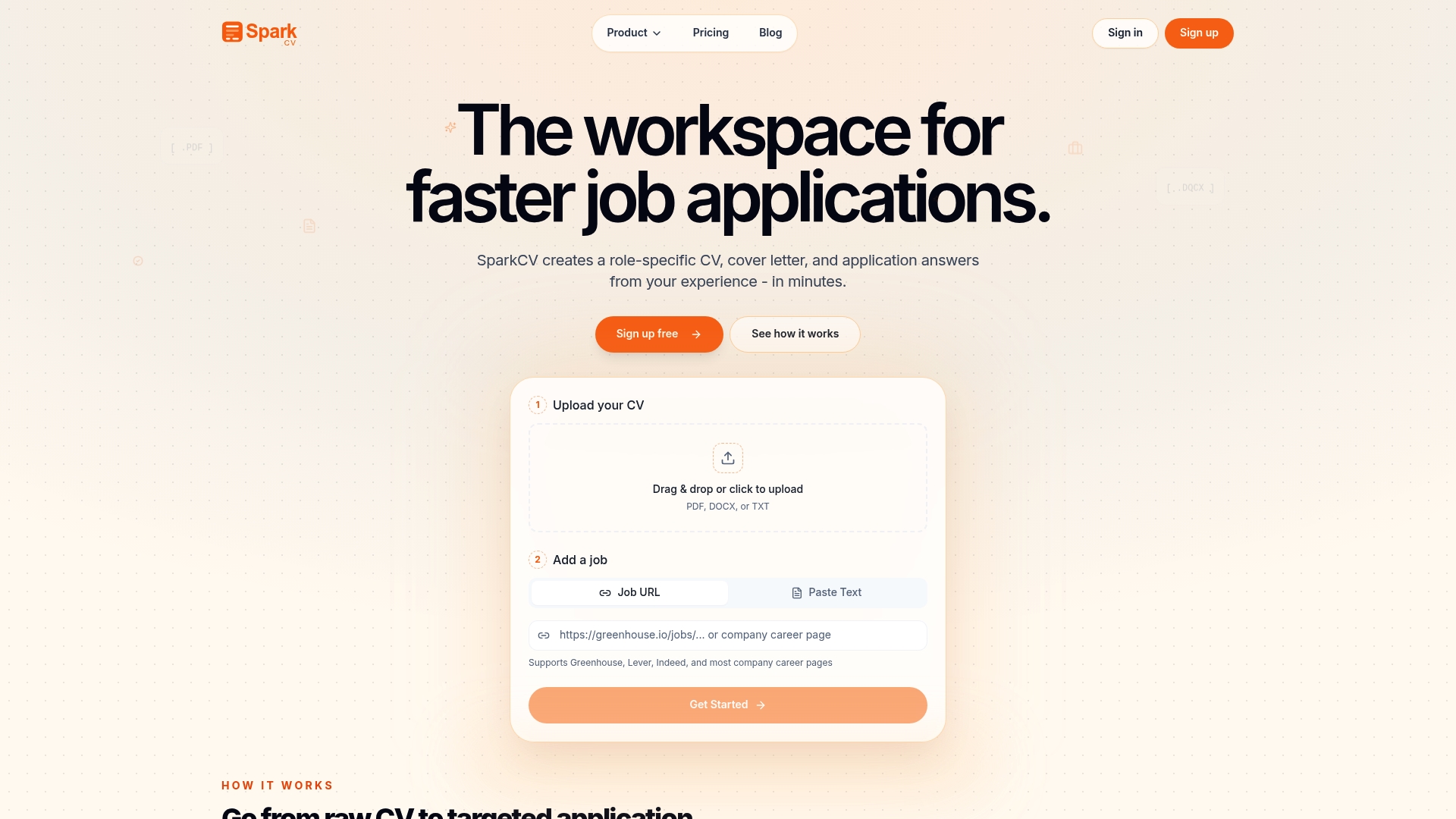
SparkCV’s AI CV optimisation identifies keyword gaps, restructures your content for the target role, and produces a polished document ready to submit. You also get a tailored cover letter and answers to application questions, all aligned to the specific job. If you are making a career pivot and need a CV that reflects where you are going, not where you have been, SparkCV gives you a practical head start. Try it free and see the difference a targeted CV makes.
FAQ
Why can’t i just update my existing CV for a career pivot?
Your existing CV is structured around your previous career, which means its format, language, and emphasis all signal the wrong field to ATS and recruiters. A full restructure using a combination format is needed to front-load transferable skills and pass screening.
What is the best CV format for a career change?
The combination CV format is the most effective for career changers. It places a skills section before work history, ensuring recruiters and ATS encounter your most relevant competencies first rather than your old job titles.
How do i show relevant experience when i am changing careers?
Include transferable skills, recent certifications, volunteer work, and freelance projects that relate to your target field. Relevant education and certification demonstrate commitment and help close experience gaps for recruiters.
Should i write a different CV for every job application during a pivot?
You should maintain one strong pivot CV and adjust the keywords, summary, and emphasis for each specific role. Tailoring your application to each job description significantly improves your chances of passing ATS screening.
How do i write a professional summary for a career change CV?
Open with your target role or field, highlight your most relevant transferable skills, and briefly connect your previous experience to your new direction. A strong opening summary signals your new direction clearly and gives recruiters an immediate reason to read on.
Recommended reads
Keep exploring






Hear more from SparkCV
Leave your email for new articles, onboarding invites, and launch news.
We’ll only use this for SparkCV emails, and you can unsubscribe any time.