
Examples of strong job application openings

Your job application opening is the single most decisive section of your entire submission. 41% of hiring managers rank the introduction as the most impactful part of a cover letter, expecting a specific achievement, referral, or business-relevant insight rather than a generic greeting. The industry term for this is the cover letter opening statement, and getting it right separates reviewed applications from rejected ones. This article gives you concrete examples of strong job application openings across every career stage, backed by 2026 hiring data, so you can adapt them immediately.
1. Lead with a measurable achievement
The most effective job application openings for experienced professionals start with a hard number. Recruiters process dozens of applications quickly, and a specific result stops them. Customised cover letters boost interview rates by up to 3.4 times compared to generic ones, and measurable achievements are the fastest way to personalise your opening.
Strong examples for senior roles:
- “After growing my team’s client retention rate from 67% to 91% in 18 months, I am ready to bring that same focus to your Customer Success Director role.”
- “Having reduced procurement costs by £340,000 across three financial years, I am confident I can deliver comparable results for your operations team.”
- “My last product launch reached 50,000 users within 60 days. I would like to do the same for your SaaS platform.”
To identify the right achievement for your opening, ask yourself:
- What is the single biggest result I delivered in my last role?
- Can I attach a number, percentage, or time frame to it?
- Does that result directly relate to the job I am applying for?
Pro Tip: Use your CV tailoring checklist to match your strongest metric to the job description before writing your opening line.
2. Use a referral to open with instant credibility

Referral-based openings are statistically the most powerful approach available to any job seeker. Referred candidates are 5 to 8 times more likely to be hired than cold applicants, and referral applications convert at 30 to 50% compared to just 1 to 3% for mass job board submissions. The reason is simple: a trusted internal voice has already done part of the hiring manager’s risk assessment for them.
Examples of referral openings across industries:
- “Your Head of Engineering, Priya Sharma, suggested I reach out after we collaborated on the DevOps migration at FinTech Solutions last year.”
- “James Okafor from your marketing team recommended I apply for this role, having seen my campaign work at Bright Media firsthand.”
- “After speaking with your Finance Director at the CFO Summit in Manchester, she encouraged me to apply for the FP&A Manager position.”
Best practices when writing a referral opening:
- Name the referrer in the first sentence, not buried in the second paragraph.
- Briefly state the context in which you know them.
- Only use a referral with the person’s permission.
If you do not have a referral, researching the hiring manager’s name on LinkedIn and addressing them directly is the next best move. Avoid “To Whom It May Concern” entirely. When the name is unavailable, use “Dear [Team Name] Hiring Team” to maintain professionalism.
3. Open with a company-specific insight
A researched opening that references a recent company development positions you as a ready-made solution rather than just another applicant. Referencing specific company developments from the last 90 days, such as a product launch or funding round, significantly increases engagement. A single company-specific sentence moves your application from the generic pile to the reviewed pile and nearly doubles interview rates.
How to research and craft a company-specific opening:
- Search the company’s newsroom or press releases for announcements in the past three months.
- Check their LinkedIn page for recent posts about team growth, new products, or strategic shifts.
- Read their latest blog post or case study to understand current priorities.
- Identify one challenge or goal that your skills directly address.
- Write one sentence connecting that insight to your specific experience.
Examples of company-specific openings:
- “Your recent Series B raise and expansion into the German market caught my attention. My experience scaling B2B sales teams across DACH makes me well placed to support that growth.”
- “I read your CEO’s post on rethinking customer onboarding last week. Having redesigned onboarding flows that cut churn by 22%, I believe I can contribute directly to that initiative.”
Pro Tip: Tools like Grammarly and Jobscan help you check tone and ATS compatibility once you have drafted your company-specific opening.
4. Craft confident openings for early career and career changers
Early career candidates and career changers often make the mistake of opening with an apology or a vague statement of enthusiasm. Career changers benefit most from confidently connecting transferable skills to the new role, rather than drawing attention to what they lack. The goal is a clear, direct value statement from the very first sentence.
Strong opening examples for these groups:
- “Three years leading community outreach programmes at a non-profit taught me how to build trust with diverse stakeholders. That skill transfers directly to your Community Manager role.” (Career changer)
- “During my final-year project at the University of Leeds, I built a machine learning model that improved demand forecasting accuracy by 18%. I am now looking to apply that work in a commercial data science environment.” (Graduate)
- “My internship at Deloitte gave me hands-on experience with financial modelling under real deadline pressure. I am ready to bring that foundation to your graduate analyst programme.” (Early career)
Avoid these common mistakes in early career openings:
- Opening with “I am a recent graduate looking for an opportunity.”
- Mentioning what you hope to gain before what you offer.
- Using vague phrases like “passionate about” without a specific example to back them up.
5. Comparison of opening strategies by career stage and context
Each opening strategy works best in specific situations. The table below helps you choose the right approach for your circumstances.
| Opening strategy | Best suited for | Impact level | Research time needed |
|---|---|---|---|
| Measurable achievement | Mid to senior level professionals | Very high | Low (use your own record) |
| Referral-based | Any career stage with a contact | Very high | Low (requires a connection) |
| Company-specific insight | Any career stage | High | Medium (30 to 60 minutes) |
| Transferable skills statement | Early career and career changers | Medium to high | Low to medium |
No single strategy is universally superior. The most competitive applications often combine two approaches, for example, opening with a referral and then immediately following with a measurable achievement. A tailored, strategic approach to openings consistently outperforms mass applications, particularly in the 2026 job market where AI screening filters generic content before a human ever reads it.
Key takeaways
Strong job application openings require a specific achievement, referral, or company insight in the very first sentence, because generic openers are filtered out before a hiring manager reads them.
| Point | Details |
|---|---|
| Lead with specificity | Open with a number, referral, or company insight rather than a generic statement of intent. |
| Referrals convert highest | Referred candidates are 5 to 8 times more likely to be hired than cold applicants. |
| Personalisation nearly doubles interviews | A single company-specific sentence significantly increases your chance of being reviewed. |
| Career changers need confidence | Replace apologetic tones with direct transferable skill statements tied to the role. |
| Combine strategies for best results | Pairing a referral with a measurable achievement produces the strongest possible opening. |
Craft your opening in minutes with SparkCV
Writing a tailored opening for every application takes time you may not have. SparkCV analyses your existing CV and the job description together, then generates a personalised cover letter opening that matches the role’s requirements and passes ATS screening.
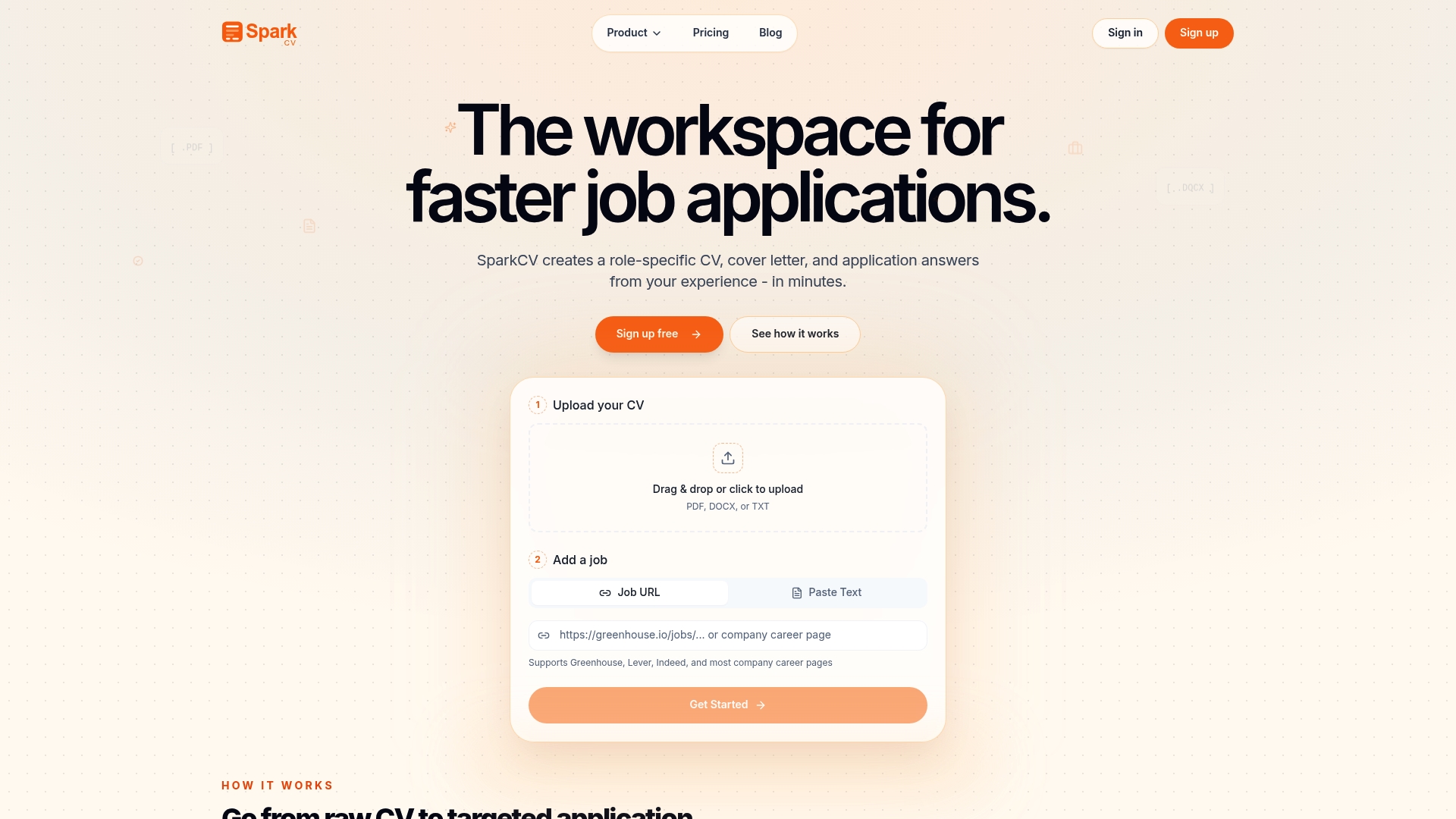
SparkCV’s AI identifies your strongest achievements, matches them to the job posting’s keywords, and produces an ATS-friendly opening statement in minutes. You can also use SparkCV’s application question tool to tailor your responses to specific employer prompts. Whether you are a graduate applying for your first role or a senior professional targeting a competitive position, SparkCV gives you a polished, targeted opening without the guesswork. Start tailoring your application today and spend your time preparing for the interview instead.
FAQ
What makes a job application opening strong?
A strong opening immediately states a specific achievement, referral, or company-relevant insight. 41% of hiring managers rank the introduction as the most impactful section, so generic phrases like “I am writing to apply” waste your best opportunity.
How should a career changer start a job application?
Career changers should open with a confident transferable skill statement tied directly to the target role. Avoid mentioning the career gap or lack of direct experience in the opening line.
Does personalising an opening really make a difference?
Yes. A company-specific opening nearly doubles interview rates compared to a generic one, because it signals genuine research and positions you as a solution to the employer’s current challenges.
What should I avoid in my opening line?
Avoid starting with “I am writing to apply,” “To Whom It May Concern,” or any statement about what you hope to gain from the role. These phrases signal a generic application and reduce your chances of passing both ATS filters and human review.
How long should a job application opening be?
Your opening statement should be two to three sentences at most. State your strongest hook in the first sentence, then add one sentence of context or connection to the company before moving into the body of your letter.
Recommended reads
Keep exploring





Hear more from SparkCV
Leave your email for new articles, onboarding invites, and launch news.
We’ll only use this for SparkCV emails, and you can unsubscribe any time.