
What is a job application funnel?
Only 1 in 180 applicants actually gets hired. Most job seekers send out applications with little understanding of why so few succeed, while many HR professionals manage bloated hiring processes without knowing where candidates are falling away. Understanding what is a job application funnel changes this entirely. It gives both sides a clear picture of the candidate journey, from first spotting a vacancy to receiving an offer, and reveals exactly where things go wrong. This guide breaks down every stage, explains the data behind conversion rates, and gives practical steps to improve your results.
Table of Contents
Key takeaways
| Point | Details |
|---|---|
| Funnel stages matter | The job application process moves through seven stages, and most drop-off happens at screening. |
| ATS filters are decisive | Keyword-matched, ATS-friendly CVs pass screening far more reliably than generic submissions. |
| Application friction loses candidates | Lengthy forms push candidates away; simplifying to three fields can lift completions by 27%. |
| Targeted beats volume | Focused applications to well-matched roles outperform mass submissions every time. |
| Early recruiter involvement helps | Engaging recruiting teams earlier reduces time-to-hire by nearly 30% in smaller organisations. |
What is a job application funnel?
A job application funnel is the structured path a candidate travels from first becoming aware of a role to being hired or rejected. The term borrows from marketing: just as a sales funnel tracks customers from discovery to purchase, a recruitment funnel tracks applicants from awareness to hire.
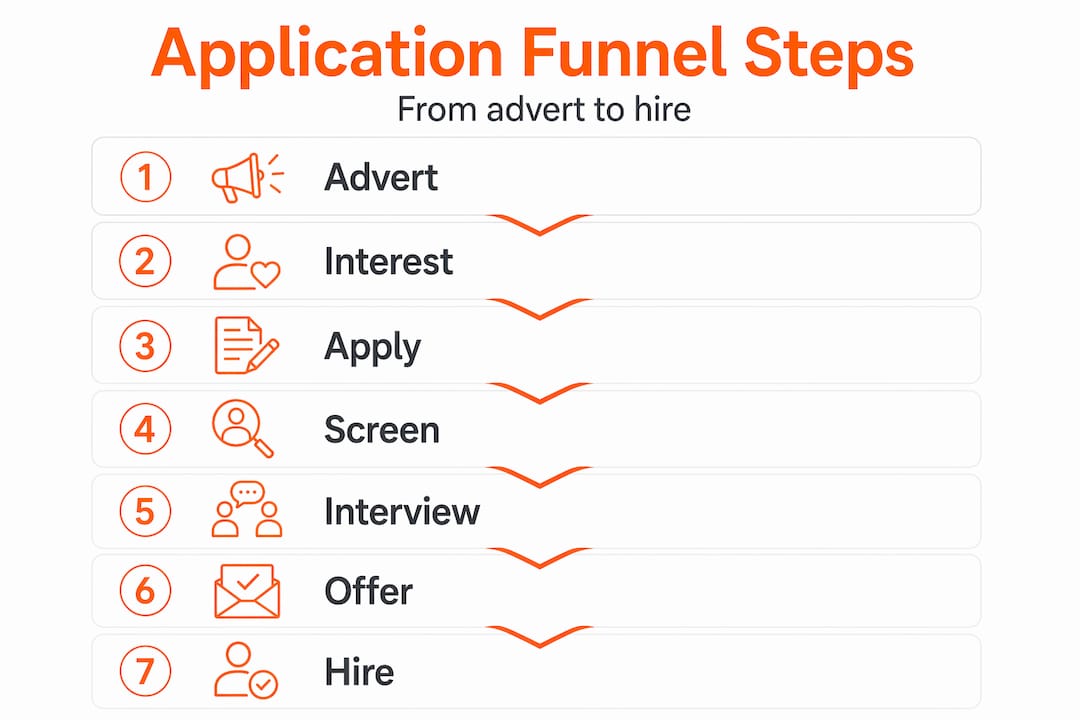
Understanding application funnels helps both job seekers and HR professionals see the process clearly rather than experiencing it as a black box. Here are the seven core stages:
-
Awareness: The candidate discovers the role through a job board, company website, or referral.
-
Interest: They read the job description and decide to find out more.
-
Application: They submit their CV and any required materials.
-
Screening: Recruiters or an applicant tracking system filter submissions against minimum criteria.
-
Interviewing: Shortlisted candidates go through one or more interview rounds.
-
Offer: The preferred candidate receives a formal offer.
-
Hire: The candidate accepts and joins the organisation.
The table below shows typical conversion rates at each stage and where the biggest losses occur.
| Stage | Candidate action | Typical conversion rate |
|---|---|---|
| Awareness → Interest | Reads the job advert | 40–60% |
| Interest → Application | Submits an application | 10–30% |
| Application → Screening pass | CV reviewed and shortlisted | 5–15% |
| Screening → Interview | Invited to interview | 3% of applicants |
| Interview → Offer | Receives a formal offer | 10–20% |
| Offer → Hire | Accepts and starts | 80–90% |
The steepest drop happens between application submission and the screening pass. Roles now receive over 300 applications per hire on average, a figure that has tripled since 2021. Screening eliminates 97% of applicants before interview, which is not a failure. It is the filter doing exactly what it was designed to do.
Where the funnel breaks down
Both job seekers and recruiters lose out when stages of the job application process are poorly designed. The friction points are predictable, and knowing them gives you an advantage.
71% of candidates expect applying to take less than 30 minutes. When it takes longer, 35% abandon the form entirely. Simplifying an application from eight fields to three can increase completion rates by 27%. That is a significant gain from a small design change.
Automated keyword filtering is another critical point. If your CV does not contain the right terms, it will be removed before a human ever reads it. This affects candidates and recruiters equally. Candidates lose opportunities they are qualified for; recruiters lose good people they never see.
Interview scheduling delays cause a different kind of damage. A 42% candidate withdrawal rate is directly linked to slow scheduling, which automated scheduling reduces by being 26% faster than manual coordination. The longer the gap between screen and interview, the more likely a candidate accepts another offer.
Common reasons candidates drop off at each stage include:
-
Forms that are too long or require account creation before applying
-
No confirmation or communication after submission
-
Vague job descriptions that attract mismatched applicants
-
Interview processes stretched over four or more weeks
-
Lack of salary transparency leading to withdrawals post-offer
Conversion rates serve as a health check for recruitment effectiveness. A large drop-off at any single stage is a signal that something in the process needs fixing, not that the talent pool is weak.
Pro Tip: If you are an HR professional reviewing your funnel, map where candidates exit and ask one question: is this drop-off caused by the candidate or by our process? The answer often points directly to the fix.
How job seekers can navigate the funnel
Understanding the funnel gives you a real edge. You stop guessing and start making decisions that actually move your application forward. Here is how to approach each stage with intent.
-
Tailor every CV to the role. Generic CVs fail at the screening stage. Match your CV’s language to the job description. Use the same terms the employer uses. Tailoring applications for ATS improves your screening pass rate significantly. Tools like SparkCV analyse the job description and align your CV with the exact keywords a recruiter or ATS is looking for.
-
Apply to fewer roles, more deliberately. Mass applications waste your time and produce weak results. A targeted application to a well-matched role consistently outperforms ten rushed submissions. Research the company, reference specific details, and show you understand the role.
-
Answer application questions concisely. Recruiters read hundreds of responses. Short, specific answers with concrete examples perform better than lengthy paragraphs. Two to three sentences per question is usually right.
-
Engage at the awareness and interest stages. Follow companies you want to work for. Connect with people in those teams on LinkedIn. When a relevant role appears, you are already a warm contact rather than a cold applicant. Sourced candidates pass screening 67% of the time versus 8% for inbound applicants.
-
Follow up professionally. A brief, polite follow-up one week after submission is acceptable and often appreciated. It signals genuine interest and keeps your name in front of the recruiter.
How HR teams can optimise the funnel
For recruiters and HR professionals, optimising job applications is about reducing waste at every stage, not simply filtering faster.
-
Involve recruiters earlier. Early involvement in defining the role and sourcing reduces time-to-hire by nearly 30% and prevents the funnel from flooding with mismatched applications.
-
Use AI for targeted sourcing. Outbound sourcing converts at four to eight times the rate of inbound applications. Using AI tools to identify and reach qualified candidates before they apply produces a higher-quality funnel from the start.
-
Simplify the application form. Review your form annually. Remove any field that does not directly inform a screening decision. Consider a two-stage approach: a short initial form, then a fuller pack for shortlisted candidates.
-
Use data to find bottlenecks. Track conversion rates at each stage. A sudden drop between screening and interview suggests unclear criteria or poor communication. A drop at offer stage points to compensation or process length.
-
Invest in candidate communication. Candidates who receive timely updates are far less likely to withdraw. Even an automated acknowledgement improves the experience. An applicant tracking system can handle this without adding workload.
Pro Tip: Automate interview scheduling from day one. The 26% speed gain is not just an efficiency win. It directly reduces the 42% candidate withdrawal rate caused by slow coordination.
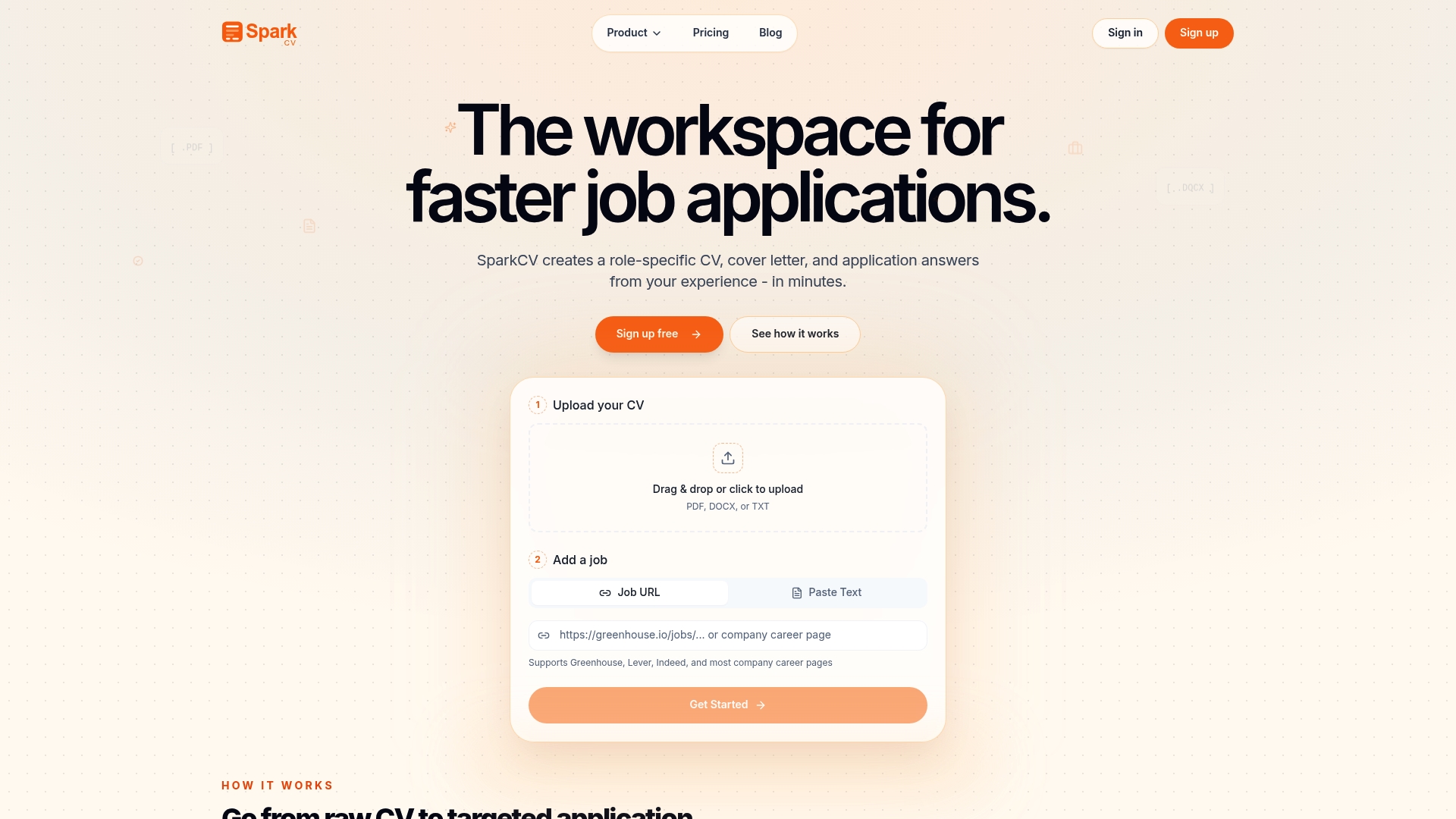
If you are a job seeker looking to move through the funnel more effectively, SparkCV gives you a direct advantage at the stages that matter most. The platform analyses your existing CV alongside the job description and generates a tailored, ATS-friendly version in minutes. You also get a matching cover letter and targeted answers to application questions, reducing friction and improving keyword alignment where screening decisions are made. No generic submissions. No guesswork about what the recruiter wants to see. Start optimising your CV with SparkCV and give every application a real chance of clearing the first filter.
FAQ
What is a job application funnel?
A job application funnel is the step-by-step process a candidate moves through from discovering a job vacancy to being hired. It typically includes awareness, application, screening, interview, offer, and hire stages.
How many applicants actually get hired?
Only about 1 in 180 applicants gets hired across industries, meaning the funnel is highly selective and most drop-off happens at the screening stage.
What causes the most candidate drop-off?
Lengthy application forms, slow interview scheduling, and lack of communication are the leading causes. 35% of candidates abandon forms they consider too complex.
How do I make my application pass ATS screening?
Tailor your CV to match the language and keywords in the job description. ATS systems filter by keyword match, so a generic CV is unlikely to progress regardless of your actual experience.
How can recruiters reduce time-to-hire?
Involving recruiting teams earlier in the process and using automated interview scheduling are the two most effective adjustments. Early involvement alone reduces time-to-hire by nearly 30% in smaller organisations.
Recommended reads
Keep exploring





Hear more from SparkCV
Leave your email for new articles, onboarding invites, and launch news.
We’ll only use this for SparkCV emails, and you can unsubscribe any time.