
CV tailoring checklist for applications in 2026

Most job seekers send the same CV everywhere and wonder why they hear nothing back. A generic CV does not fail because it is poorly written. It fails because recruiters and applicant tracking systems are looking for something specific, and a one-size-fits-all document rarely delivers it. This cv tailoring checklist for applications gives you a clear, step-by-step process to fix that. Follow it and you will submit CVs that feel written for the role, not just copied and pasted with a new company name at the top.
Table of Contents
Key takeaways
| Point | Details |
|---|---|
| Research before you write | Analyse the job description carefully to extract keywords, priorities, and company values before editing anything. |
| Build a master CV first | A complete master CV saves time and reduces formatting errors when creating tailored versions quickly. |
| Focus tailoring on key sections | Your summary, skills, and top achievement bullets drive the most impact per minute of tailoring effort. |
| Front-load your strongest content | Placing relevant skills early improves recruiter retention during fast CV scans. |
| Proofread every tailored version | Copy-paste errors like wrong company names damage credibility and cost you interviews in competitive markets. |
1. Research the role before touching your CV
This is the step most people skip, and it is also the most important. Before you change a single word, you need to understand exactly what the employer wants.
Start by reading the job description twice. On the second read, note every skill, qualification, and responsibility that appears more than once. Terms repeated throughout often signal the employer’s real priorities, including soft skills and behavioural traits they will not spell out directly. A role that mentions “cross-functional collaboration” three times is telling you something.
Look beyond the bullet points too. The company’s about page, recent news, and LinkedIn presence can tell you about their culture and values. Candidates who reflect those values in their CV language stand out immediately.
-
Note all required qualifications separately from preferred ones
-
Highlight specific tools, platforms, or methodologies named in the description
-
Identify the two or three responsibilities that sit at the core of the role
-
Look for soft skill language such as “proactive”, “detail-oriented”, or “commercially minded”
Pro Tip: Copy the full job description into a plain text document and use your browser’s find function to count keyword repetitions. The words that appear most often are the ones your CV must contain.
2. Build and maintain a strong master CV
A master CV is not the document you send. It is your complete record of every role, achievement, skill, and qualification you have accumulated. Think of it as a source library that you draw from when building each tailored version.
Using a master CV with outcome-focused bullets allows you to swap in the most relevant content quickly without reformatting from scratch every time. Each bullet in your master CV should follow a results-first structure. For example: “Reduced client onboarding time by 30% by redesigning the intake process” beats “Responsible for client onboarding.”
Keep your master CV updated every time you complete a project, receive feedback, or change roles. A quarterly review is enough for most people. The goal is to never be starting from zero.
Pro Tip: Store your master CV in a cloud document so you can access it from anywhere. When you spot a great job unexpectedly, you want your full experience ready to copy from immediately.
3. Tailor your professional summary for each role
Your professional summary sits at the top of your CV and is often the first thing a recruiter reads. A targeted summary of 3 to 5 sentences using role-specific keywords gives you the best chance of hooking them immediately.
Do not use a generic summary like “experienced marketing professional seeking new opportunities.” Instead, mirror the language of the role. If the job description says “data-driven digital marketer with B2B experience,” your summary should confirm you are exactly that, in your own words.
A strong tailored summary answers three questions quickly: who you are professionally, what you bring to this specific role, and what differentiates you from other candidates. Keep it natural. A targeted summary should sound like a confident introduction, not a keyword list.
-
Write a fresh summary for every application, not a lightly edited version
-
Include the job title from the description naturally within the summary
-
Reference one or two specific strengths that the role clearly requires
-
Avoid hollow phrases like “passionate team player” unless supported by evidence
Pro Tip: Write your summary last, after you have already tailored the rest of the CV. By then you will know exactly which strengths to highlight.
4. Prioritise and reorder your skills and experience bullets
Tailoring is not only about rewriting. It is also about reordering. Positioning the most relevant content in the top third of your CV is one of the highest-impact changes you can make, and it takes minutes.
Here is how to approach it:
-
Move your most role-relevant skills to the top of your skills section
-
Within each job entry, reorder bullets so the most relevant achievement appears first
-
Select two to four achievement bullets per role that directly match the job requirements
-
Reduce or remove older, less relevant experience to give the targeted content more room
-
Bold key terms or qualifications where it helps a skimming reader spot them quickly
Recruiters spend only a few seconds on initial CV scans, so the decisions are often made before they reach the second half of the page. Your job is to make those first few seconds count. Reordering takes no extra time to write but can dramatically change what a recruiter notices first.
5. Check for ATS compatibility and keyword alignment
Many applications pass through an applicant tracking system before a human ever reads them. If your CV does not contain the right keywords, it may be filtered out automatically. This is why job application optimisation includes more than making your CV look good. It needs to read well to software too.
Tailoring around 3 to 5 core areas improves both ATS performance and interview rates without making the process unmanageable. Match the exact phrasing from the job description where possible. If they say “project management” and you wrote “managing projects,” the system may not make the connection.
You can learn more about why CVs get rejected early and how to avoid the most common ATS pitfalls. Avoid tables, headers with unusual fonts, or graphics in the main body, as these can confuse parsing software.
6. Use a tiered approach to manage your time
You do not need to deeply tailor every single application. That approach leads to burnout, and lower-quality submissions across the board.
A tiered tailoring strategy reserves deep tailoring for your top-priority roles. Light tailoring takes around 10 minutes, covering the summary, a few keyword swaps, and a quick reorder. Deep tailoring for a role you really want can take up to 90 minutes and covers every section thoroughly. The distinction matters. Applying to 20 roles with light tailoring is far more effective than sending 20 generic CVs.
Decide your tier for each application before you start editing. It saves decision fatigue and keeps your process consistent.
7. Run a final checklist before you submit
Before you hit send, run through this quick review. One copy-paste error with a wrong company name reduces your credibility immediately. It tells the recruiter you did not care enough to check.
| Checklist item | Done? |
|---|---|
| Summary reflects this specific role | ✓ |
| Keywords from the job description are present naturally | ✓ |
| Most relevant bullets appear at the top of each role | ✓ |
| Company name and job title are correct throughout | ✓ |
| Formatting is consistent across all sections | ✓ |
| CV reads naturally when skimmed from top to bottom | ✓ |
| File is saved as a PDF unless the employer specifies otherwise | ✓ |
Pro Tip: Read your CV aloud before submitting. Your ear will catch awkward phrasing and mismatched language that your eye skips over on a silent read.
Tailor your CV faster with SparkCV
Knowing the steps is one thing. Having a tool that does the heavy lifting is another.
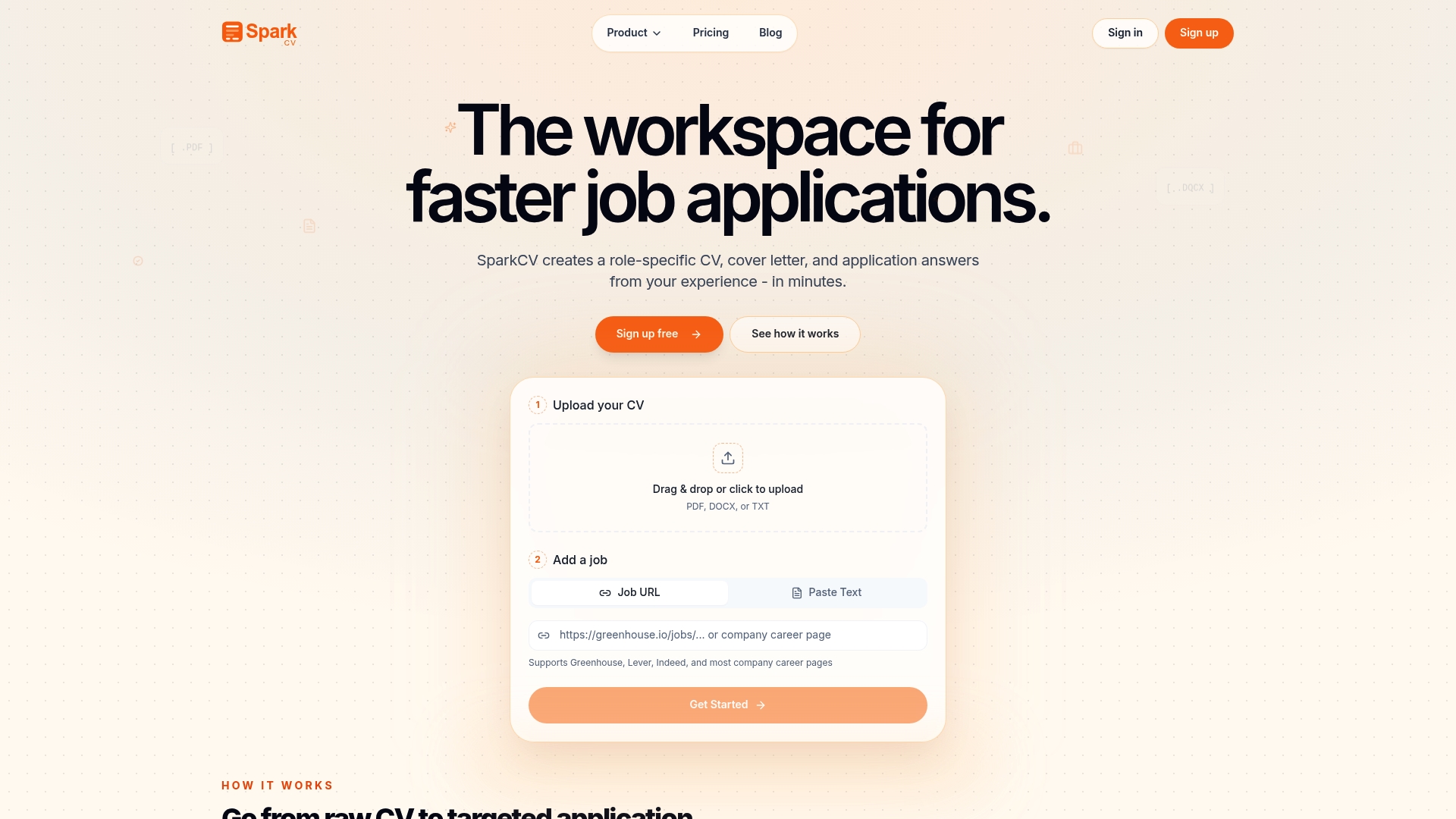
SparkCV analyses your existing CV alongside any job description and generates a tailored version in minutes. It identifies keyword gaps, suggests targeted wording, and formats everything to be ATS-friendly, so you are not starting from scratch every time. Whether you are applying to one role or twenty, SparkCV helps you optimise every application without the manual effort. Try it free at SparkCV and see how quickly a targeted CV comes together.
FAQ
What is a cv tailoring checklist for applications?
A CV tailoring checklist is a step-by-step guide covering research, keyword matching, section reordering, and proofreading to align your CV with a specific job description before submission.
How long does it take to tailor a CV properly?
Light tailoring takes around 10 minutes for lower-priority roles, while deep tailoring for a top-priority application can take up to 90 minutes.
Which CV sections should I tailor first?
Start with your professional summary, then your skills section, and then the top achievement bullets within each relevant role. These three areas deliver the most impact.
Does tailoring a CV really improve interview chances?
Yes. Focusing your CV on 3 to 5 core areas with role-specific keywords measurably improves both ATS performance and the likelihood of recruiter engagement.
Should I write a new cover letter for each application?
A tailored cover letter that mirrors the language and priorities of the job description complements a tailored CV and strengthens your overall application significantly.
Recommended reads
Keep exploring






Hear more from SparkCV
Leave your email for new articles, onboarding invites, and launch news.
We’ll only use this for SparkCV emails, and you can unsubscribe any time.