
Why your first job application differs from all others

Your first job application differs from every subsequent one because you are solving a different problem. Later applications ask you to prove a track record. Your first asks you to prove potential. That shift changes everything: the format you use, the timing of your submission, the skills you highlight, and the way employers evaluate you. Understanding these differences is the most direct path to a stronger application.
Why the first job application differs in timing and visibility
The job market operates as a timing-based attention system. Recruiters begin reviewing candidates within 24–72 hours of a posting going live. That means your window for maximum visibility is narrow, and first-time job seekers who miss it face a much harder climb.
Applying within 48 hours of a posting increases your response likelihood by 3.1 times. That figure is not just about speed. It reflects the fact that early applicants shape what “qualified” looks like before the recruiter has seen enough CVs to form firm expectations.
The first batch of applicants helps calibrate the recruiter’s benchmark for the role. If you arrive early, you influence that benchmark rather than being measured against it. That is a structural advantage no amount of polish can replicate if you apply late.
Practical steps to act on this:
- Set up job alerts on LinkedIn, Indeed, and sector-specific boards so new postings reach you immediately.
- Prepare a base CV and cover letter template in advance so you can tailor and submit within hours, not days.
- Use a career log tool to track posting dates and submission times so you can identify patterns in your response rate.
- Aim to submit before 9am on a weekday, when recruiters are most likely to begin their review queue.
Pro Tip: Set a daily 15-minute window each morning to check job boards. Treating it as a fixed habit removes the friction that causes delays.
How AI screening changes the rules for first-time applicants
AI screening is not a future concern. 43% of organisations already use AI tools to screen CVs before a human ever sees them. For first-time job seekers, this creates a specific challenge: your CV must pass a machine before it can impress a person.

Standard, ATS-friendly formatting is non-negotiable at this stage. Avoid tables, graphics, text boxes, and unusual fonts. Use clear section headings such as “Work Experience,” “Education,” and “Skills.” These labels are what parsing software looks for. A creative layout that looks impressive in a PDF can render as blank space inside a screening system.
Keyword matching is the second layer. Read each job description carefully and mirror its exact language in your CV where it applies honestly. If the posting asks for “customer-facing communication,” use that phrase rather than a synonym. A CV tailoring checklist helps you work through this systematically for each role.
The combined effect of tailoring and early submission is significant. A tailored application submitted early achieves a 5.75% interview rate, nearly double the rate of generic or late submissions. That gap widens further when you have limited experience, because a generic CV gives the screener nothing to hold onto.
Pro Tip: Paste the job description into a plain text document and highlight every skill or requirement mentioned more than once. Those repeated terms are your keyword priorities.
Showcasing transferable skills when you lack direct experience
The absence of formal work experience is the defining challenge of a first application. The solution is not to apologise for it. The solution is to reframe what you do have.
Transferable skills such as communication, reliability, time management, and the ability to learn quickly are genuinely valued by employers at entry level. Evidence of these skills does not have to come from paid work. Volunteering, sports teams, school projects, part-time retail, and caring responsibilities all demonstrate real qualities. The key is presenting them with structure.
Experienced applicants typically use the STAR method (Situation, Task, Action, Result) because they have clear professional achievements to draw on. First-time job seekers benefit more from the FRESH framework, which stands for Fact, Reason, Effort, Strength, and Hear-back. FRESH is built for entry-level interviews where energy, reliability, and coachability matter more than a list of past wins.
Here is how to apply FRESH in a written application:
- Fact. State a specific situation you were part of. (“I organised a fundraising event for 80 people at college.”)
- Reason. Explain why you took on that role. (“I volunteered because no one else had experience with logistics.”)
- Effort. Describe what you actually did. (“I coordinated five teams, managed a budget of £400, and handled supplier communications.”)
- Strength. Name the skill it demonstrates. (“This showed I can manage competing priorities under pressure.”)
- Hear-back. Show you are open to feedback and growth. (“I would approach the supplier negotiation differently now and would welcome guidance on that.”)
This structure works in cover letters and application form answers, not just interviews. It gives employers a concrete picture of who you are without requiring a CV full of job titles.
Pro Tip: Soft skills like reliability and communication are often the deciding factor at entry level. List them with evidence, not as bare adjectives.
Practical differences between first and later job searches
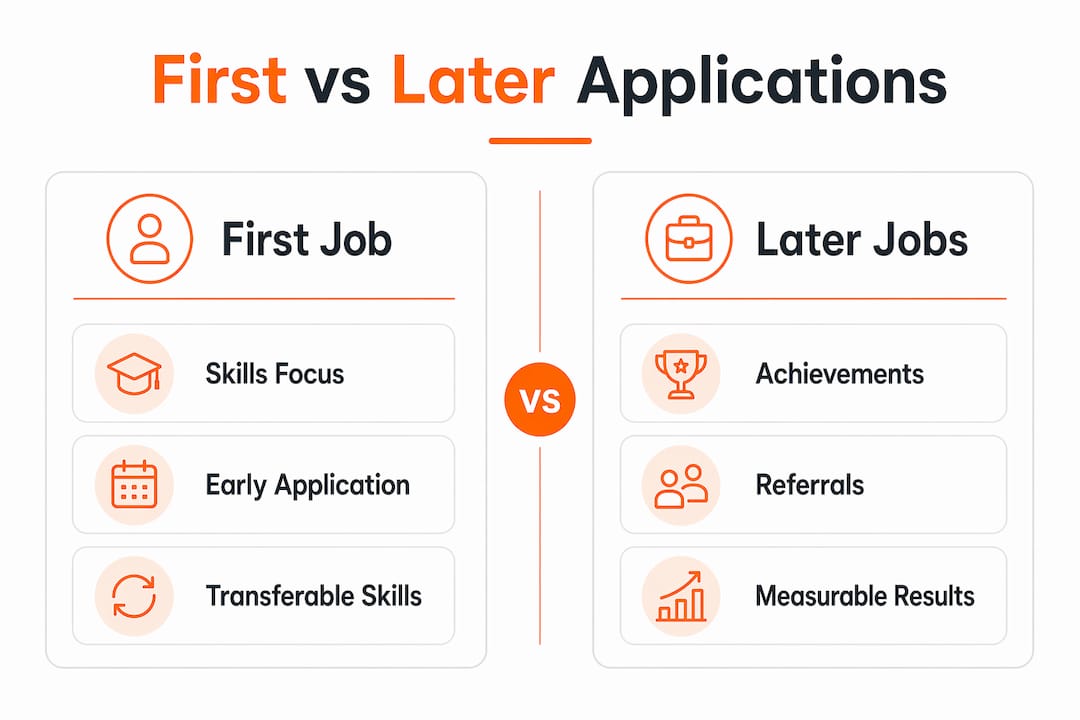
Later job searches rely heavily on measurable achievements: revenue generated, teams managed, projects delivered on time. First searches cannot do that. The tactics that work at the start of a career are genuinely different, not just a weaker version of the same approach.
Personal introductions carry more weight in a first search than most job seekers realise. Walking into a local business and introducing yourself directly can move your application to the top of the pile, particularly at independent retailers, cafés, or small professional services firms. Confidence and initiative are visible in person in a way a CV cannot replicate.
Referrals convert at a 30% success rate compared to 7% for cold applications. That gap is even more pronounced when you have no track record, because a referral substitutes for the credibility your CV cannot yet provide. Tell everyone in your network that you are looking, including teachers, coaches, neighbours, and family contacts.
The table below shows how first and later applications differ across key dimensions:
| Dimension | First job search | Later job search |
|---|---|---|
| CV content | Skills, education, activities | Measurable achievements |
| Screening priority | ATS keyword matching | Recruiter pattern recognition |
| Networking approach | Personal introductions, warm contacts | LinkedIn, sector events |
| Employer expectation | Coachability, energy, reliability | Proven output and leadership |
| Application volume | Targeted but broader | Highly targeted, fewer roles |
The shift from first to later searches is not just about adding experience to your CV. It is about moving from demonstrating potential to demonstrating proof.
Key takeaways
Your first job application succeeds when you combine early submission, ATS-friendly formatting, keyword tailoring, and a clear demonstration of transferable skills.
| Point | Details |
|---|---|
| Apply within 48 hours | Early applicants are 3.1 times more likely to receive a response than late ones. |
| Use standard CV formatting | ATS systems reject non-standard layouts before a recruiter ever sees your application. |
| Mirror job description language | Keyword matching improves your chances of passing AI screening at the first stage. |
| Use the FRESH framework | Structure answers around Fact, Reason, Effort, Strength, and Hear-back to show potential. |
| Prioritise referrals and introductions | Referrals convert at 30% versus 7% for cold applications, especially without a track record. |
SparkCV makes your first application count
Getting your first application right requires speed, precision, and the right structure. SparkCV analyses your existing CV and the job description together, then generates a tailored, ATS-friendly CV in minutes. You get keyword matching built in, so your application reflects the exact language recruiters and screening systems are looking for.
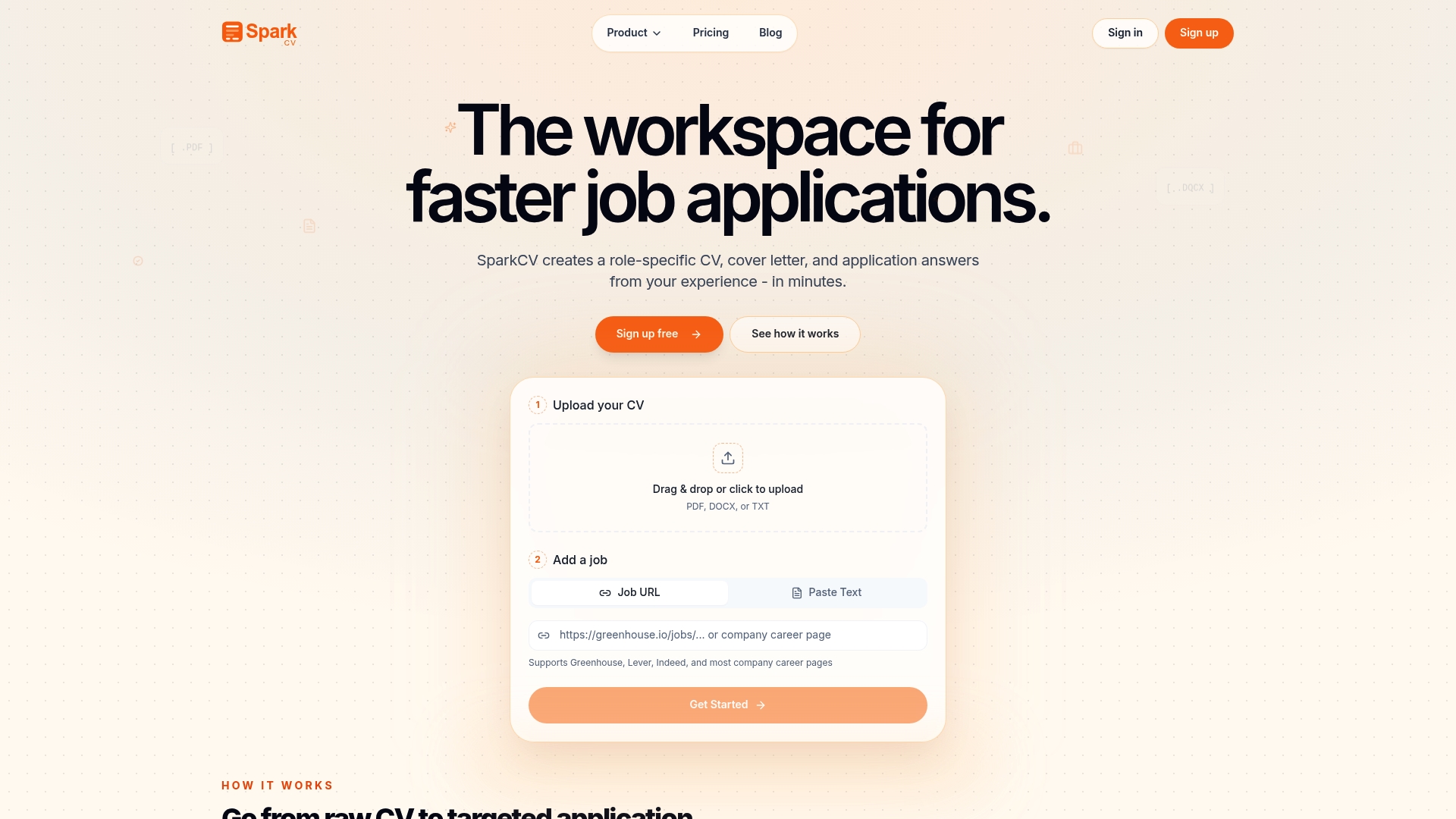
SparkCV also generates cover letters and tailored answers to application questions, so every part of your submission is aligned with the role. For first-time job seekers who need to move fast and make every application count, that combination of speed and accuracy is exactly what the process demands. Get started with SparkCV and submit your next application with confidence.
FAQ
Why does my first job application need a different approach?
Your first application must prove potential rather than a track record. Employers at entry level assess coachability, energy, and reliability rather than past achievements.
How soon should I apply after a job is posted?
Apply within 48 hours. Candidates who do so are 3.1 times more likely to receive a response, and early applicants help shape the recruiter’s expectations for the role.
What is the FRESH framework for first-time job seekers?
FRESH stands for Fact, Reason, Effort, Strength, and Hear-back. It is designed for entry-level applicants who lack formal work experience but can demonstrate relevant qualities through other activities.
How do I pass AI screening with no work experience?
Use a clean, standard CV format with clear section headings and mirror the exact keywords from the job description. ATS-friendly formatting is the first filter your application must pass before a human reviews it.
Does networking really help for a first job?
Referrals convert at 30% compared to 7% for cold applications. Telling your personal network you are looking, and introducing yourself in person at local businesses, can compensate significantly for limited experience.
Recommended reads
Keep exploring





Hear more from SparkCV
Leave your email for new articles, onboarding invites, and launch news.
We’ll only use this for SparkCV emails, and you can unsubscribe any time.