
What is a cover letter purpose? Your 2026 guide

A cover letter is a personalised document that explains why you are the right fit for a role and why you want it, going beyond the facts listed in your CV. Where your CV records what you have done, a cover letter explains why it matters to this specific employer. Despite the rise of AI-generated applications, cover letters remain a critical signal of genuine interest and communication ability. A study of one million job applications found that including a cover letter increases response rates, with up to a 3.4x improvement in some sectors. That figure tells you one thing clearly: a well-written cover letter is not optional effort.
What is a cover letter purpose in a job application?
A cover letter’s purpose is to connect your experience to the employer’s needs in a way that a CV cannot. Your CV lists job titles, responsibilities, and dates. It cannot explain why you are leaving your current role, why you are passionate about this particular company, or how a career change actually makes you a stronger candidate. The cover letter fills every one of those gaps.

HR professionals consistently describe cover letters as bridging the “what” and the “why” of an application. The “what” is your CV. The “why” is your motivation, your cultural fit, and your understanding of the employer’s problems. Without the “why,” a hiring manager is left to guess, and guessing rarely works in your favour.
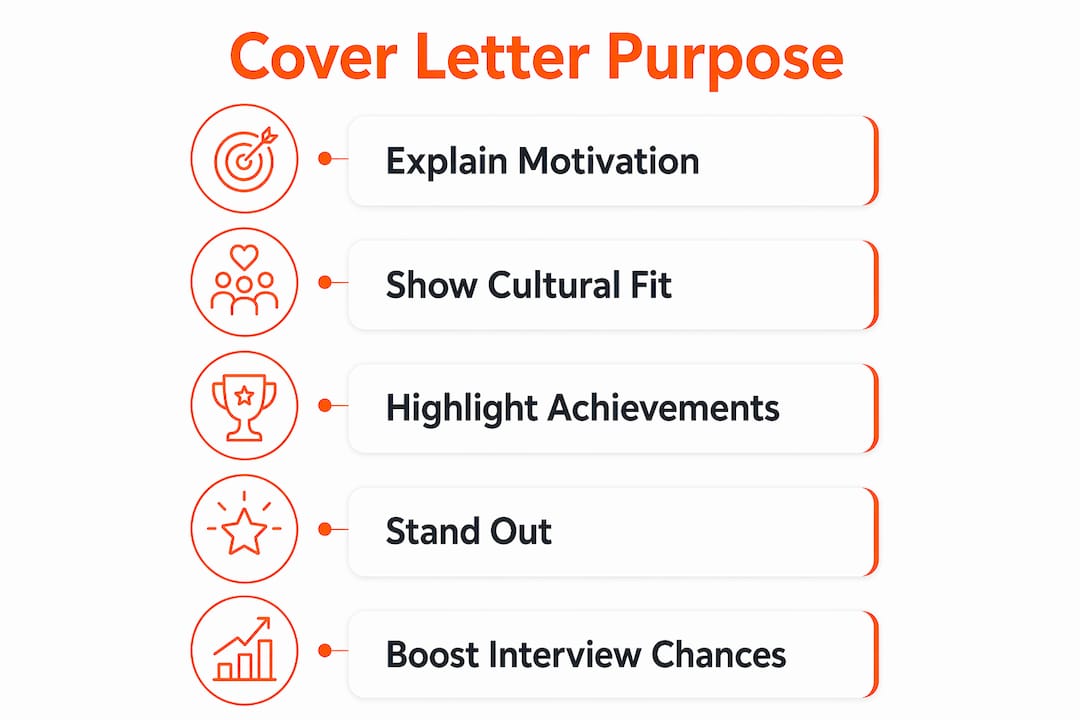
The cover letter also serves four distinct functions:
- Signal genuine interest in the specific role and organisation, not just any job
- Connect your experience directly to the employer’s stated problems or goals
- Address questions your CV raises, such as employment gaps or an unusual career path
- Showcase your writing skills as a professional communication sample
Each of these functions matters independently. Together, they give a hiring manager a complete picture of you as a candidate.
What advantages does a cover letter bring to your application in 2026?
The importance of cover letters has not diminished in 2026. It has sharpened. Here is why.
- Higher response rates. A study of one million applications confirmed that including a cover letter increases response rates by 1.6 percentage points overall, rising to 3.4x for executive roles. In a competitive market, that difference is significant.
- Proof of serious candidacy. Hiring managers now receive thousands of AI-generated CVs that look identical. A personalised cover letter signals that you have invested real effort, which immediately separates you from mass applicants.
- Demonstration of communication skills. Cover letters are evaluated as writing samples, giving hiring managers direct evidence of your ability to organise ideas and write clearly under professional constraints.
- Cultural alignment. For mission-driven organisations, charities, and government bodies, a cover letter that explicitly connects your values to theirs increases interview rates measurably.
“In the era of generative AI, a thoughtful, personalised cover letter is one of the clearest signals that a candidate is genuinely invested in the role.” Knowledge at Wharton, University of Pennsylvania.
The cover letter significance in 2026 is therefore not about tradition. It is about standing out in a market where automation has made most applications look the same. Your cover letter is one of the few places where your voice, judgement, and personality come through directly.
Pro Tip: If you are applying to a role where the job posting explicitly requests a cover letter, treat it as a test of your attention to detail. Ignoring the request is an immediate disqualifier for many hiring managers.
When is a cover letter essential versus optional?
Context determines whether a cover letter will be read at all. Matching your effort to the situation is one of the most practical cover letter objectives you can set.
| Situation | Cover letter needed? |
|---|---|
| Executive or senior leadership roles | Yes, always |
| Mission-driven, nonprofit, or government roles | Yes, always |
| Career change or non-linear career path | Yes, strongly recommended |
| Direct application to a company (not via a platform) | Yes, recommended |
| Job posting explicitly requests one | Yes, mandatory |
| LinkedIn Easy Apply or similar one-click tools | No, rarely read |
| Staffing agency submissions | No, agency handles screening |
| High-volume entry-level roles with automated filters | No, low impact |
The cover letter effort should match the application method. When automated filters process your application before any human sees it, a cover letter adds little. When a hiring manager reads your application directly, it can be the deciding factor.
A common misconception is that every application needs a cover letter. It does not. The real skill is knowing when to invest the time. For career changers in particular, a cover letter is not just useful. It is the only place to explain why your background, which may look unrelated on paper, is actually an asset. You can read more about this in SparkCV’s guide on writing a cover letter for career transition.
Pro Tip: When a job posting says “cover letter optional,” send one anyway for roles you genuinely want. Most candidates skip it, which means yours will be read.
How to write an effective cover letter that gets interviews
An effective cover letter follows a clear structure. The four-part framework used by successful candidates in 2026 is:
- Hook. Open with a specific statement about your enthusiasm for this role at this company. Name the company. Reference something real about their work, product, or mission.
- Proof. Cite one or two achievements that are directly relevant to the job description. Use numbers where possible. “Managed a team of eight” is weaker than “Led a team of eight to deliver a product launch three weeks ahead of schedule.”
- Connection. Explain explicitly how your experience addresses the employer’s stated needs. Mirror the language from the job posting to show alignment.
- Close. End with a clear call to action. State that you would welcome the opportunity to discuss your application and confirm your availability.
Beyond structure, tailoring is the single most important factor in cover letter effectiveness. A generic letter that could apply to any company is immediately recognisable and rarely progresses. Use the CV tailoring checklist to align both your CV and cover letter to each specific role before you apply.
Common mistakes to avoid:
- Repeating your CV word for word instead of adding context
- Opening with “I am writing to apply for…” which wastes your first sentence
- Writing more than one page
- Failing to address the hiring manager by name when it is findable
Your cover letter is also a professional writing sample. Hiring managers assess sentence clarity, structure, and tone alongside the content itself. A polished letter with no grammatical errors signals professionalism before the interview even begins.
Key takeaways
A cover letter’s primary purpose is to explain the motivation and fit behind your CV, and it remains one of the most effective tools for increasing your interview rate in 2026.
| Point | Details |
|---|---|
| Core purpose | A cover letter explains your motivation and cultural fit, which a CV cannot convey alone. |
| Impact on response rates | Including a cover letter can increase response rates by up to 3.4x for executive and senior roles. |
| When to include one | Prioritise cover letters for executive, mission-driven, career change, and direct applications. |
| Structure that works | Use a four-part format: hook, proof, connection to role, and a clear closing call to action. |
| AI era relevance | Personalised cover letters distinguish serious candidates from mass AI-generated applications. |
Write better cover letters faster with SparkCV
SparkCV analyses your existing CV and the job description together, then generates a tailored cover letter aligned to the role’s specific requirements in minutes. You get keyword matching, ATS-friendly formatting, and a letter that reflects your actual experience rather than a generic template.
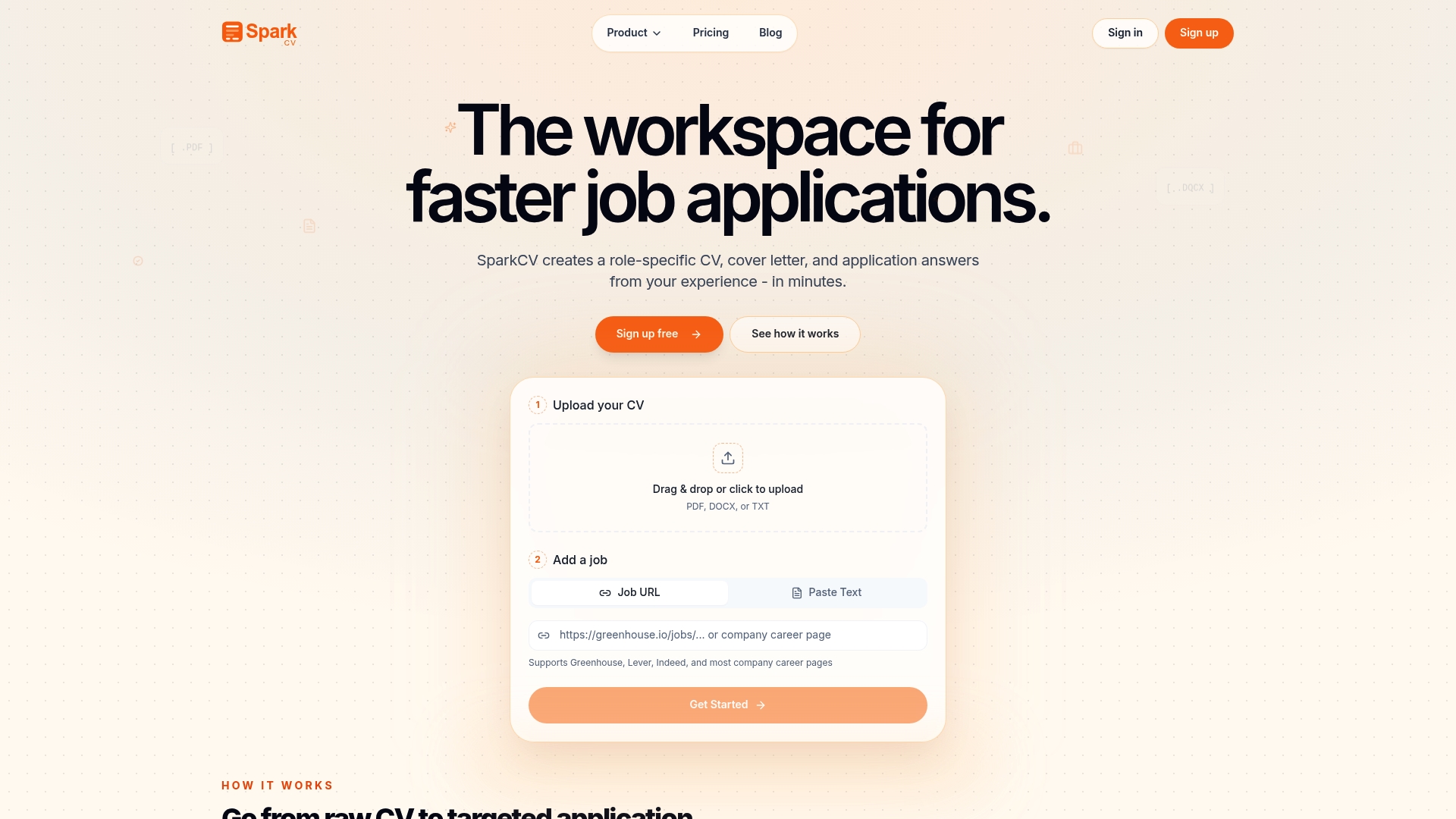
If you are applying to roles where cover letter significance is high, such as executive positions, career changes, or mission-driven organisations, SparkCV gives you the precision and speed to apply with confidence. The platform also handles tailored application questions so every part of your submission is consistent and targeted. Start building stronger applications today at SparkCV.
FAQ
What is the main purpose of a cover letter?
A cover letter’s purpose is to explain your motivation for applying and connect your experience directly to the employer’s needs, going beyond the factual record in your CV.
Does a cover letter actually improve your chances of getting an interview?
Yes. A study of one million applications found that cover letters increase response rates by up to 3.4x for executive roles, making them one of the most effective tools available to job seekers.
What should a cover letter include?
A strong cover letter includes a specific opening hook, one or two relevant achievements with evidence, a clear connection to the role, and a closing call to action inviting further discussion.
When is it acceptable to skip a cover letter?
Skip the cover letter for LinkedIn Easy Apply submissions, staffing agency applications, and high-volume entry-level roles where automated filters process applications before any human review.
How long should a cover letter be?
A cover letter should fit on one page, typically three to four short paragraphs. Hiring managers rarely read beyond the first page, so concise and targeted writing is more effective than length.
Recommended reads
Keep exploring






Hear more from SparkCV
Leave your email for new articles, onboarding invites, and launch news.
We’ll only use this for SparkCV emails, and you can unsubscribe any time.