
Why cover letter tone matters for graduates

Cover letter tone is defined as the overall voice, register, and emotional quality that shapes how an employer perceives you on the page. For graduates, getting this right is not optional. 83% of hiring managers read cover letters, and 94% say they influence interview decisions directly. That means your tone is doing real work before you ever set foot in a room. In a market where many candidates share similar academic backgrounds, tone becomes one of the clearest ways to differentiate yourself.
Why cover letter tone matters for graduates in 2026
Tone communicates far more than the words themselves. 8 out of 10 recruiters use cover letters to assess soft skills like enthusiasm and communication, qualities that a CV simply cannot capture. This matters enormously for graduates, who often lack the work history to demonstrate these traits through experience alone.
Recruiters spend around 30 seconds on a first read. A tone that feels flat, overly formal, or robotic will lose their attention before you reach your second paragraph. The impact of tone in job applications is measurable: well-crafted cover letters can increase callback rates from 10.7% to 16.4%. That is a significant uplift driven not by additional qualifications, but by how you communicate.
Graduates frequently make two opposite mistakes. Some adopt a stiff, corporate register that reads as impersonal and generic. Others swing too casual, using informal phrasing that signals a lack of professionalism. Both approaches fail to build the connection that hiring managers are looking for.
“A cover letter that sounds like an intelligent human outperforms robotic or overly formal styles, increasing interview chances significantly.” — CraftMyLetter, 2026
The soft skills revealed by tone include enthusiasm, cultural awareness, and the ability to communicate clearly under pressure. These are exactly the qualities employers want from a graduate hire.
What are the main cover letter tone styles?
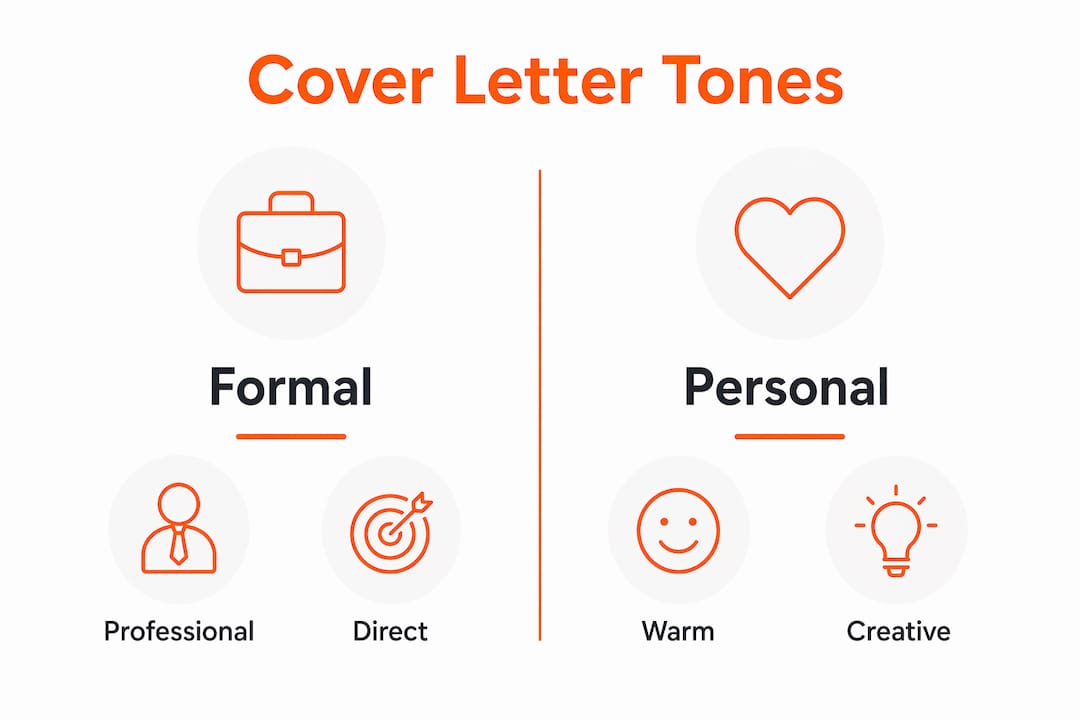
The four main tones for cover letters are professional, warm, direct, and creative. Each suits a different context, and choosing the wrong one is a common and avoidable error.

| Tone style | Best suited to | What to avoid |
|---|---|---|
| Professional | Law, finance, accountancy, public sector | Stiff or impersonal phrasing |
| Warm | Hospitality, education, healthcare, charity | Overly familiar or sentimental language |
| Direct | Technology, consulting, sales | Bluntness without context or personality |
| Creative | Marketing, design, media, advertising | Gimmicks that distract from your substance |
Tone-matching must align with company culture. Conservative sectors prefer formal structure, while startups favour direct and conversational registers. A creative agency that posts playful content on LinkedIn will not respond well to a letter that reads like a legal brief.
Researching the right tone takes less time than most graduates assume. Read the company’s website copy, scan their recent job adverts, and look at how senior staff write on LinkedIn. These sources reveal the register the organisation uses internally and externally. Calibrating tone involves adapting phrasing, length, and formality based on these signals, not simply swapping out vocabulary.
Pro Tip: If a company’s job advert uses contractions and first-person language, mirror that register in your letter. If it reads formally and uses full titles, match that level of structure.
Tone mismatch is easy to spot and hard to recover from. A letter that feels out of step with a company’s culture signals poor research and weak communication awareness. Both are red flags for any hiring manager.
How can graduates adapt their tone authentically?
Authenticity is the word that separates a good tone from a great one. You can research a company’s register perfectly and still produce a letter that feels hollow if you force a voice that is not yours. The goal is to find the overlap between your natural communication style and the employer’s expected register.
Follow these steps to calibrate your tone without losing your voice:
- Read three to five pieces of company content before you write a single word. Note whether the language is formal or relaxed, whether they use “we” frequently, and how they describe their team culture.
- Draft your opening paragraph twice. Write one version in your natural voice and one that mirrors the company’s register. Then combine the best elements of both.
- Replace defensive language immediately. Phrases like “Although I have no experience” signal low confidence. Forward-focused language transforms an apologetic tone into confident engagement. Write “My dissertation research in data analysis has prepared me to contribute directly to your analytics team” instead.
- Use specific examples, not generalisations. “I am a strong communicator” says nothing. “I presented my final-year research to a panel of 12 industry professionals” says everything.
- Read your letter aloud before submitting. If you stumble over a sentence, a recruiter will too. Smooth, natural phrasing reads as confident and considered.
Defensive language in graduate cover letters signals insecurity. Successful applicants reframe academic and volunteer experience as proactive preparation, not as a substitute for “real” work. Your placement year, society leadership, or freelance project is not a consolation prize. Present it as deliberate, relevant experience.
Pro Tip: Use SparkCV to generate your initial cover letter structure based on the job description, then rewrite the opening and closing paragraphs in your own voice. The structure handles the logic; your tone handles the connection.
AI tools can draft a structure but require substantial human editing to inject authentic tone and specific detail. Treat any AI-generated draft as a scaffold, not a finished product. The tailoring checklist for 2026 applications is a useful reference for ensuring your language aligns with the role before you submit.
What does good and bad tone look like in practice?
Concrete examples make the difference between understanding tone in theory and applying it correctly. Consider these two versions of the same opening sentence:
Robotic version: “I am writing to apply for the position of Marketing Assistant as advertised on your website. I believe I meet the requirements outlined in the job description.”
Human version: “Your recent campaign for the Tate Modern stopped me mid-scroll. That kind of audience-first thinking is exactly what drew me to apply for your Marketing Assistant role.”
The second version demonstrates research, personality, and genuine interest. It does not sacrifice professionalism. It simply sounds like a person wrote it.
Common pitfalls to watch for in your own drafts:
- Apologetic openings: Starting with what you lack rather than what you bring.
- Excessive formality: Using “I would like to humbly submit my application” when “I am applying for” works perfectly well.
- Hollow enthusiasm: Phrases like “I am passionate about this opportunity” without any evidence to support the claim.
- Abrupt closings: Ending with “I look forward to hearing from you” alone, rather than restating your value and inviting a specific next step.
Showing personality in cover letters means revealing your voice, motivation, and work style while remaining professional. A closing paragraph that restates one specific reason you are excited about the role, and one concrete thing you would bring to it, leaves a far stronger impression than a generic sign-off.
Key takeaways
Tone is the single most controllable variable in your cover letter, and graduates who calibrate it correctly see measurably higher callback rates.
| Point | Details |
|---|---|
| Tone shapes first impressions | Recruiters spend around 30 seconds on a first read; the right tone grabs attention immediately. |
| Match tone to company culture | Research job adverts, website copy, and LinkedIn posts to identify the expected register before writing. |
| Avoid defensive language | Replace “I have no experience” with forward-focused phrasing that frames your background as preparation. |
| Use four tone styles strategically | Professional, warm, direct, and creative each suit different sectors; choosing correctly signals cultural awareness. |
| AI drafts need human editing | Use AI tools to build structure, then rewrite key sections in your own voice to add authenticity. |
Get your cover letter tone right with SparkCV
SparkCV is built for graduates who want to move quickly without sacrificing quality. The platform analyses your existing CV and the job description, then generates a tailored cover letter structure aligned with the role’s requirements.
From there, you personalise the tone using the strategies in this article. SparkCV handles the keyword matching and ATS-friendly formatting, so you can focus on making your letter sound like you. Whether you are applying to a City law firm or a creative agency, the right starting point makes a real difference. Start building your cover letter with SparkCV today and spend your editing time on tone, not structure.
FAQ
How does tone affect a graduate’s cover letter?
Tone signals soft skills like enthusiasm, communication ability, and cultural fit, qualities that 94% of hiring managers say influence their interview decisions. A well-calibrated tone can increase your callback rate significantly even when your experience is limited.
What is the best tone for a graduate cover letter?
The best tone depends on the industry. Professional suits law and finance, warm suits healthcare and education, direct suits technology and consulting, and creative suits marketing and design. Research the company’s own communications to confirm which register fits.
Should graduates use AI to write their cover letters?
AI tools are useful for building a structured draft quickly, but require substantial editing to add authentic tone and specific personal detail. Use AI as a starting point, then rewrite key sections in your own voice.
What language should graduates avoid in cover letters?
Avoid defensive phrases like “Although I have no experience” and hollow claims like “I am passionate about this role” without evidence. Forward-focused language that frames your background as deliberate preparation is far more persuasive.
How long should a graduate cover letter be?
One page is the standard. Three to four focused paragraphs that open with genuine interest, demonstrate relevant skills, and close with a specific next step will outperform a longer letter that dilutes its own impact.
Recommended reads
Keep exploring






Hear more from SparkCV
Leave your email for new articles, onboarding invites, and launch news.
We’ll only use this for SparkCV emails, and you can unsubscribe any time.