
Why tailored cover letters work: your 2026 guide
Most job seekers treat cover letters as a formality. They copy a template, swap in the company name, and send it off. The problem is that hiring managers notice. Understanding why tailored cover letters work is not just useful theory. It directly affects whether you get called for an interview or not. 81% of hiring managers read cover letters even when not required, and 49% say a strong one can secure an interview. That number should change how seriously you approach every application.
Table of Contents
Key takeaways
| Point | Details |
|---|---|
| Tailoring goes beyond templates | Genuine tailoring requires research into the job, company, and hiring manager priorities. |
| Data proves the difference | Personalised cover letters produce a 3.4× increase in interview chances versus generic ones. |
| Authenticity is detectable | Hiring managers quickly spot generic or AI-generated letters, which reduces your chances significantly. |
| Modular writing saves time | Building reusable sections lets you personalise quickly without starting from scratch each time. |
| Cover letters add unique context | A tailored letter explains your motivation and fit in ways a CV alone cannot. |
Why tailored cover letters work differently
There is a widespread belief that cover letters are either ignored or that any letter will do. Neither is true. The importance of tailored cover letters lies in a simple fact: hiring managers are not looking for more information about you. They are looking for evidence that you understand them.
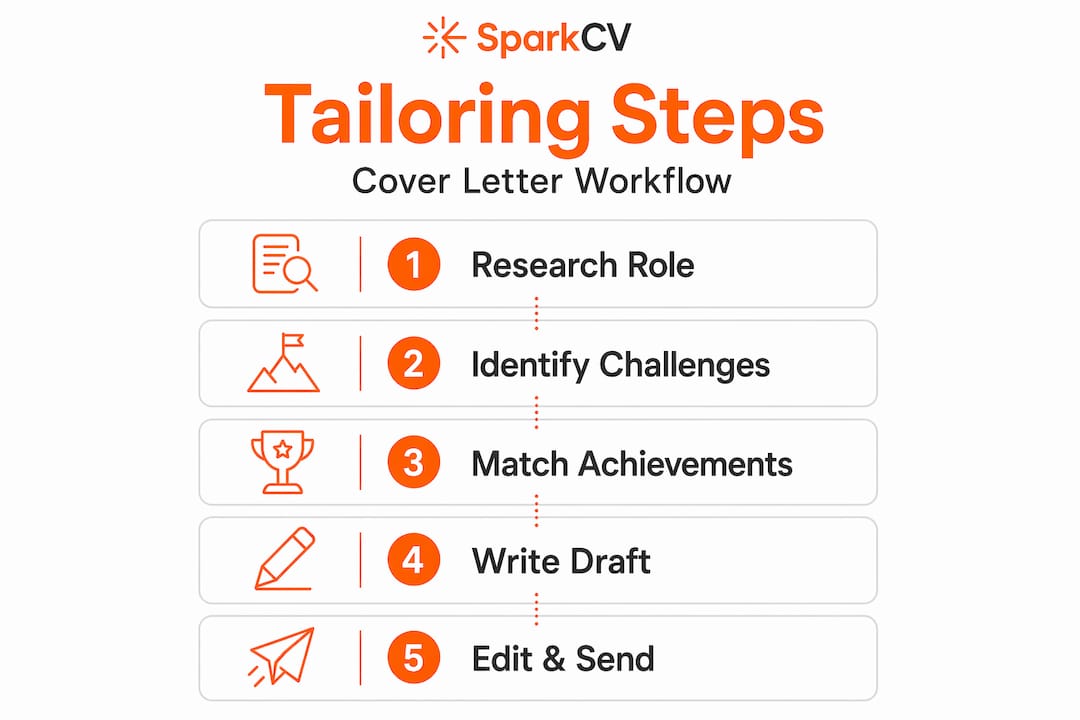
Genuine tailoring involves three distinct layers of research. First, you analyse the job description for specific skills, language, and priorities. Second, you study the company context: its current challenges, recent news, and strategic direction. Third, you consider the hiring manager’s perspective and what success in this role actually looks like to them. Most candidates skip all three.
A generic cover letter says: “I am a results-driven professional with five years of experience.” A tailored one says: “I noticed your team is expanding into European markets. My three years managing cross-border partnerships at [Company] put me in a strong position to help you move fast there.” One of these gets read. The other gets filed.
-
Research the role deeply. Go beyond the job title. Read the full description and highlight repeated phrases, since these signal what the hiring manager actually prioritises.
-
Study the company’s recent activity. Check press releases, LinkedIn posts, and news coverage to find real problems you can reference.
-
Connect your specific achievements to their specific needs. Not your career in general. This role, this company, this moment.
-
Address the hiring manager’s implicit question. That question is always: “Why should I take a chance on this person?”
Pro Tip: Before writing a single word, spend ten minutes listing three challenges the company is likely facing right now. Then check how your experience directly addresses at least one of them. This one step separates a memorable letter from a forgettable one.
The data on tailored applications
The numbers make a clear case. Candidates who send personalised cover letters see a 53% higher callback rate than those who send no letter at all, and a 31% higher rate than those who send generic ones. These are not marginal gains.
| Application type | Callback/hiring advantage |
|---|---|
| No cover letter | Baseline |
| Generic cover letter | +31% over no letter |
| Tailored cover letter | +53% over no letter, 35.8% hiring rate |
The hiring rate gap is equally striking. Applicants with tailored cover letters achieve a 35.8% hiring rate compared to 21.2% for those who never write one. That is a gap of more than fourteen percentage points, which is substantial in a competitive market.
Recruiter behaviour backs this up too. Cover letters are read only when they demonstrate a clear understanding of the company and position. When they do, candidates rank in the top 10% of applicants. That is not a coincidence. It reflects how a well-crafted, specific letter signals genuine interest and professional maturity.
“A tailored cover letter opens with the company’s problem and how the candidate can solve it, not with a generic career summary.” — The Interview Guys
The evidence on custom cover letter benefits is not ambiguous. The gap between a tailored and a generic application is measurable, consistent, and large enough to change the outcome of your job search.
Common pitfalls and how to avoid them
The biggest mistake candidates make when trying to personalise their cover letters is surface-level editing. Swapping the company name and changing one sentence is not tailoring. Hiring managers have seen thousands of letters, and 53% can identify AI-generated or generic content immediately. When they do, your application typically ends there.
Here is how to build cover letters that are both personal and efficient:
-
Build a modular letter structure. Create three or four strong opening paragraphs covering different themes, such as growth, technical expertise, or leadership. Then select and adjust the most relevant one for each application. Modular cover letter components let you move quickly without losing quality.
-
Open with their problem, not your history. Reference a specific challenge the company is facing or an initiative they have announced. This immediately signals that you did your research.
-
Use their language. Pull exact phrases from the job description where they apply naturally to your experience. This serves both keyword matching for ATS systems and human readability.
-
Write one strong evidence paragraph. Choose a single achievement that maps directly to the role’s key requirement. Quantify it. Explain the context. This is not the place to summarise your entire career.
-
Close with clear intent. State specifically why this role is the right next step for you, not just why you are qualified. Motivation matters to hiring managers.
Pro Tip: Read your finished cover letter aloud before sending it. If a sentence feels awkward to say, it will read awkwardly too. This simple check catches both tone problems and sentences that sound pasted-in rather than written with purpose.
Aligning your achievements with the role
One of the most common cover letter mistakes is repeating your CV. Your letter should not be a prose version of your bullet points. Tailored letters serve a different purpose entirely. They explain why this role and this company are the logical next step for you, providing context and motivation that a CV cannot convey on its own.
The way to do this well is to treat the job description as a brief and your achievements as evidence. Find the match, then tell the story behind it.
| Generic content strategy | Tailored content strategy |
|---|---|
| Lists all past responsibilities | Highlights one achievement directly relevant to the role |
| Repeats CV in paragraph form | Adds context, motivation, and narrative behind the experience |
| Uses standard career language | Mirrors the company’s own language and stated priorities |
| Focuses on what the candidate has done | Focuses on what the candidate can do for this specific employer |
| Generic closing statement | Explains why this role is the right next step in their career |
Credibility matters here too. If you reference a company challenge, make sure your experience genuinely addresses it. Overstating fit is detectable in interviews. Authentic engagement, where you are honest about your strengths and clear about why they are relevant, builds more trust than polished exaggeration. Understanding how to present your soft skills within this context can also add genuine depth to your application narrative.
Get tailored cover letters done faster with SparkCV
SparkCV is built specifically for job seekers who understand the importance of tailored cover letters but struggle to produce them quickly at scale.
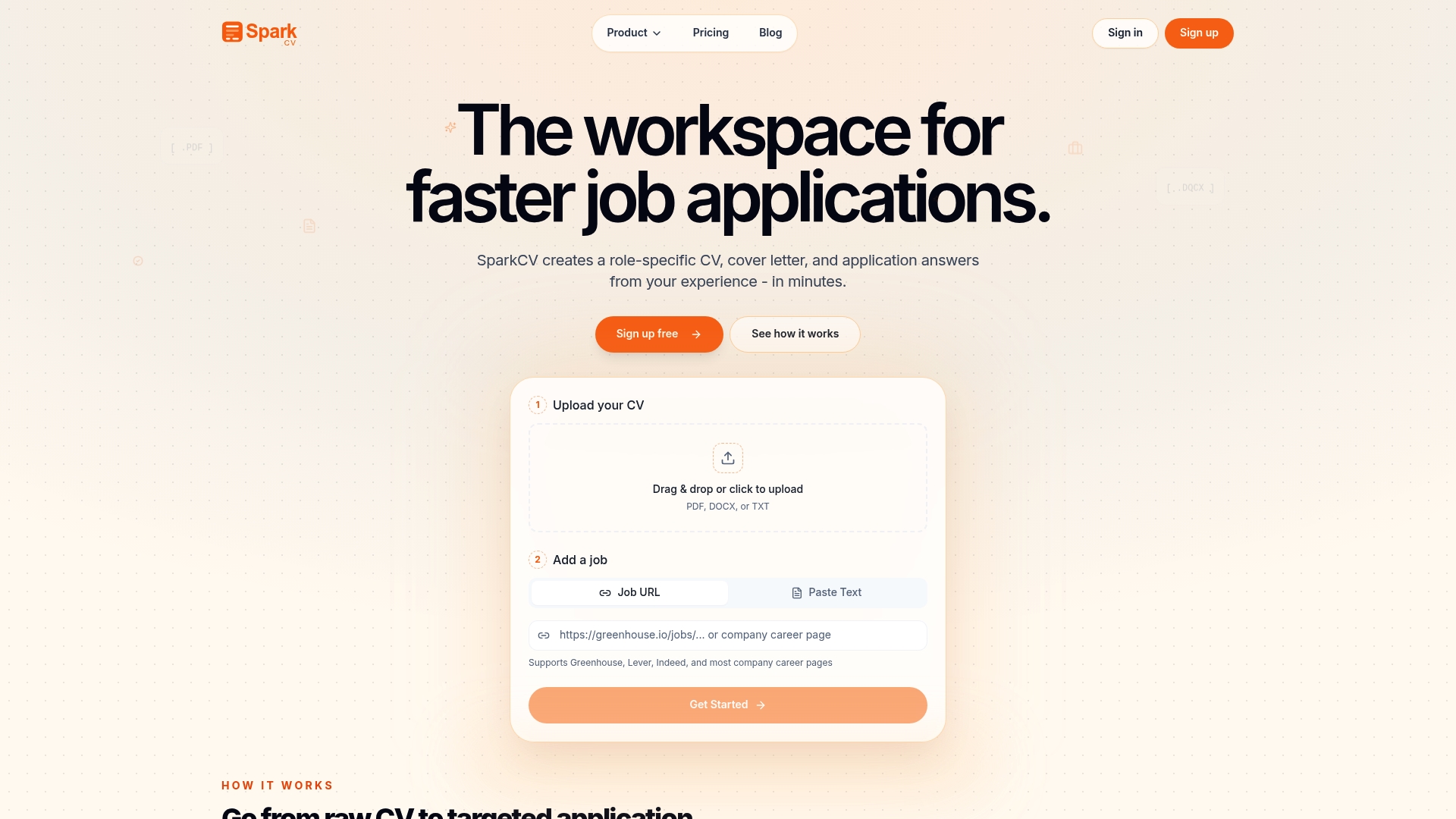
SparkCV analyses your existing CV alongside the job description and generates a cover letter aligned with the role’s specific requirements. It handles keyword matching, tone calibration, and structural alignment, so you can focus on adding the personal detail that makes the difference. The result is an ATS-friendly, personalised letter in minutes rather than hours. If you are applying to multiple roles and want every application to reflect genuine effort, try SparkCV and see the difference a properly tailored application makes.
FAQ
Why do tailored cover letters increase interview rates?
Tailored cover letters directly address employer needs and demonstrate genuine research, which is why they produce a 3.4× higher interview rate than generic alternatives. Hiring managers respond to relevance, not volume.
How long does it take to tailor a cover letter properly?
With a modular approach, where you build reusable sections and adapt them per application, a well-tailored cover letter typically takes 20 to 30 minutes. The research phase is the most time-consuming part.
Do hiring managers actually read cover letters?
Yes. 81% of hiring managers read cover letters even when they are not required. A strong, tailored letter can secure an interview independently of the CV.
What makes a cover letter generic rather than tailored?
Generic letters repeat CV content, use standard career language, and contain no specific reference to the company or role. Tailored letters address a specific company challenge, use the employer’s language, and explain why this particular role is the right next step for the candidate.
Can AI tools help with cover letter tailoring?
AI tools are useful for drafting, structuring, and keyword alignment. However, hiring managers can detect purely AI-generated letters. The strongest results come from using AI for efficiency and then adding genuine, personal detail on top.
Recommended reads
Keep exploring






Hear more from SparkCV
Leave your email for new articles, onboarding invites, and launch news.
We’ll only use this for SparkCV emails, and you can unsubscribe any time.