
The role of project-based experience on your CV

Most job seekers assume that paid work experience is the only thing recruiters care about. That assumption costs them interviews. The role of project-based experience on a CV is far more significant than most graduates realise, particularly in a hiring market that increasingly rewards what you can do over where you studied. Whether you built an app, led a university research group, or managed a volunteer campaign, those projects carry real weight. This article shows you exactly why they matter and how to present them in a way that gets results.
Table of Contents
Key takeaways
| Point | Details |
|---|---|
| Projects prove applied skills | Employers want evidence of real problem-solving, not just academic credentials or a list of modules studied. |
| Relevance beats quantity | Two well-chosen, well-described projects outperform a long list of vague or unrelated ones every time. |
| Quantify your impact | Measurable outcomes such as cost savings or efficiency gains make project entries far more persuasive to hiring managers. |
| Soft skills count too | Projects naturally develop communication and leadership skills that employers actively look for on a CV. |
| Tailor to each role | Adjusting your project descriptions to match job requirements significantly improves your chances with ATS screening. |
Why project-based experience matters on your CV
There is a persistent myth that project work is a poor substitute for “real” employment. Career advisers and hiring managers increasingly disagree. Projects are the great equaliser in skills-first hiring, valued for the applied experience they represent rather than the prestige of the institution behind them.
Think about what a project actually requires. You start with a problem, make decisions under constraints, collaborate with others, and deliver something tangible. That process mirrors exactly what employers need you to do on day one. A degree tells a recruiter you can absorb information. A project tells them you can act on it.
The importance of project experience becomes even clearer when you consider how hiring priorities are shifting. Corporate hiring increasingly values operational experience over formal academic credentials, as the so-called “degree premium” flattens across many sectors. Employers in IT, finance, and construction are actively prioritising candidates who can demonstrate planning, delegation, and delivery skills.
Projects also build the full range of skills employers seek:
-
Problem-solving. Projects expose you to real constraints and require you to find workable solutions without a textbook answer.
-
Collaboration. Group projects build skills employers seek and give you credible, specific examples to discuss in interviews.
-
Adaptability. Handling unexpected setbacks during a project demonstrates exactly the kind of resilience hiring managers value.
-
Technical competence. Applied tools and methods learned in project contexts stick in a way that classroom theory rarely does.
“Projects offer practical problem-solving that shows adaptability to unforeseen real-world challenges.” — The value of projects on your resume, Ohio State University
Choosing the right projects to include
Not every project belongs on your CV. The goal is relevance, not volume. Start by mapping the roles you are targeting and identifying the skills those job descriptions mention most frequently. Then look at your project history and ask which ones best demonstrate those skills.
| Project type | CV relevance | Best for |
|---|---|---|
| University dissertation or thesis | High | Research, analytical, and specialist roles |
| Group coursework project | Medium to high | Teamwork, communication, and leadership evidence |
| Freelance or client work | Very high | Demonstrating real-world ownership and delivery |
| Volunteer project | High | Showing initiative, social awareness, and soft skills |
| Personal or self-directed project | Medium to high | Technical roles, entrepreneurial positions |
| Open-source contribution | High | Software development and engineering roles |
Freelance and volunteer work often gets overlooked, but both are entirely legitimate project-based skills for your CV. If you organised a fundraising campaign that raised £3,000, managed a community website, or led a student society through a major event, those are projects. They show initiative and delivery.
When it comes to academic work, framing research experience properly is especially important if you are applying outside academia. Focus on the transferable elements: data handling, collaboration, written communication, and project management. Leave the technical jargon for roles that explicitly require it.
Pro Tip: When reviewing your project history, ask yourself: “What was the problem, what did I do, and what changed as a result?” If you can answer all three, you have a strong project entry.
How to present project experience on your CV
The structure of your project entries matters as much as the content. A well-formatted project section can hold its own against formal employment history if you write it correctly.

Start with a clear section heading. “Projects” or “Relevant experience” both work well. If your projects are closely tied to a specific role type, you can label the section more specifically, such as “Data projects” or “Marketing campaigns.” This helps recruiters scan quickly.
Each project entry should follow a consistent format:
-
Project name and date. Keep it concise. One line is enough.
-
Your role. Be specific. “Team lead” or “sole developer” tells a recruiter more than “contributor.”
-
What you did. Use action verbs: built, analysed, coordinated, delivered, reduced, improved.
-
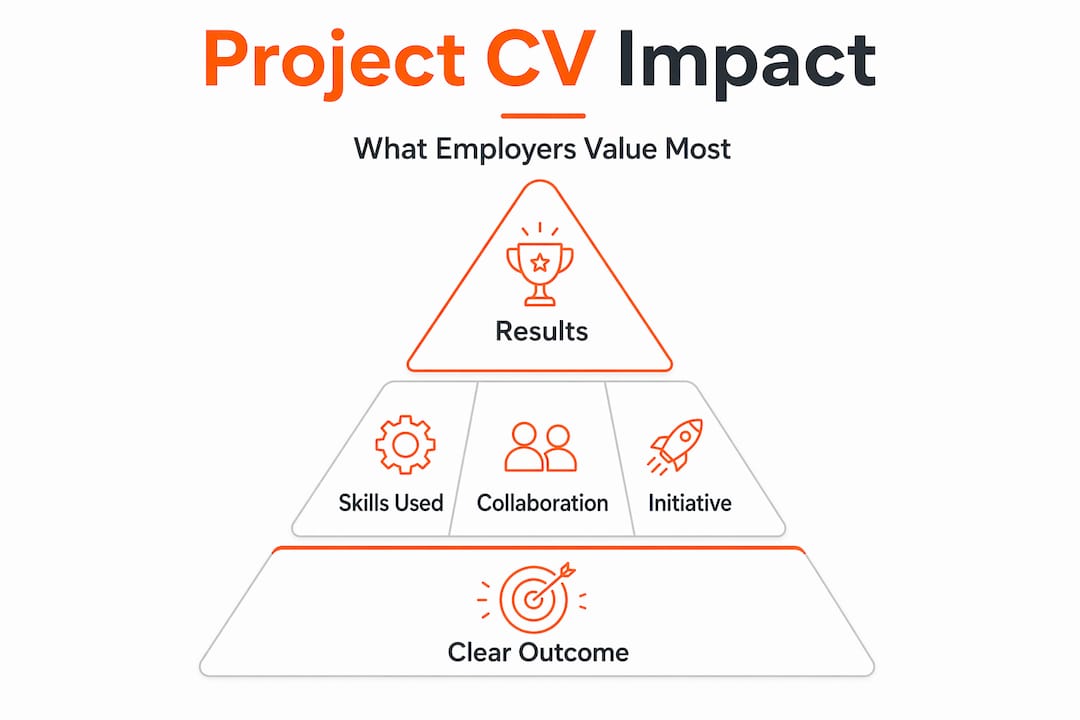
What you achieved. This is where most people fall short. Hiring managers prefer measurable outcomes such as “reduced churn by 15%” over a list of tools used.
Quantifying impact is one of the most effective CV tips for project experience. You do not need dramatic numbers. “Reduced processing time by 20%” or “managed a budget of £500” both add credibility. If you cannot quantify the outcome, describe the scope: team size, timeline, or the scale of the problem you addressed.
For non-technical roles, framing project experience around communication, leadership, and teamwork is more persuasive than listing software tools. A recruiter hiring a marketing coordinator does not need to know you used Trello. They need to know you coordinated a five-person team and delivered a campaign on time.
Pro Tip: Tailor your project descriptions for each application. Swap in keywords from the job description to improve your ATS match rate. SparkCV’s keyword matching feature makes this fast and accurate.
Project experience and professional certifications
One underappreciated benefit of documenting your project work carefully is that it directly supports professional certification applications. This is particularly relevant if you are working towards qualifications in project management, data, or engineering.
The Project Management Institute requires 4,500 hours of leading projects for the PMP certification and 1,500 hours for the CAPM. Those hours must be documented. If you have been managing projects informally, whether in a university setting, a volunteer role, or a side business, those hours count.
| Certification | Experience required | What counts |
|---|---|---|
| PMP | 4,500 hours leading projects | Any sector, paid or unpaid |
| CAPM | 1,500 hours on project teams | Academic and volunteer work included |
| Prince2 Practitioner | Practical application evidence | Work-based or simulated projects |
What counts as project management experience is broader than most people assume. Managing a team of two or three qualifies as valuable experience for certifications and roles. Running a student society, coordinating a departmental event, or leading a small freelance engagement all demonstrate the core competencies: planning, delegation, monitoring progress, and closing out deliverables.
“Active participation in all five PMP process groups, from initiation through to closure, reflects mature project management experience.” — The Knowledge Academy
Including relevant certifications alongside your project entries on your CV signals to employers that your project work is not informal or ad hoc. It shows a structured, professional approach to delivery.
Common mistakes when showcasing project work
Even strong projects can fail to impress if they are presented poorly. These are the errors that most frequently undermine project sections on a CV.
-
Listing tools without context. Writing “used Python, SQL, and Tableau” tells a recruiter nothing about what you actually built or achieved. Always pair tools with outcomes.
-
Including too many minor projects. Three well-described, relevant projects are far more persuasive than ten bullet points of vague activity. Quality and project work relevance in your CV always win over quantity.
-
Failing to connect to the job. A project about social media analytics is relevant for a marketing role but needs to be framed differently for a data analyst position. Make the connection explicit.
-
Using technical language for non-technical audiences. Recruiters outside your specialism will not understand acronyms or niche tools. Write for the person reading the CV, not for a peer in your field.
-
Describing tasks instead of contributions. “Worked on a team that built a website” is weak. “Led the front-end development of a five-page client website, delivered two weeks ahead of schedule” is strong.
One useful check: read your project entry and ask whether it could have been written by anyone on the team. If yes, rewrite it to reflect your specific contribution and the outcome you personally drove. Hiring managers look for proof of ownership and measurable impact, not just a list of tasks.
Make your project experience work harder with SparkCV
If you know your projects are strong but your CV is not reflecting that, the issue is often presentation rather than content. SparkCV analyses your existing CV alongside the job description and identifies exactly where your project descriptions need to be sharpened, reworded, or repositioned to match what the employer is looking for.
You get ATS-friendly formatting, keyword matching, and tailored language suggestions in minutes. Whether you are struggling to rewrite your CV or simply want to make sure your project section lands properly, SparkCV gives you a focused, polished result without the guesswork. Try SparkCV free and see how your project experience reads when it is properly aligned to the role you want.
FAQ
Why does project experience matter on a CV?
Project experience demonstrates applied skills and real-world problem-solving, which many employers value more than academic qualifications alone. It gives recruiters specific, verifiable evidence of what you can deliver.
What types of projects should I include on my CV?
Include projects that are most relevant to the roles you are targeting, such as university dissertations, freelance work, volunteer projects, or personal technical builds. Prioritise those where you can clearly describe your contribution and the outcome.
How do I quantify project experience on my CV?
Use numbers wherever possible: team size, budget managed, percentage improvements, or time saved. If exact figures are not available, describe the scope and scale of the project to give context and credibility.
Can unpaid or volunteer projects count as professional experience?
Yes. Unpaid projects, including volunteer work and self-directed builds, are fully legitimate on a CV. What matters to employers is the skill demonstrated and the result achieved, not whether you were paid.
How many projects should I list on my CV?
Two to four well-described, relevant projects are typically more effective than a longer list of vague entries. Focus on quality, relevance, and clear outcomes rather than trying to fill space.
Recommended reads
Keep exploring






Hear more from SparkCV
Leave your email for new articles, onboarding invites, and launch news.
We’ll only use this for SparkCV emails, and you can unsubscribe any time.