
What is a skills-based CV? A guide for job seekers

A skills-based CV is defined as a document that places your competencies and transferable skills at the centre, rather than listing jobs in reverse chronological order. Also known as a functional CV, this format is the recognised industry term for a skills-led approach to presenting your qualifications. It works particularly well for recent graduates, career changers, and anyone whose work history does not directly reflect their ability to do the job. Skills such as communication, project management, computer literacy, and leadership take priority, giving hiring managers an immediate picture of what you bring to a role.
What is a skills-based CV and who should use one?
A skills-based CV prioritises what you can do over where you have worked, making it the strongest format when your employment history is thin, irrelevant, or interrupted. The format shifts the recruiter’s attention from job titles and dates to the competencies that actually matter for the role. For hiring managers reviewing dozens of applications, that clarity is a genuine advantage.
The candidates who benefit most from this format include:
- Recent graduates with limited paid experience but strong academic, voluntary, or extracurricular skills
- Career changers who have little direct industry experience in their new field but hold relevant transferable competencies
- Candidates with employment gaps caused by caring responsibilities, illness, or travel
- Freelancers and contractors whose short-term roles look fragmented in a chronological list
- Applicants targeting roles where specific competencies, such as data analysis or stakeholder management, outweigh years of service
There is also a fairness argument for this format. Standardised, competency-led CVs help reduce unconscious bias in screening by directing attention toward capability rather than personal history. That matters if you are entering a sector where your background differs from the typical candidate profile.
How is a skills-based CV structured?
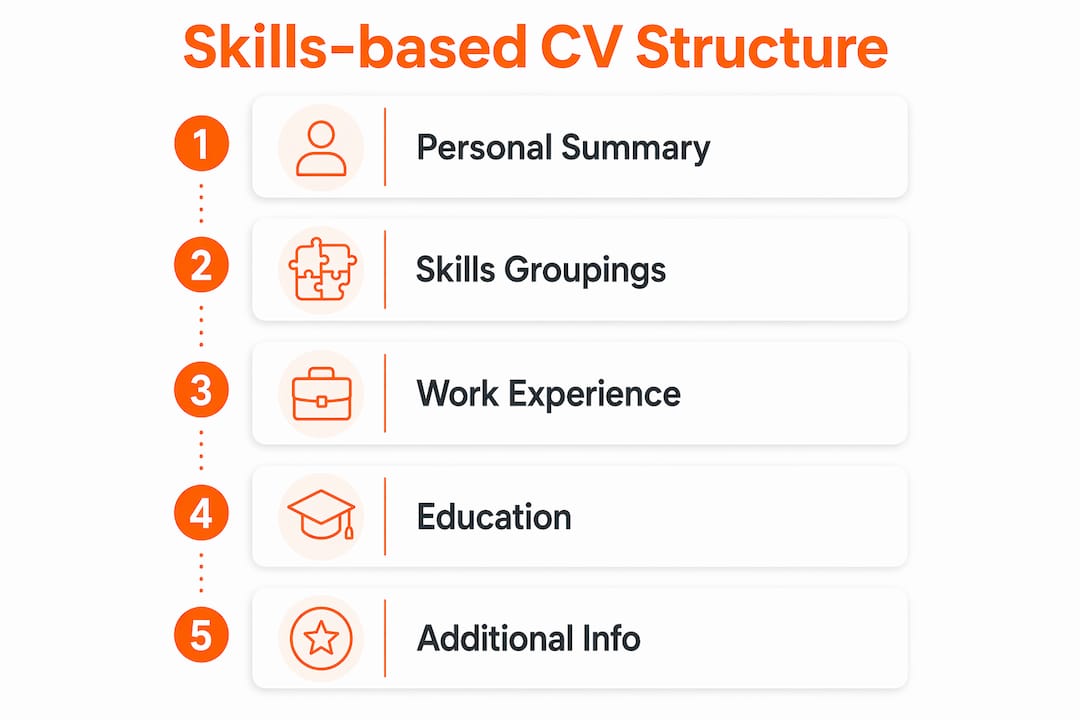
The typical structure of a skills-based CV follows a clear sequence: personal information, a personal summary, a grouped skills section, a brief work history, and education. The skills section carries the most weight and should appear near the top of the first page, before any employment dates.
Here is what to include in each section:
- Personal information: Name, phone number, email address, LinkedIn profile, and location (city only, not full address)
- Personal summary: Three to four sentences summarising your strongest competencies and career direction, written to match the job description
- Skills section: Grouped into three or four labelled categories, each containing achievement-focused bullet points
- Work experience: Brief entries listing employer, role title, and dates; detail is minimal here
- Education and qualifications: Position this higher on the page if you are a recent graduate with limited work history
| Section | Purpose | Typical length |
|---|---|---|
| Personal summary | Frames your competencies and career goal | 3 to 4 sentences |
| Skills section | Core of the CV; grouped by category | 3 to 4 groups, 3 to 5 bullets each |
| Work experience | Provides context and satisfies ATS | 2 to 4 lines per role |
| Education | Confirms qualifications | 1 to 2 lines per qualification |
A well-structured skills section with clear sub-headings improves both ATS parsing and recruiter scanning, increasing your chance of progressing to interview. Spacing and consistent formatting matter as much as content.

Pro Tip: Label your skill groups with terms that mirror the job description. If the posting mentions “stakeholder communication” and “data reporting,” use those exact phrases as your category headers. This directly improves keyword matching for ATS systems.
Skills-based vs chronological vs hybrid CV: what is the difference?
The three main CV formats serve different candidate profiles, and choosing the wrong one can work against you even when your skills are strong.
A chronological CV lists your roles in reverse order, starting with the most recent. It is the default format for candidates with a solid, relevant work history in a single field. Recruiters and ATS systems are most familiar with it, which is both its strength and its limitation. If your history has gaps or a change of direction, a chronological format puts those weaknesses front and centre.
A skills-based CV leads with competencies and de-emphasises detailed employment dates. This is the right choice when your skills outpace your job titles. The trade-off is that a purely functional format can raise flags for ATS software and some recruiters, who may assume you are concealing a patchy history.
A hybrid CV combines a strong skills summary at the top with a concise reverse-chronological work section below. Hybrid formats are most effective in 2026 because they satisfy ATS requirements while giving hiring managers the skills context they want.
| Format | Best for | ATS compatibility | Skills visibility |
|---|---|---|---|
| Chronological | Experienced candidates, linear careers | High | Low |
| Skills-based (functional) | Graduates, career changers, gaps | Moderate | High |
| Hybrid | Most candidates in 2026 | High | High |
The practical recommendation: if you have any work history at all, use a hybrid approach. Lead with a skills summary, then include a brief chronological section. This gives you the benefits of a skills-focused CV without the ATS risk of a purely functional format.
How to create an effective skills-based CV
Writing a skills-focused CV requires more preparation than filling in a template. The goal is to match your competencies directly to the role, with every bullet point tied to a concrete outcome.
-
Identify your most relevant skills. Review the job description and highlight the competencies mentioned most frequently. Cross-reference these with your own experience, including voluntary work, academic projects, and extracurricular activities. Your soft skills are often as persuasive as technical ones.
-
Group skills into three or four categories. Split your skills into broad sets such as “Communication and Stakeholder Management,” “Data Analysis,” and “Project Coordination.” Each group should contain three to five bullet points, each tied to a specific achievement or outcome rather than a vague claim.
-
Write a targeted personal summary. This is the first thing a recruiter reads. State your professional identity, your top two or three competencies, and the type of role you are targeting. Keep it to four sentences maximum and tailor it for each application.
-
Keep work history concise but present. List employer names, job titles, and dates without lengthy descriptions. This section exists to provide context and satisfy ATS requirements, not to carry the CV. If you are a recent graduate, read SparkCV’s guidance on positioning education over experience to structure this section effectively.
-
Tailor every version to the specific job. A generic skills CV performs poorly. Use the job description as a checklist and adjust your skill categories, bullet points, and summary for each application. A CV tailoring checklist can help you do this consistently without starting from scratch each time.
-
Format for readability and ATS parsing. Use standard fonts such as Arial or Calibri, clear section headers, and consistent spacing. Avoid tables, text boxes, or graphics in the main body, as these can confuse ATS software.
Pro Tip: Tie every skill bullet point to a measurable result. “Managed social media accounts” is weak. “Grew Instagram engagement by 40% over three months through a targeted content schedule” is a professional achievement that proves the skill rather than just claiming it.
Key takeaways
A skills-based CV is the strongest format for graduates and career changers because it puts your most relevant competencies in front of recruiters before they reach your job titles.
| Point | Details |
|---|---|
| Definition is clear | A skills-based CV leads with competencies, not chronological job history. |
| Best candidates to use it | Graduates, career changers, and those with gaps or short-term roles benefit most. |
| Structure matters | Group skills into 3 to 4 labelled categories with achievement-focused bullet points near the top. |
| Hybrid beats pure functional | A hybrid format satisfies ATS and hiring managers better than a purely skills-based layout in 2026. |
| Tailor every application | Adjust skill categories and your personal summary to match each job description individually. |
Get your skills-based CV working harder with SparkCV
Writing a skills-based CV that passes ATS screening and impresses hiring managers takes more than a good template. SparkCV analyses your existing CV alongside the job description, identifies the skills and keywords that matter most for that specific role, and generates a tailored, ATS-friendly version in minutes.
Whether you are a recent graduate building your first professional CV or a career changer repositioning your experience, SparkCV gives you a polished, targeted document without the hours of manual editing. Try it free and see exactly how your skills match the roles you want.
FAQ
What is the main difference between a skills-based and a chronological CV?
A skills-based CV leads with grouped competencies and minimises employment dates, while a chronological CV lists roles in reverse order with full detail. The skills-based format suits candidates whose work history does not directly reflect their ability to do the job.
Is a skills-based CV good for recent graduates?
Yes. For early-career applicants, emphasising competencies over job titles reduces the impact of limited work history on first impressions, making it easier for recruiters to see your suitability for the role.
Will a skills-based CV pass ATS screening?
A purely functional CV can be flagged by ATS systems. A hybrid format that leads with a skills summary but retains a brief chronological work history is the most ATS-compatible approach and is widely recommended for applications in 2026.
What skills should I include in a skills-based CV?
Include transferable skills directly relevant to the target role. Common categories cover communication, computer literacy, project management, and leadership, but your groupings should mirror the language used in the specific job description.
How long should a skills-based CV be?
Two pages is the standard for most candidates. Recent graduates with limited experience can use one page, provided all key sections, including a personal summary, grouped skills, brief work history, and education, are present and clearly formatted.
Recommended reads
Keep exploring






Hear more from SparkCV
Leave your email for new articles, onboarding invites, and launch news.
We’ll only use this for SparkCV emails, and you can unsubscribe any time.