
How to position education over experience on your CV

Entering the job market without years of experience behind you is genuinely tough. When you know your degree is your strongest asset, burying it halfway down your CV is a mistake you cannot afford. Learning how to position education over experience on your CV — what recruiters call leading with your academic credentials — can shift your application from overlooked to shortlisted. This guide walks you through exactly when to do it, how to format it, and how to avoid the pitfalls that trip up most recent graduates.
Table of Contents
- Key takeaways
- When to position education over experience on your CV
- Preparing your education section for maximum impact
- Structuring your CV layout to lead with education
- Common mistakes that undermine an education-first CV
- What to expect when you lead with your education
- My perspective on education versus experience
- How SparkCV helps you get your CV structure right
- FAQ
Key takeaways
| Point | Details |
|---|---|
| Education first for early careers | Place your education section before work experience if you have fewer than five years in the field. |
| Format like a work entry | List degree title, institution, dates, and relevant coursework to match ATS expectations. |
| Mirror job posting language | Use exact credential names and course titles from the job description to improve ATS ranking. |
| Hybrid CV format works best | Combine a skills summary, education, then experience for early-career ATS and recruiter clarity. |
| Academic projects count | Present university projects as “mini roles” with measurable outcomes to substitute for work experience. |
When to position education over experience on your CV
The standard rule is straightforward. Education near the top suits recent graduates and anyone with fewer than three to five years of professional experience. Once you accumulate five or more years of relevant work history, your experience takes precedence and your education moves below it.
Beyond years of experience, there are specific situations where leading with education makes particular sense:
- Field-specific requirements. Roles in law, medicine, engineering, and academia often require formal qualifications as a baseline. Recruiters in these fields check credentials before anything else.
- The job description signals it. When a posting lists a specific degree or certification in the first few lines, that qualification belongs near the top of your CV.
- You have limited or unrelated work history. If your jobs to date are in an unrelated sector, your degree is more directly relevant than your employment record.
- Your academic results are exceptional. First-class honours, a distinction, or a high GPA are competitive advantages. Do not hide them.
The risk of misplacing education is real. Recruiters spend an average of 7.4 seconds scanning a CV. If your strongest credential is buried on page two, it will not register in time.
Preparing your education section for maximum impact
Most graduates list a degree title and a university and call it done. That approach wastes the section entirely. A well-built education entry communicates depth, relevance, and achievement. Here is how to build one properly.
- Start with the degree title and classification. Write “BSc Computer Science, First Class Honours” not “Computer Science degree.” Specificity signals professionalism and helps ATS systems match your credentials accurately.
- Include your institution and graduation date. List the full university name and your graduation month and year. Consistent date formatting prevents ATS parsing errors that can miscount your experience.
- Add relevant modules and coursework. Pick four to six modules that align directly with the role. If the job description mentions data analysis, list that module by name.
- Include academic projects. Describe each project in two to three bullet points with measurable outcomes. “Built a machine learning model achieving 91% accuracy on a 10,000-record dataset” is far stronger than “completed a machine learning project.”
- List distinctions and awards. Dean’s List, scholarships, and competition prizes belong here. They are evidence of performance, not decoration.
- Mirror the job posting language. Matching keywords exactly from the posting in your education entries improves both ATS ranking and recruiter recognition.
Pro Tip: If a job posting asks for “data visualisation skills,” use that exact phrase in your coursework list if your studies covered it. Do not paraphrase what you can match precisely.
Structuring your CV layout to lead with education
Knowing what to include is only half the task. Where and how you arrange sections determines whether a recruiter and an ATS actually read your education before anything else.

The layout below sets out the recommended section order and formatting standards for an education-first CV.
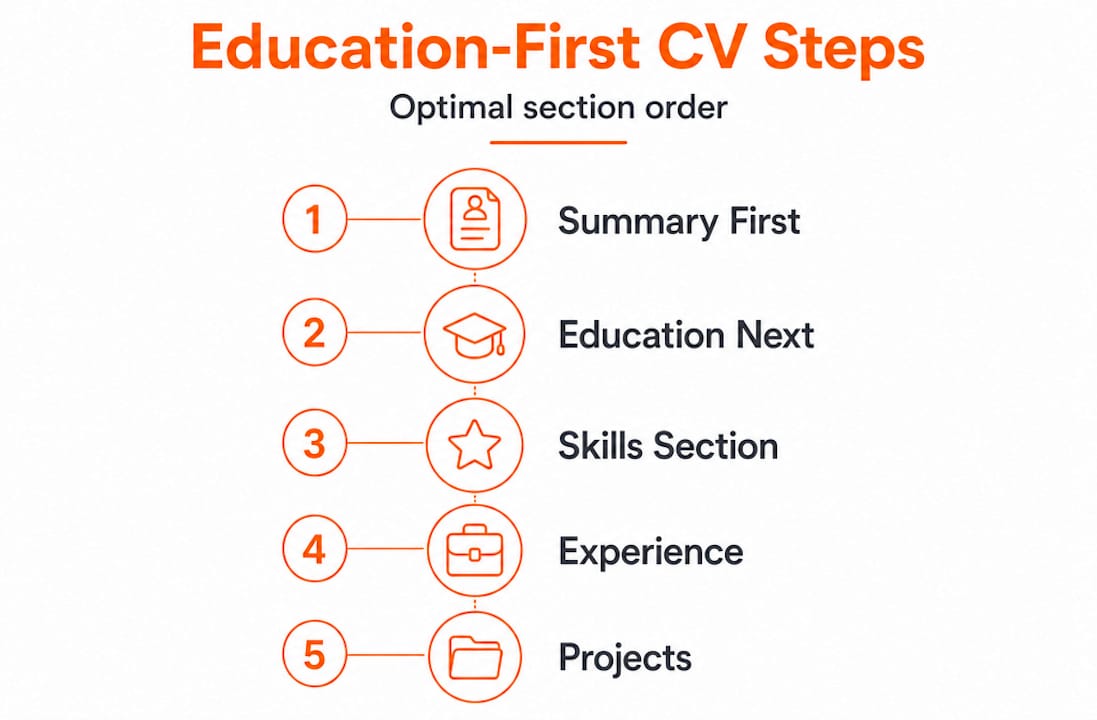
| Section | Position | Formatting notes |
|---|---|---|
| Professional summary | 1st | Two to three lines; mention your degree field and career goal |
| Education | 2nd | Full entries with dates, modules, and achievements |
| Skills | 3rd | Hard and soft skills relevant to the role |
| Work experience | 4th | Internships, part-time roles, and voluntary work |
| Additional sections | 5th | Languages, certifications, or publications if relevant |
Hybrid CV formats that combine a skills summary with education first and experience second consistently perform better for early-career job seekers in ATS ranking and readability. Avoid two-column designs or tables for your CV layout. ATS systems favour clean, single-column documents with standard headings. Use the exact label “Education” not “Academic Background” or “Qualifications,” as non-standard headings confuse parsers.
Pro Tip: Write your professional summary with your degree front and centre. “Recent BSc Marketing graduate with hands-on experience in SEO and content strategy” immediately signals your strongest credential to a recruiter who is skimming.
Common mistakes that undermine an education-first CV
Even with the right structure, specific errors can quietly ruin your application before a recruiter reads a word.
- Inconsistent date formats. Mixing “September 2024” with “09/24” across entries causes ATS experience miscounts. Pick one format and use it throughout.
- Ignoring internships and placements. Placing education first does not mean dropping your internships. List them under work experience with the same structured format you use for full roles.
- Generic module lists. Writing “Studied marketing principles” adds nothing. Name the module, name the tool, and add a result.
- Failing to tailor for each application. Effective CV tailoring means adjusting your coursework list, skills, and summary for every role, not sending the same document everywhere.
Treat your academic projects as mini roles. Recruiters respond to measurable outcomes from projects just as they respond to measurable outcomes from paid work. The format is identical; only the employer name is missing.
For a step-by-step guide on making your CV readable by automated systems, the advice on building an ATS-friendly CV covers the structural rules clearly.
What to expect when you lead with your education
Leading with education improves your visibility as an early-career applicant, but it is not a fix for every application. Education and experience in hiring are increasingly evaluated together rather than as alternatives. The proven strategy is to lead with credentials until you build enough relevant, measurable experience to let your work history carry more weight.
In practical terms, an education-first CV works best when paired with a tailored cover letter, a strong skills section, and formatted internship entries that signal applied competence. You can find specific guidance on structuring these elements in this CV tailoring checklist from SparkCV.
Keep reviewing your CV every three to six months. As you gain experience, your section order will shift naturally. The goal is always to put your strongest evidence first.
My perspective on education versus experience
I have reviewed hundreds of CVs from recent graduates, and the single most common waste of potential is a well-earned degree buried below a list of unrelated part-time jobs. The candidate spent three or four years building that qualification, and then positioned it as an afterthought.
What I have learned is that the education versus experience debate is less binary than most guides suggest. Skills and applied experience are rising in importance across industries, with many employers no longer listing degree requirements as mandatory. That shift actually strengthens the case for detailed, skills-rich education sections rather than weakening it. If your degree no longer serves as a guaranteed qualifier, it must instead serve as evidence of capability.
The early-career candidates I see succeed are those who treat their university projects as work. They quantify outcomes, name the tools they used, and frame the results in language the employer recognises. That is not embellishment. That is accurate communication of real competence.
Future-proof your CV by learning to tailor it per application. Understanding how AI can improve your CV is no longer optional for competitive applications.
— Max
How SparkCV helps you get your CV structure right
If tailoring your CV layout for every application sounds time-consuming, SparkCV removes most of that effort.
SparkCV analyses your existing CV and the job description, then generates a tailored version that places your strongest credentials first. For early-career applicants, that means your education section, modules, and academic projects get positioned exactly where they will have the most impact. The tool applies ATS-friendly CV formatting automatically and matches your language to the job posting. Try SparkCV free and see how your optimised CV compares to what you are currently sending out at sparkcv.co.
FAQ
When should you place education before experience on a CV?
Place education before work experience if you have fewer than three to five years of professional experience, according to standard career advice. It also makes sense when the role specifically requires a particular degree or qualification.
Does leading with education hurt your CV with experienced-hire recruiters?
It can, if your work history is strong and you bury it. For roles that specify several years of experience, lead with a professional summary that references your degree, then move to your experience section directly after.
How do you make your education section ATS-friendly?
Use the standard heading “Education,” keep dates consistent throughout, and mirror credential names from the job posting exactly. Avoid tables or text boxes, as ATS parsers often skip content inside them.
Can academic projects replace work experience on a CV?
Yes, when formatted correctly. Present each project as a mini role with achievements, tools used, and measurable results. Recruiters respond to outcomes regardless of whether they came from a paid role or a university brief.
Should you tailor your education section for each application?
Yes. Adjust your listed modules, project descriptions, and skills to reflect the language in each job posting. Generic education sections rank lower in ATS systems and fail to signal direct relevance to the role.
Recommended reads
Keep exploring






Hear more from SparkCV
Leave your email for new articles, onboarding invites, and launch news.
We’ll only use this for SparkCV emails, and you can unsubscribe any time.