
Culinary resume examples and templates for chefs and cooks

Hiring managers scan a culinary resume for five things in this order: current contact details, a short professional summary, reverse-chronological work experience with measurable results, a skills block, and certifications like ServSafe. If you only fix one thing today, fix this: write a two-sentence summary and back it with two to four bullets that contain a real number (covers per shift, waste percentage, ticket time).
Copy-ready line for your header: “Line Cook | 3 Years Kitchen Experience | ServSafe Certified | [Phone] | [Email] | [Portfolio Link]”. Paste it, adjust it, done.
Before you touch the rest of the document, get the header right. The mandatory elements are:
- Full name, in a slightly larger font than the rest of the document
- A one-line role or title strap (e.g., “Pastry Cook” or “Sous Chef”)
- Phone number and a professional email address (not a nickname from school)
- City and state, not a full street address
- A portfolio link, Instagram feed, or LinkedIn profile if it shows real work
Once the header is solid, the highest-impact fix is the summary-plus-bullets combination. A generic “hardworking team player seeking opportunities” summary gets skimmed past in seconds. A summary naming your specialism and one number, followed by bullets that quantify output, gets read twice. You’ll find full downloadable templates further down this guide, including entry-level and experienced versions ready to adapt.
Key Takeaways
A strong culinary resume pairs a specific, numbers-led summary with quantified experience bullets, ATS-friendly formatting, and certifications matched to the exact role being applied for.
| Point | Details |
|---|---|
| Fix the summary first | Write a two-sentence summary naming your specialism and one measurable result. |
| Quantify every role | Add covers per shift, waste percentage, or ticket time to at least two bullets per job. |
| Keep formatting simple | Use a single column, standard headings, and export as PDF unless the posting requests .docx. |
| Treat externships as jobs | List the establishment, role, and outcomes exactly as you would a paid position. |
| Tailor every application | Match four to six keywords from each posting, then save a role-specific version through a tool like SparkCV. |
Table of Contents
- Culinary resume examples and templates you can copy today
- What goes in each section of a chef resume
- How do you format a resume so it passes ATS?
- Action verbs and how to quantify kitchen achievements
- How do you tailor a culinary resume to a job posting?
- How should students list externships on a resume?
- Final resume checklist and mistakes to avoid
- Get your culinary resume tailored to each job in minutes
- Sources
Culinary resume examples and templates you can copy today
Two working examples cover most applicants: someone early in their career applying for a line cook or commis role, and someone with several years behind the line applying for a sous chef or executive chef position. Both follow the same ATS-friendly logic: single column, standard section headings, no graphics or tables inside the document itself.
Entry-level example (student or line cook):
Jordan Ellis Line Cook | ServSafe Certified (555) 012-3456 | jordan.ellis@email.com | Denver, CO | instagram.com/jordancooks
Summary: Culinary arts graduate with 400+ hours of hands on kitchen training and a 3-month externship in a 120-seat bistro. Comfortable on sauté and grill stations during dinner service.
Experience Line Cook (Externship), Bramble & Vine Bistro, Denver, CO — March to May 2026
- Executed 40 to 60 covers per night on the grill station during weekend dinner service
- Reduced ticket time by 90 seconds per plate after restructuring mise en place
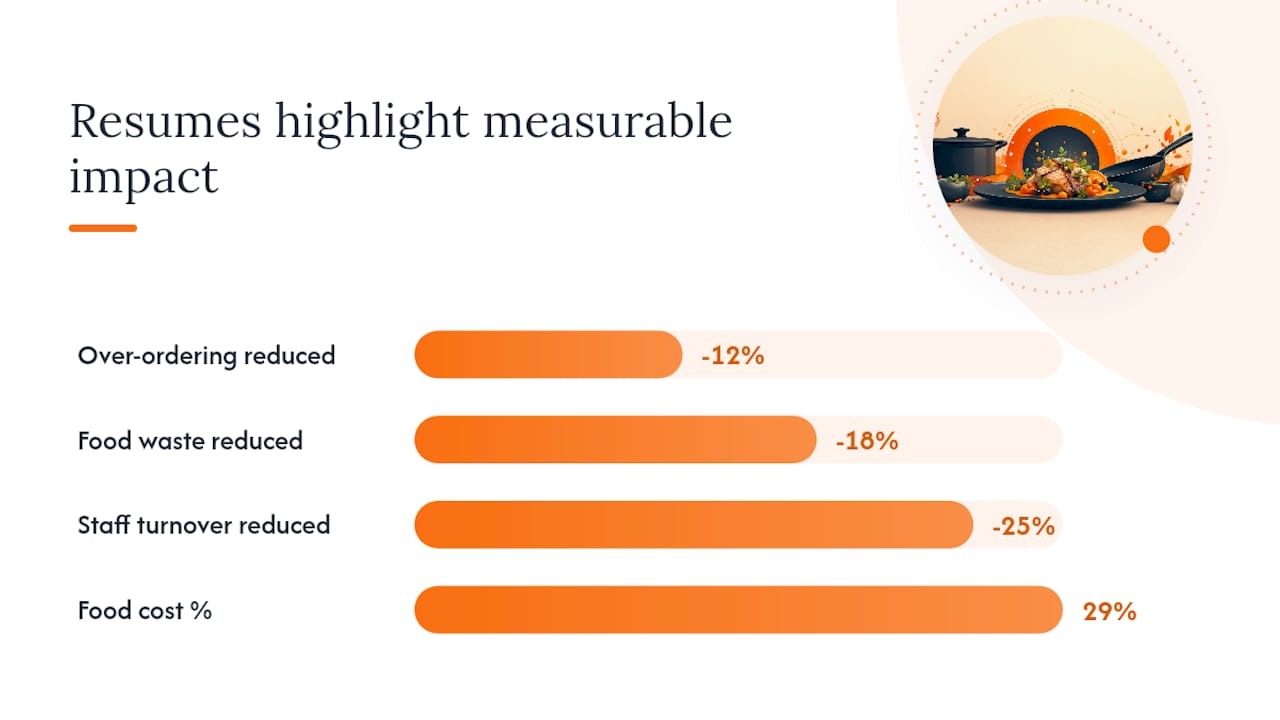
- Assisted with inventory counts, cutting weekly over-ordering by roughly 12%
Skills: Knife work, grill and sauté stations, food safety compliance, POS entry (Toast), inventory tracking, team communication
Education: Diploma in Culinary Arts, [School Name], 2026. ServSafe Food Handler Certification, current.
Experienced example (sous or executive chef):
Maria Torres Sous Chef (555) 987-6543 | maria.torres@email.com | Austin, TX | linkedin.com/in/mariatorreschef
Summary: Sous chef with 7 years in high-volume kitchens, leading teams of up to 12 cooks across dinner and banquet service for venues averaging 300 covers a night.
Experience Sous Chef, The Ferro Room, Austin, TX — 2022 to Present
- Standardised prep procedures across three stations, cutting food waste by 18% over six months
- Trained and scheduled a team of 12 line cooks, reducing turnover by 25% year on year
- Managed food cost percentage, holding it steady at 29% during a menu overhaul
Line Cook to Junior Sous, Halcyon Kitchen, Austin, TX — 2019 to 2022
- Promoted twice in three years based on consistency during 300-cover Friday services
- Cut average ticket time from 14 to 9 minutes by redesigning the pass workflow
Skills: Menu costing, butchery, French technique, staff scheduling, P&L awareness, POS systems (Aloha), team leadership
Education: AAS in Culinary Arts, [School Name]. ServSafe Manager Certification, ACF Certified Sous Chef.
For file format, export as a PDF unless the application portal specifically requests a .docx, and always follow whatever instructions the job posting gives about accepted attachment formats. Keep both a PDF and a .docx version saved so you’re never scrambling before a deadline.
Pro Tip: Name your file “FirstName_LastName_LineCook_Resume.pdf” rather than “Resume_final_v3.pdf” — recruiters open dozens of files a day, and a clear name makes yours easier to find again.
What goes in each section of a chef resume
Every section on a culinary resume earns its place by answering a specific question a hiring manager is asking. Get the order and content right, and the document reads itself.
Header and contact details
Put your name first, then a one-line title strap, then contact information on a single line: phone, email, city and state, and a portfolio or social link if it’s genuinely relevant. Skip the full postal address. Skip “References available on request” too. It wastes a line that could hold something useful.
Professional summary or objective
Use a summary if you have any kitchen experience at all, including externships. Reserve an objective statement for someone with genuinely zero food service background, such as a career changer moving into culinary work for the first time.
Two examples ready to adapt:
Chef summary: “Executive chef with 9 years leading kitchens for 150 to 300-cover restaurants, specialising in modern French technique and menu development that lifted average check size by double digits.”
Line cook summary: “Line cook with 2 years on grill and sauté stations, ServSafe certified, comfortable maintaining pace during 200-cover Saturday dinner services.”
Work experience
List roles in reverse-chronological order: most recent first. Each entry needs the employer name, city and state, your job title, and the dates you worked there. Below that, three to five bullets focused on what you achieved, not just what you were assigned to do. “Responsible for grill station” tells a hiring manager nothing they can’t assume. “Executed 60+ covers nightly on grill during peak weekend service” tells them exactly what you can handle.

Skills
Split hard and soft skills so both get noticed. Hard skills cover technique and tools: knife work, butchery, sauce work, sushi preparation, POS systems, inventory software. Escoffier’s guidance recommends listing kitchen technology proficiency alongside cooking technique, since larger operators often screen specifically for POS and inventory systems experience to cut onboarding time. Soft skills cover how you work under pressure: team leadership, communication during service, adaptability when a station runs short-handed.
- Hard skills: butchery, sauté, grill, pastry lamination, sushi rice preparation, POS systems (Toast, Aloha, Square)
- Soft skills: calm under pressure during rush, cross-training junior cooks, clear communication with front of house
Education and certifications
List your culinary school or diploma programme, the credential name, and the year. If you’re unsure how a school’s official name should appear, cross-check it against a source like the NCES College Navigator, which lists accredited culinary institutions by their registered names.
Certifications matter more in this field than in most. ServSafe Food Handler or ServSafe Manager should sit near the top if you hold one, and ACF credentials (Certified Culinarian, Certified Sous Chef, and so on) carry real weight for management-track roles. Always show the certification date, and note a renewal date if the certificate is close to expiring.
How do you format a resume so it passes ATS?
Formatting choices that look fine on screen can quietly break an applicant tracking system’s ability to read your resume at all. ATS software parses text in a specific order, and anything that disrupts that order, columns, text boxes, embedded graphics, gets scrambled or dropped entirely before a human ever sees it.
PDF is generally the safer export, since it preserves formatting across devices and most modern ATS platforms parse it correctly. That said, some older systems still parse .docx more reliably, and application portals for roles like line cook positions often specify accepted file types directly in the posting, sometimes with a file size limit around 5MB. Read the instructions on the job posting itself before you decide which to upload.
Keep the layout simple: single column, standard section headings (“Experience”, “Skills”, “Education”), a readable font like Calibri or Arial at 10 to 12 point size, and one page for most applicants (two pages only if you have 10-plus years of relevant experience).
| Formatting choice | Effect on ATS parsing |
|---|---|
| Single-column layout | Reads cleanly, top to bottom, no dropped sections |
| Multi-column or table layout | Often scrambles text order or drops content entirely |
| Standard section headings | Recognised instantly by most parsing software |
| Creative headings (“My Journey”) | May not be recognised as a section at all |
| Text in headers/footers | Frequently ignored by ATS software |
| Images, icons, logos | Not readable by ATS, wastes visual space |
| Job-description keywords in context | Improves match score without looking forced |
Keyword insertion works best when it’s woven into a real bullet, not bolted on as a list. If a posting mentions “sanitation compliance”, don’t just add the phrase in isolation. Write: “Maintained full sanitation compliance across three stations during health department inspections.” Same keyword, real sentence, and it reads naturally to a human reviewer as well as a parser.
Action verbs and how to quantify kitchen achievements
Weak verbs like “responsible for” or “helped with” describe a task without proving you did it well. Strong verbs describe outcomes, and outcomes are what get shortlisted. According to Escoffier’s guidance for chef resumes, the difference between a passed-over resume and a shortlisted one usually comes down to specificity: named stations, precise numbers, and explicit certifications rather than vague claims.
Strong culinary action verbs to build bullets around:
- Spearheaded (a menu launch, a new prep system)
- Standardised (recipes, portion sizes, plating)
- Reduced (waste, cost percentage, ticket time)
- Scaled (recipes for volume, catering orders)
- Trained (new hires, cross-trained staff)
- Streamlined workflows should be described specifically, e.g., “restructured” or “reorganised” rather than the generic verb itself
- Managed (inventory, food cost, scheduling)
- Executed (high-volume service, banquet menus)
Before and after, side by side:
Weak: “Responsible for prep work and helped reduce waste.”
Weak: “Worked the line during busy shifts.” Strong: “Executed 60+ covers nightly on grill during peak weekend service without a single missed ticket.”
Quantification templates worth keeping handy:
- “Reduced food waste by [X]% over [Y] months through [specific action].”
- “Cut ticket time from [A] minutes to [B] minutes by [specific change].”
- “Managed food cost percentage at [X]% across [Y] menu items.”
- “Trained [X] new hires, reducing onboarding time by [Y] days.”
Pro Tip: *If you don’t have exact numbers from a past role, estimate conservatively rather than skip the metric entirely.
How do you tailor a culinary resume to a job posting?
A tailored resume beats a generic one because job adverts function as a direct keyword source. Job posting language for a line cook role frequently includes exact phrasing, such as “execute recipes to specification” or “meet ticket times consistently”, and copying that phrasing (when it’s true of your experience) helps a resume pass automated screening and read as an immediate fit to a human reviewer.
- Read the job advert twice and highlight the four to six phrases that repeat or appear in the requirements section.
- Check those phrases against your existing bullets. If you have a matching accomplishment, rewrite the bullet to mirror the posting’s own wording.
- Revise your summary line to mention the exact title from the posting (“Line Cook” rather than “Cook”) and the specific setting if named (high-volume, fine dining, banquet).
- Update your skills block to include any tool or certification named explicitly in the posting.
- Check the stated experience level. If a posting requires 2+ years, make sure your summary states your years of experience clearly, so there’s no ambiguity for an automated filter or a quick human scan.
Here’s how that mapping works in practice. A job posting says: “Execute recipes to specification, maintain sanitation compliance, work weekend shifts.” A generic bullet reading “Cooked food during shifts” becomes: “Executed recipes to specification across weekend dinner service while maintaining full sanitation compliance.”
Mirror the language of section headings and required skills closely. Preserve your own voice in the summary and in how you describe your personal strengths, since that’s where authenticity still matters to a human reader. If you’re applying across different specialisms, pastry one week, high-volume line cooking the next, keep separate saved versions of your resume rather than trying to make one document cover everything. SparkCV’s tailoring checklist walks through this same matching process if you want a repeatable framework for every application.
How should students list externships on a resume?
Treat an externship exactly like a paid job. Culinary educators are explicit on this point: an externship belongs in your experience section with the establishment name, your role, and measurable outcomes, not tucked away as a footnote under education.
Externship entry example, ready to adapt:
Externship, [Restaurant Name], [City, State] — [Month/Year to Month/Year]
- Rotated across grill, sauté, and pastry stations during a 12-week placement
- Assisted head chef with inventory counts and weekly ordering for a 90-seat dining room
- Maintained sanitation standards during two unannounced health inspections with zero violations
- Supported prep for private events serving up to 150 guests
Place your externship directly in the experience section if it’s your most substantial kitchen exposure, above education. If you also have part-time hospitality work (serving, hosting), list the externship first since it’s more directly relevant to a kitchen role.
Culinary educators consistently point to specificity as the deciding factor between a resume that gets read twice and one that gets skimmed once. Naming the exact station you worked, the establishment, and one measurable outcome does more for a student’s credibility than any number of general statements about “passion for cooking”.
Filling a one-page resume as a student usually means combining a solid education section, your externship, any part-time food service work, and a skills block that includes both kitchen technique and transferable soft skills from other jobs, retail, customer service, whatever you’ve done. A career log tool can help you keep track of specific wins as they happen during placements, so you’re not trying to remember exact numbers months later when you finally sit down to write the resume.
Final resume checklist and mistakes to avoid
Run through this before you submit anything:
- Header includes current phone, professional email, city/state, and a portfolio link if relevant
- Summary names your role and includes at least one number or specific detail
- Every experience bullet describes an outcome, not just a duty
- At least two to three bullets per role contain a measurable metric
- Skills section splits hard and soft skills clearly
- Certifications are current, with expiry dates noted if close to renewal
- File is named clearly and saved as both PDF and .docx
- Document is one page unless you have 10-plus years of relevant experience
The mistakes that sink a resume before it’s even properly read tend to repeat across applicants:
- Generic verbs (“helped”, “worked on”) with no measurable outcome attached
- Resumes stretching past one page without enough senior-level experience to justify it
- Missing or outdated contact information, especially a dead phone number
- Multi-column layouts or graphics that scramble when opened in an ATS
- Keyword lists stuffed at the bottom in white text or tiny font, which most modern systems now flag rather than reward
Before you hit send, open the exported PDF on a phone or a different computer to confirm formatting holds up, click every link to make sure they work, and check that every date range across your work history lines up correctly. A resume with a one-month gap in the dates that doesn’t match the actual timeline is one of the fastest ways to trigger doubt in a hiring manager’s mind, so check the common reasons a CV gets rejected before you submit anything.
Get your culinary resume tailored to each job in minutes
Building one strong resume is only half the job. The real time cost comes from adjusting it for every posting, swapping in the right keywords, rewriting the summary, matching the exact experience level a listing asks for. Do that manually for ten applications and you’ll spend an entire evening on formatting instead of cooking.
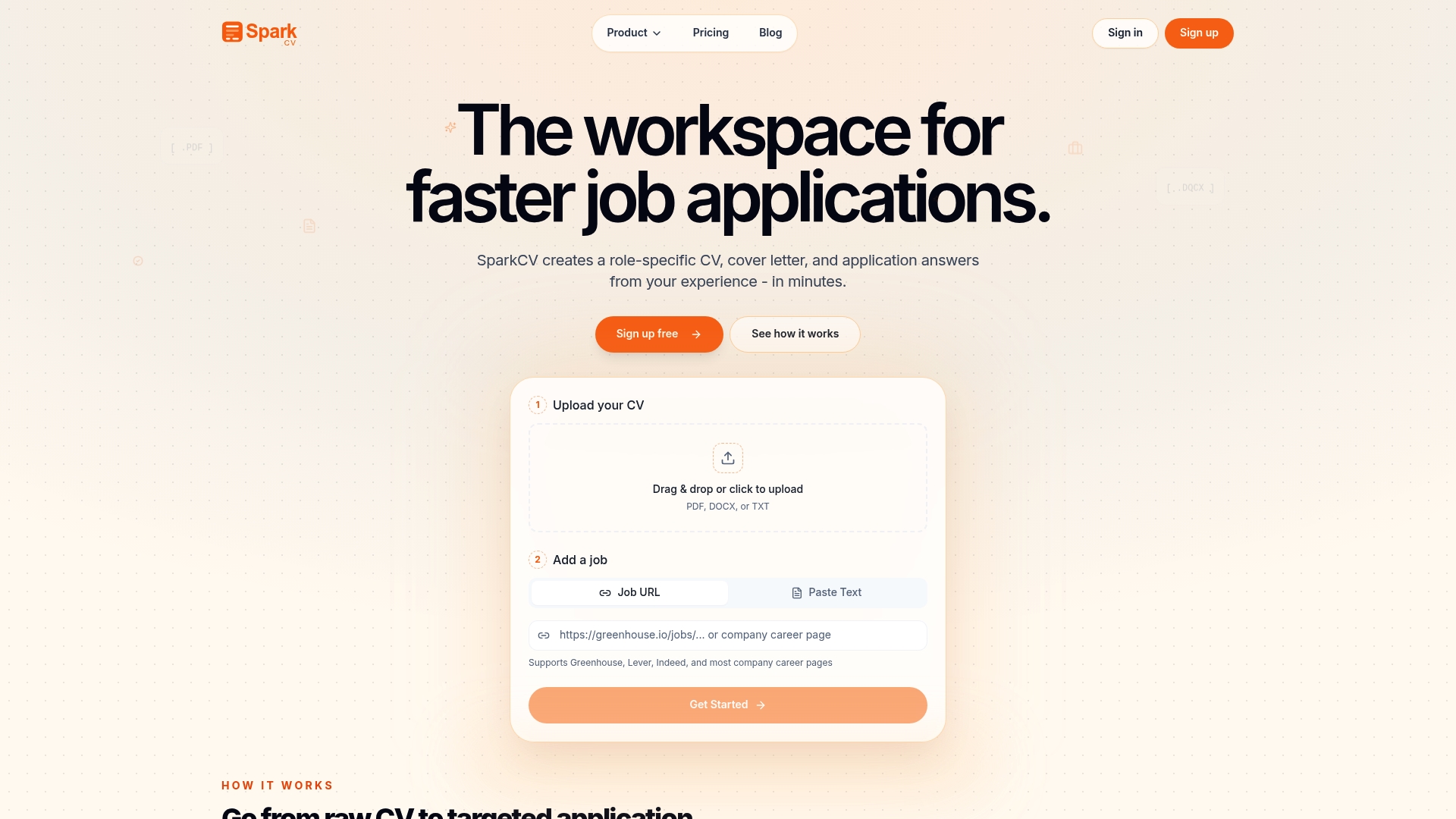
SparkCV reads your existing resume alongside the job description and generates a tailored version in minutes, matched to the specific role, whether that’s a line cook posting asking for 2+ years or a sous chef role listing ACF credentials as a requirement. It handles the keyword matching automatically and exports in ATS-friendly formats, so you’re not manually checking whether a layout will parse correctly.
- Generates tailored bullets and a matching summary based on the actual job posting
- Checks keyword alignment so your resume reads as a fit to both software and hiring managers
- Exports clean, ATS-friendly PDF and .docx versions ready to upload
- Produces application question answers and cover letters alongside the resume itself
- Career log feature helps you track achievements as they happen, so quantified bullets are ready when you need them
Upload your current resume and a job posting to SparkCV and see a tailored version generated in minutes rather than an evening.
Sources
Recommended reads
Keep exploring






Hear more from SparkCV
Leave your email for new articles, onboarding invites, and launch news.
We’ll only use this for SparkCV emails, and you can unsubscribe any time.