
How to present contract work on a resume in 2026

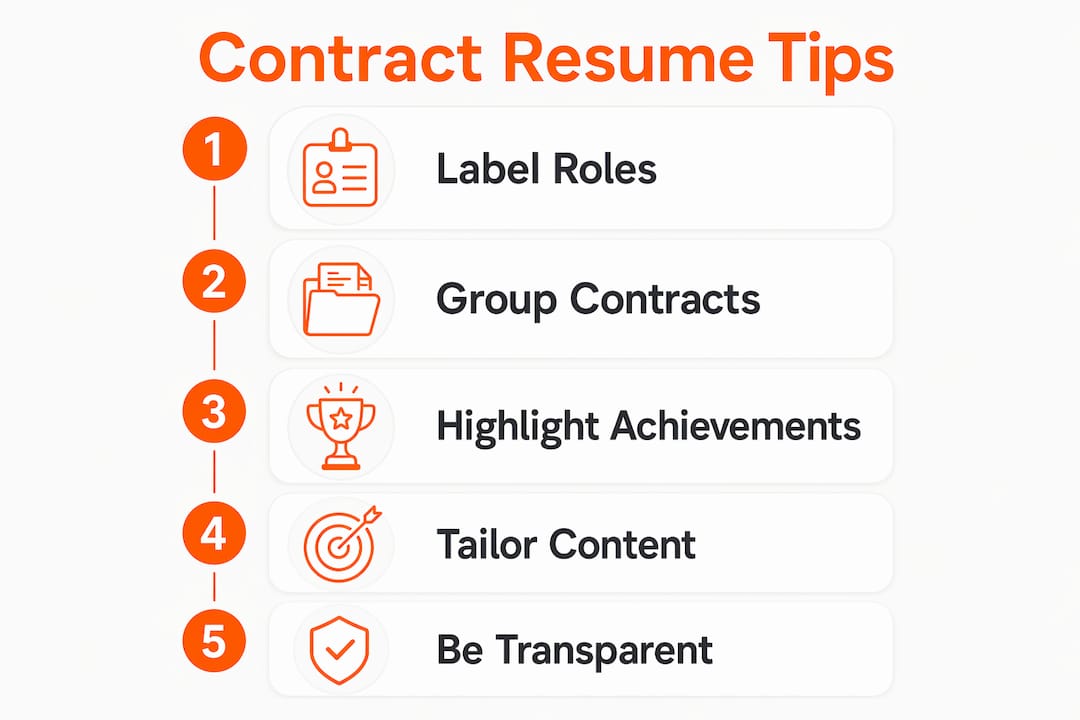
The most effective way to present contract work on a resume is to integrate it directly into your main work experience section, listed in reverse-chronological order, with clear labels, client names, and achievement-focused bullet points. Done well, contract and freelance experience reads as proof of adaptability and delivery, not instability. Done poorly, it triggers the “job hopper” alarm before a recruiter reads a single bullet.
Here is what every contract entry needs as a minimum:
- Job title with a contract label — e.g., “Marketing Manager (Contract)” or “Senior Developer, Contract”
- Client or company name, plus the staffing agency if applicable — e.g., “Barclays (via Hays)”
- Contract duration — month and year start and end, formatted consistently throughout
- Achievement-led bullet points — what problem you solved, what you did, and what the result was
If a staffing agency placed you, list both employers — the agency as your legal employer and the client as the worksite. This gives applicant tracking systems (ATS) two keyword matches and keeps background checks clean. Never list only the agency; it hides where you actually worked.
Pro Tip: Always include “(Contract)” in your job title. Without it, a four-month role looks like a permanent position that ended badly. Transparency builds trust with recruiters from the first glance.

How should you decide how to list contract work on your CV?
The right listing method depends on how many contracts you have held and how similar they are. There is no single correct format, but consistency across every entry is non-negotiable for both readability and ATS compatibility.
Three approaches work well in practice:
- Individual entries — best when you have held a small number of contracts, each with a distinct client and clearly different scope. List each role separately, just as you would a permanent position, with a contract label on the title.
- Grouped by agency — if one staffing agency placed you across several assignments, use the agency as the parent entry and list each client engagement underneath as a sub-entry with its own dates and bullets.
- Umbrella consulting practice — if you have worked independently across multiple clients, create a single entry such as “Independent Consultant” or “Freelance Project Manager” with a continuous date range, then list selected client projects beneath it.
Whichever method you choose, consistent job title formatting across every entry signals professionalism and prevents confusion. Use the same structure for each role: title, contract type, company, location (optional), and dates. Mixing formats mid-CV, where some entries have locations and others do not, or where date formats switch between “Jan 2024” and “01/2024,” creates visual noise that slows recruiters down.
For ATS compatibility, avoid tables, text boxes, or columns. Save your file as .docx unless the application portal specifies otherwise, and use the same section header (“Professional Experience” or “Work Experience”) for both contract and permanent roles. Separating contract work into its own section implies it is less valuable, which is the opposite of what you want.
Pro Tip: If you worked through a UK umbrella company, list the umbrella company as your employer and name the end client in the role description. This reflects the actual payroll arrangement and keeps your CV accurate for reference checks.
How do you list multiple short-term contracts without looking like a job hopper?
Multiple short contracts are where most contractors lose confidence in their CV. The instinct is to list every role individually, which creates a wall of short tenures that reads as instability. The fix is grouping.

Grouping short contracts under an umbrella heading transforms five separate three-month entries into one coherent consulting practice with selected client projects underneath. The reader sees continuity at the top and variety underneath. That combination signals expertise, not restlessness.
A hybrid or achievement-based format works particularly well here. Rather than leading with dates, you lead with skills and results, then show the chronology underneath. You are not hiding the movement; you are stopping dates from being the headline.
Here is how to build a grouped entry:
- Main heading: “Independent Consultant” or “Contract Specialist, [your sector]”
- Date range: one continuous span covering all engagements, e.g., “March 2022 to present”
- Scope line: one sentence describing the type of work you deliver across clients
- Selected projects: only the strongest, most relevant engagements, each with its own client name, dates, and two or three achievement bullets
- Sub-bullets: specific outcomes per project, not generic duties
Be selective. Including only the most relevant contracts increases impact and reduces clutter. A contract that lasted six weeks and bears no relation to the role you are applying for does not need its own entry. If omitting it creates a visible gap, a brief note within the umbrella entry covers it cleanly.
Pro Tip: Use SparkCV’s career log tool to record every contract as you complete it, including outcomes and metrics. When it comes to tailoring your CV, you will have the raw material ready rather than trying to reconstruct details months later.
How do you make contract roles stand out with achievements?
The fastest way to undermine a strong contract history is to write it like a job description. Listing duties tells a recruiter what the role involved. Listing achievements tells them what you delivered. Recruiters and hiring managers care about the latter.
Every contract bullet point should answer three questions: what problem were you brought in to solve, what did you do, and what was the result? This problem-action-result structure is the industry standard for contract work and shifts the narrative from temporary employment to high-impact delivery.
Practical guidance for writing achievement bullets:
- Use active delivery verbs — “Built,” “Led,” “Reduced,” “Launched,” “Resolved,” “Implemented.” Avoid soft verbs like “Assisted,” “Helped,” or “Participated,” which sound like attendance rather than contribution.
- Add metrics wherever possible — time saved, error rates reduced, team size managed, volume handled, revenue influenced. If you lack clean numbers, use tangible scope: name the system, the audience, or the output.
- Mirror the job description language — tailoring each entry to echo the keywords and skills in the target posting increases your ATS score and shows the recruiter you understand what they need.
- Include portfolio or work sample links thoughtfully — one URL in the header is enough. If a specific project is highly relevant, reference it in a bullet with a label such as “case study available on request.”
- Highlight contract-to-hire conversions — if a contract led to a full-time offer, say so explicitly. A conversion offer is third-party validation that the client valued your work enough to want you permanently.
The soft skills you build through contract work, rapid onboarding, working across different teams and systems, and delivering under pressure, are genuinely valuable. Make them visible in your bullets rather than leaving them implied.
Best practices for including contract work on UK resumes
Getting the format right is half the job. The other half is making sure every decision you make serves the specific application in front of you.
Be selective about what you include. Not every contract belongs on your CV. Focus on roles that are relevant to the position you are applying for. Unrelated short-term work can be left off unless omitting it creates a gap that needs explaining.
Be transparent about contract status. Label every role clearly with “(Contract),” “(Freelance),” or “(Temp)” so recruiters understand the nature of each engagement from the start. Ambiguity raises questions; clarity builds confidence.
Tailor each description to the job posting. Read the job advert carefully and identify the skills and outcomes it prioritises. Then adjust your bullet points to reflect that language. This is not about rewriting your history; it is about emphasising the parts of your experience that matter most to this employer. SparkCV’s CV tailoring checklist walks you through this process step by step for 2026 applications.
Address employment gaps honestly. If gaps exist between contracts, grouping contracts strategically often resolves the visual problem. Where a gap remains visible, a brief factual note works better than silence: “three-month break between engagements” or “sabbatical, [dates]” is enough.
Use your cover letter to add context. Your CV presents the facts; your cover letter explains the narrative. If you are moving from contract to permanent work, or if your contract history spans several industries, the cover letter is where you connect the dots. A well-written cover letter for a career transition can reframe a varied contract history as deliberate, skills-building experience rather than a series of unconnected jobs.
Prepare to explain in interviews. Recruiters may ask why you have worked on contracts rather than in permanent roles. A clear, confident answer that focuses on the skills you built and the results you delivered is far more persuasive than an apologetic one. Frame your contract career as a choice that gave you breadth, speed, and delivery experience that permanent employees rarely accumulate at the same pace.
Let SparkCV do the heavy lifting
Tailoring a CV for every application takes time, especially when your work history includes multiple contracts across different clients and industries. SparkCV analyses your existing CV and the job description, then generates a tailored, ATS-friendly version in minutes. You get a polished CV, a matching cover letter, and targeted answers to application questions, all aligned to the role you are going for.
Get started free and turn your contract experience into your strongest asset.
Key takeaways
Presenting contract work clearly and consistently, with achievement-led bullets and accurate labels, is the single most effective way to turn a varied contract history into a compelling professional narrative.
| Point | Details |
|---|---|
| Integrate contracts into main experience | List contract roles in reverse-chronological order within your standard work experience section, not in a separate block. |
| Label every role clearly | Always include “(Contract),” “(Freelance),” or “(Temp)” in the job title so recruiters understand the engagement type immediately. |
| Name both agency and client | For agency-placed work, use the format “Client (via Agency)” to maximise ATS keyword matches and maintain transparency. |
| Group short contracts strategically | Use an umbrella entry with selected project sub-bullets to avoid a job-hopper impression and show consulting expertise. |
| Tailor bullets to each application | Mirror the job description’s language in your achievement bullets to improve ATS scores and recruiter engagement. |
Recommended reads
Keep exploring






Hear more from SparkCV
Leave your email for new articles, onboarding invites, and launch news.
We’ll only use this for SparkCV emails, and you can unsubscribe any time.