
What is an entry-level CV: a guide for 2026

An entry-level CV is a focused document that summarises your skills, education, and relevant experiences to show employers you are the right candidate, even without extensive work history. If you are a recent graduate or stepping into the workforce for the first time, this document is your first impression. Employers use it to judge your potential, not just your past. Entry-level CVs typically include education, relevant coursework, volunteer work, internships, and skills rather than a long list of jobs. Getting the format and content right from the start puts you ahead of candidates who submit generic, untailored applications.
What is an entry-level CV and what should it include?
An entry-level CV is built around what you know and what you can do, not where you have worked. Its core purpose is to show a recruiter that your qualifications, skills, and attitude match the role on offer. Every section should earn its place.
The standard sections for an entry-level job application CV are:
- Contact details: Full name, professional email address, phone number, and a LinkedIn profile URL if relevant.
- Personal statement or career objective: A two to three sentence summary that states the role you want, your key qualifications, and what you bring to the employer. Career objectives should be concise and directly aligned with the employer’s needs.
- Education and qualifications: List your most recent qualification first. Include relevant modules, projects, or dissertations that relate to the role.
- Skills summary: Split this into hard skills (software, languages, technical methods) and soft skills (communication, teamwork, problem-solving). Presenting soft skills clearly can set you apart when your work history is limited.
- Relevant experience: This covers internships, part-time roles, volunteering, and extracurricular activities. Extracurricular activities and volunteer work demonstrate transferable skills such as leadership and teamwork that employers actively seek.
- Optional sections: Awards, certifications, languages spoken, or interests that add genuine relevance to the role.
Pro Tip: Keep your CV to one page at entry level. Recruiters spend an average of seconds per CV at first glance, so every line must count.

How does an entry-level CV differ from other CVs?
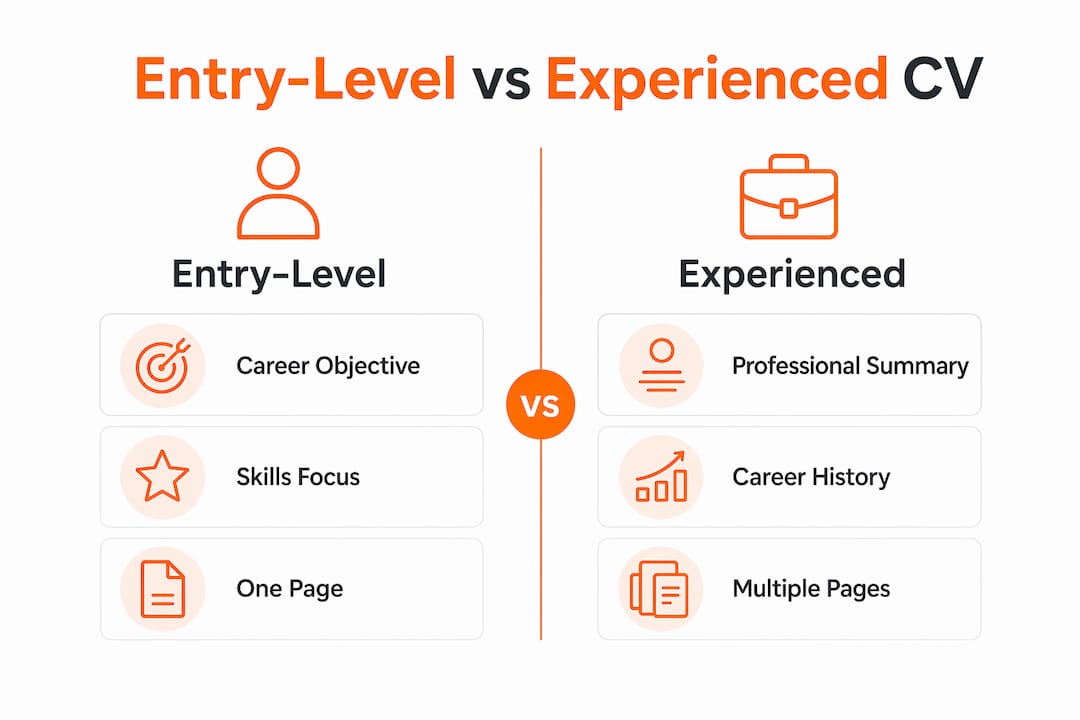
The key difference is emphasis. An experienced professional’s CV leads with a career history spanning years of roles and achievements. An entry-level CV leads with education and potential. That shift in priority changes the entire structure.
| Feature | Entry-level CV | Experienced CV |
|---|---|---|
| Opening section | Career objective | Professional summary |
| Primary focus | Education and skills | Work history |
| Experience type | Internships, volunteering, projects | Paid employment |
| Design complexity | Simple, ATS-friendly | Can include more detail |
| Length | One page | One to two pages |
Three CV formats are commonly used at entry level. The chronological format lists education and experience in reverse date order. It works well if you have relevant internships or placements. The functional format groups content by skill rather than timeline. Functional CVs suit candidates with little or no work experience because they put transferable abilities front and centre. The combination format blends both, opening with a skills summary before listing experience chronologically. Most entry-level candidates do best with either a chronological or functional approach, depending on how much relevant experience they hold.
ATS compatibility is a critical factor at this stage. Applicant tracking systems scan CVs before a human ever reads them. Simple formatting, standard fonts, and clear section headings give your CV the best chance of passing that first filter.
Pro Tip: Avoid tables, text boxes, and columns in your CV layout. Many ATS programs cannot read them correctly, and your content may be lost entirely.
How to tailor your entry-level CV to specific job applications
Tailoring your CV is the single most effective thing you can do to improve your chances of selection. A generic CV sent to ten employers performs far worse than a targeted one sent to three. Customising your CV for each role aligns your credentials directly with what the employer needs.
Follow these steps for every application:
- Read the job description carefully. Identify the specific skills, qualifications, and responsibilities the employer lists. These are the keywords your CV must reflect.
- Rewrite your career objective. Reference the job title and one or two skills or qualities the employer has highlighted. A tailored objective takes two minutes to write and signals genuine interest.
- Adjust your skills section. Move the skills most relevant to this role to the top of your list. Remove skills that have no bearing on the position.
- Select the most relevant experiences. If you have three internships and only one relates to the role, lead with that one. Relevance outweighs quantity every time.
- Mirror the employer’s language. If the job description says “client communication,” use that phrase rather than “talking to customers.” Keyword matching improves both ATS scores and recruiter recognition.
- Cut anything that does not serve this application. Irrelevant hobbies, outdated qualifications, and generic filler weaken your CV. Remove them without hesitation.
Employers look for candidates who show specific interest in the role and demonstrate relevant skills, not just a broad list of attributes. Tailoring proves you have done your research.
Pro Tip: Save a master CV with all your experiences and skills listed. Pull from it selectively for each application rather than editing your live CV directly. This keeps your options open and your submissions clean.
What common mistakes should entry-level candidates avoid?
Poor CV habits are easy to develop and hard to spot in your own work. These are the mistakes that most frequently lead to early rejection.
- Sending a generic CV. A CV that has not been tailored to the role signals low effort. Recruiters notice immediately when a personal statement does not match the job advertised.
- Poor formatting. Resume fluff and excessive design such as graphics, photos, and unusual fonts interfere with ATS scanning and reduce professional impact. Stick to clean layouts with standard fonts like Arial or Calibri.
- Typos and inconsistent tense. A single spelling error can disqualify an otherwise strong application. Write in consistent past tense for previous roles and present tense for current ones.
- Irrelevant personal details. Age, marital status, and photographs are not required on a UK CV and add no value. Remove them.
- Overloading with unrelated content. Listing every hobby, school prize, or part-time role since the age of sixteen dilutes the impact of your strongest credentials. Be selective.
- Using an outdated template. A CV that looks like it was built a decade ago suggests you have not kept pace with professional standards. Use a clean, modern layout that reads well on screen and in print.
Common entry-level CV mistakes including irrelevant information and poor formatting directly reduce your chances of progressing in recruitment. Fixing them costs nothing but time.
Key takeaways
An entry-level CV succeeds when it is tailored, clearly formatted, and built around the skills and education most relevant to the specific role you are applying for.
| Point | Details |
|---|---|
| Lead with education and skills | Entry-level CVs prioritise qualifications and transferable skills over work history. |
| Use a career objective | A targeted two to three sentence objective shows employers you understand the role. |
| Tailor every application | Mirror the job description’s language and highlight only the most relevant experience. |
| Keep design simple | Plain formatting with standard fonts passes ATS filters and reads clearly on screen. |
| Cut irrelevant content | Remove anything that does not directly support your case for this specific role. |
How SparkCV can sharpen your entry-level CV
Writing a tailored CV for every application takes time, and it is easy to miss keywords or misjudge what to include. SparkCV analyses your existing CV alongside the job description and generates a focused, ATS-compatible version in minutes.
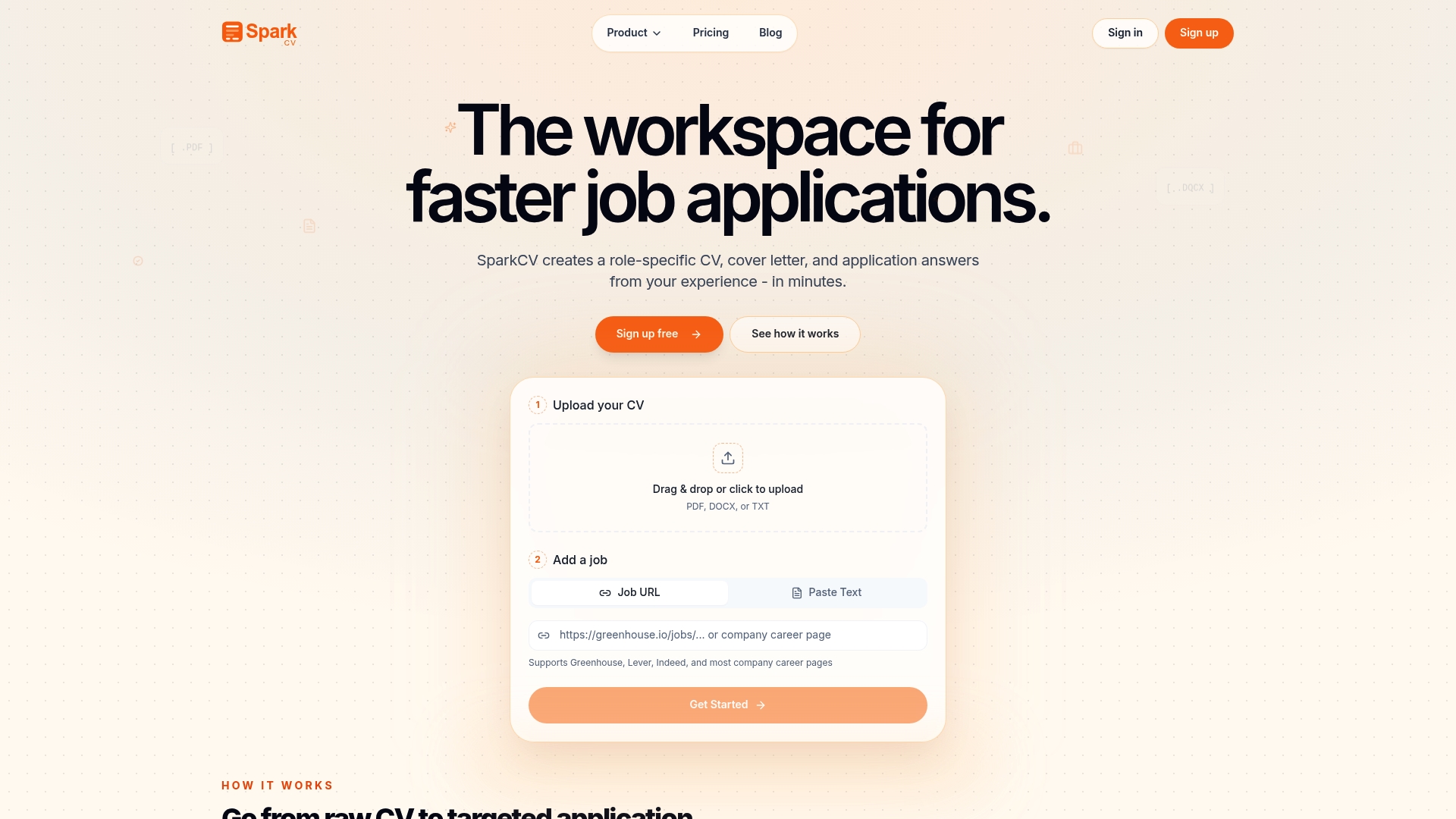
SparkCV’s keyword matching identifies gaps between your current CV and the role’s requirements. Its format checks flag layout issues that could block ATS scanning. You also get a tailored cover letter and answers to application questions built from your own experience. For entry-level candidates who need every application to count, SparkCV removes the guesswork from tailoring and gives you a polished submission every time. Get started with SparkCV and put your best application forward.
FAQ
What is an entry-level CV?
An entry-level CV is a one-page document that presents your education, skills, and relevant experiences to an employer when you have limited or no formal work history. It focuses on your potential and transferable abilities rather than a long career record.
What should I include in an entry-level CV with no experience?
Include your education, a tailored career objective, a skills summary, and any relevant experience such as volunteer work or internships. Extracurricular activities and academic projects also demonstrate skills that employers value.
How long should an entry-level CV be?
An entry-level CV should be one page. Recruiters spend very little time on an initial read, so a concise, well-structured page is more effective than two pages of diluted content.
What is the best format for an entry-level CV?
A chronological or functional format works best. Use chronological if you have relevant internships or placements, and functional if you are relying primarily on skills and education to make your case.
How do I make my entry-level CV ATS-friendly?
Use a simple layout with standard fonts, clear section headings, and no graphics or text boxes. Mirror the job description’s keywords throughout your skills and experience sections to improve your ATS score.
Recommended reads
Keep exploring






Hear more from SparkCV
Leave your email for new articles, onboarding invites, and launch news.
We’ll only use this for SparkCV emails, and you can unsubscribe any time.