
What is a tailored CV? your 2026 job application guide

A tailored CV is a customised version of your CV, edited to highlight the qualifications that align specifically with a particular job description. Unlike a generic CV sent to every employer, a targeted CV prioritises and frames your most relevant skills and experience so both ATS (applicant tracking system) parsers and human recruiters quickly see the match. Tools like SparkCV and services such as ATS Verification have made this process faster and more precise than ever. The difference between landing an interview and being filtered out often comes down to this one adjustment.
What is a tailored CV and why does it matter in 2026?
A tailored CV is defined as a customised, job-specific document that adjusts key sections to emphasise qualifications matching a particular role. You are not rewriting your entire career history. You are reorganising prominence, mirroring the employer’s language, and surfacing the most relevant proof of your abilities first.
Generic CVs treat every job the same. A tailored CV treats each application as a unique case. That distinction matters because tailored CVs generate 2–3 times more interview callbacks than generic ones. Recruiters spend seconds scanning a CV, and a document that immediately reflects their priorities earns more attention.
ATS compatibility is the other critical factor. Most large employers use ATS software to filter applications before a human ever reads them. A CV that does not contain the right keywords in the right sections will be ranked lower or rejected outright. Tailoring your CV to each role is the most direct way to avoid early rejection at the screening stage.

Which CV sections should you tailor for each application?
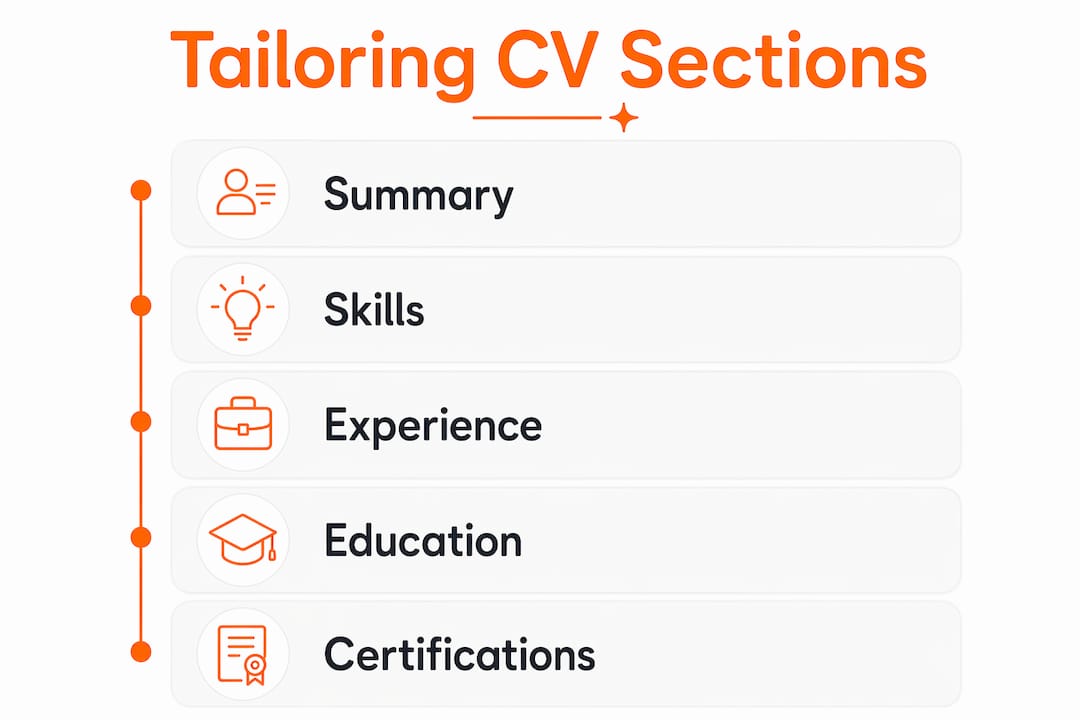
You do not need to overhaul your entire CV for every role. Adjusting three core sections is sufficient to create a strong, targeted application.
- Professional summary or profile. This is the highest-impact section to tailor quickly. It functions as your elevator pitch and should mirror the top two or three priorities from the job advertisement. If the role emphasises stakeholder management and data analysis, your summary should open with exactly those capabilities.
- Skills section. Reorder your skills list so the most relevant competencies appear first. If the job description lists Python, SQL, and data visualisation, those should lead your skills section, not sit buried at the bottom.
- Experience bullets. Select and adjust two or three bullet points per role to reflect the language and priorities of the job ad. You are not fabricating experience. You are choosing which genuine achievements to surface and how to phrase them.
- Certifications and awards. Include only those directly relevant to the role. A marketing certification is worth listing for a digital marketing position but adds noise to a finance application.
Pro Tip: Place each key term from the job description in your summary, your skills list, and at least one experience bullet. This keyword redundancy improves your ATS score and makes relevance immediately clear to a recruiter scanning your CV.
How do you avoid common tailoring mistakes?
Tailoring a CV incorrectly can be as damaging as not tailoring it at all. These are the four most common errors and how to avoid them.
- Copying the job description verbatim. Pasting phrases directly from the job ad triggers ATS penalties and raises recruiter scepticism. Echo the employer’s language, but tie every claim to a measurable outcome or real experience you can evidence.
- Keyword stuffing. ATS engines now penalise excessive repetition of the same term. Use each keyword naturally across sections rather than forcing it into every sentence.
- Only adjusting the skills list. Many candidates stop there. A more effective method is redundancy across summary, skills, and experience bullets, which reinforces relevance at every stage of review.
- Claiming skills you cannot evidence. Every skill or competency you list should be backed by a specific achievement, project, or result. Recruiters probe these claims in interviews.
Pro Tip: Before submitting, scan your CV and count how many times each key job requirement appears. If a critical skill appears only once, add it to one more section with a concrete example attached.
Authenticity is the foundation of effective tailoring. Your goal is to make genuine relevance visible, not to manufacture a false fit.
How to create a tailored CV step by step
The entire process takes 10–15 minutes per application when you follow a structured workflow. Here is how to do it efficiently.
- Build a master CV. A comprehensive master CV contains every role, skill, achievement, and certification from your career. You never send this document. It is your source material. SparkCV’s Career Log is designed precisely for this purpose, helping you document your full career history in one place.
- Read the job description carefully. Identify the top five to seven required skills and responsibilities. Note the exact language the employer uses.
- Highlight priority keywords. Separate must-have requirements from nice-to-haves. Focus your tailoring on the must-haves first.
- Adjust your summary. Rewrite your profile section to open with the two or three capabilities the employer values most. Keep it to three or four sentences.
- Reorder your skills section. Move the most relevant skills to the top of the list. Remove skills that add no value for this specific role.
- Select and refine experience bullets. Pull the most relevant achievements from your master CV. Rephrase them to use the employer’s terminology where it fits naturally.
- Verify with an ATS tool. Use SparkCV or an ATS verification service to check keyword placement and scoring before you submit.
For batches of similar roles, you can reuse the same tailored version with minor adjustments. Unique or senior positions warrant a fresh tailoring pass each time.
Tailored CV vs standard CV: what the data shows
The performance gap between a tailored CV and a generic one is significant and well documented.
| Factor | Standard CV | Tailored CV |
|---|---|---|
| Interview callback rate | Baseline | 2–3 times higher |
| ATS keyword match score | Low to moderate | High, with structured placement |
| Recruiter reading time | Seconds, often discarded | Longer, with clear relevance signals |
| Effort per application | Low | 10–15 minutes per role |
| Risk of rejection at screening | High | Significantly reduced |
A generic CV asks the recruiter to infer your relevance. A targeted CV connects the dots directly, surfacing the right terms in the right sections so neither the ATS nor the recruiter has to work to understand your fit.
The recruiter preference is equally clear. When a CV immediately reflects the priorities of the role, it reads as prepared and professional. A generic CV, regardless of the candidate’s actual ability, signals low effort.
Tailored CV examples across different industries
How you tailor your CV changes depending on the sector. Here are three practical examples.
- Technology roles. A software engineer applying for a Python-focused backend role should lead their summary with backend development and Python experience, reorder their skills to list Python, Django, and REST APIs first, and select experience bullets that reference specific system performance improvements or deployment outcomes.
- Finance roles. A candidate applying for a financial analyst position should mirror language around financial modelling, variance analysis, and stakeholder reporting. Certifications like CIMA or ACA should appear prominently if listed in the job description.
- Marketing roles. For a content marketing manager role, your summary should open with content strategy and SEO expertise. Bullets should reference measurable outcomes such as organic traffic growth or campaign conversion rates.
Recent graduates face a specific challenge: limited work experience. The solution is to tailor your education section and project descriptions with the same discipline. If a graduate role requires data analysis skills, a relevant dissertation or university project using Excel or R belongs in your CV, framed with the employer’s language.
Pro Tip: When adapting your CV for a different industry, check whether soft skills like communication, project management, or stakeholder engagement appear in the job description. These transfer across sectors and are worth surfacing explicitly.
Key takeaways
A tailored CV consistently outperforms a generic one because it connects your genuine qualifications directly to what each employer is looking for.
| Point | Details |
|---|---|
| Definition of a tailored CV | A job-specific CV that adjusts key sections to match a particular role’s requirements. |
| Sections to prioritise | Tailor your summary, skills order, and selected experience bullets for each application. |
| Keyword redundancy | Place each key term in your summary, skills list, and at least one experience bullet. |
| Avoid keyword stuffing | Echo employer language tied to real achievements; never copy job descriptions verbatim. |
| Time investment | A structured tailoring process takes 10–15 minutes per application using a master CV. |
Speed up your CV tailoring with SparkCV
Tailoring every CV manually is effective but time-consuming. SparkCV removes the friction by analysing your existing CV alongside the job description and generating a targeted version in minutes.
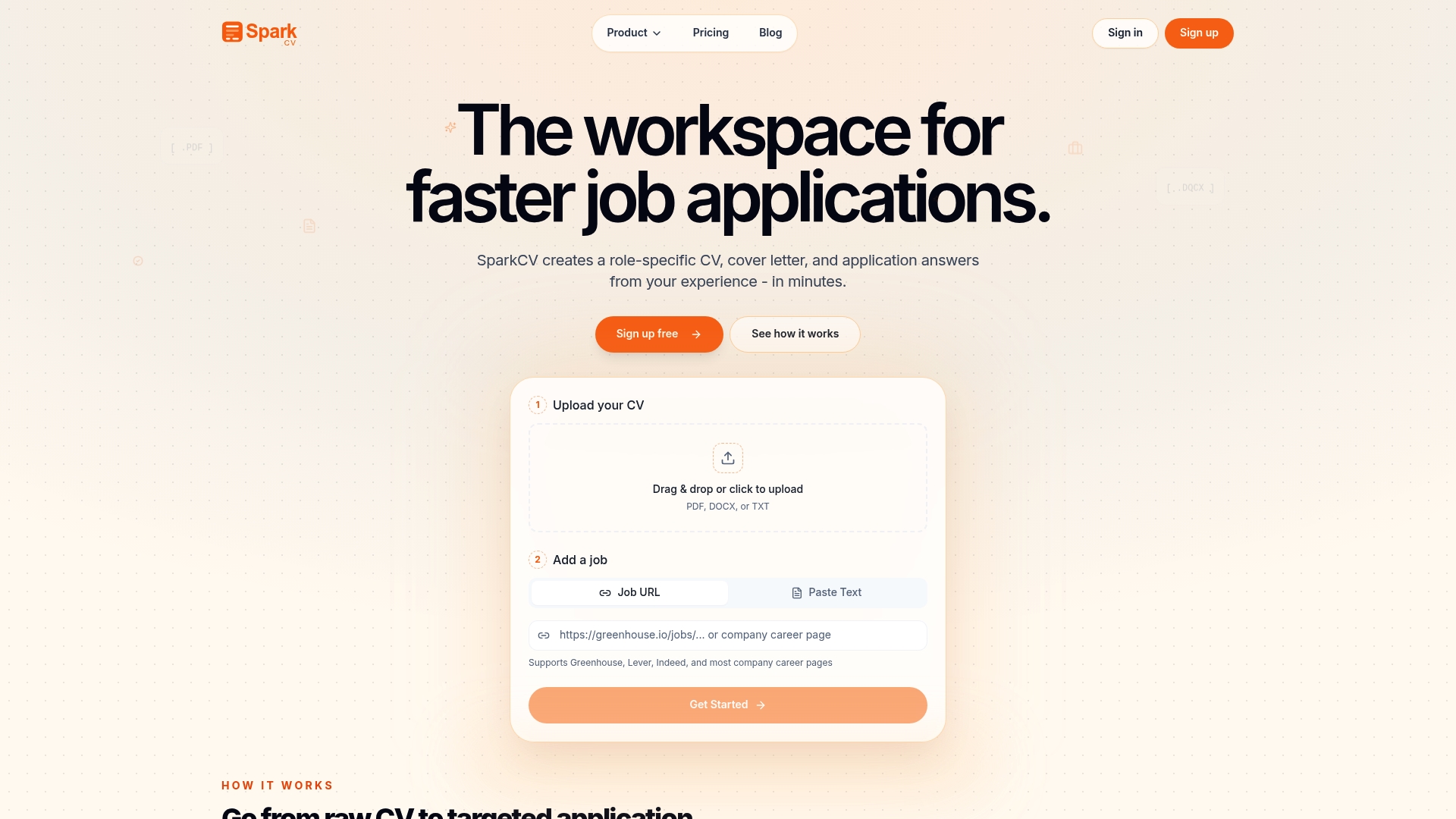
SparkCV’s keyword matching technology identifies the terms your application is missing and places them accurately across your summary, skills, and experience sections. The platform produces ATS-friendly output, so your CV is optimised for both automated screening and human review. You also get access to tailored cover letters and application question answers, giving you a complete, consistent application package. Follow the CV tailoring checklist alongside SparkCV to get the best results. Get started free and see the difference a properly targeted CV makes.
FAQ
What is a tailored CV in simple terms?
A tailored CV is a version of your CV edited specifically for one job, using the employer’s language and prioritising the skills and experience most relevant to that role.
How long does it take to tailor a CV?
A structured tailoring process takes 10–15 minutes per application when you work from a comprehensive master CV.
Does tailoring a CV really improve interview chances?
Yes. Tailored CVs generate 2–3 times more interview callbacks than generic ones, according to data from multiple job boards.
What sections of a CV should i tailor?
Focus on your professional summary, skills section order, and two or three experience bullets per role. You do not need to rewrite your entire career history for each application.
Can recent graduates benefit from tailoring their CV?
Graduates can tailor their education section, project descriptions, and skills list to reflect the language and priorities of each role, even without extensive work experience.
Recommended reads
Keep exploring






Hear more from SparkCV
Leave your email for new articles, onboarding invites, and launch news.
We’ll only use this for SparkCV emails, and you can unsubscribe any time.