
What is a professional CV refresh? Your 2026 guide

A professional CV refresh is the process of updating your existing CV to keep it current, competitive, and aligned with what employers and applicant tracking systems (ATS) actually look for, without rewriting the whole document from scratch. It is a targeted, tactical update: you sharpen your accomplishments, modernise your formatting, and swap in the right keywords for the roles you want. Done well, a CV refresh is one of the most efficient career moves you can make.
Table of Contents
- What a professional CV refresh actually means
- When should you refresh your CV?
- How to refresh your CV step by step
- Common mistakes that undermine a CV refresh
- How to tailor your CV for the UK job market and ATS
- How SparkCV can accelerate your CV refresh
- Before and after: what a CV refresh looks like in practice
- How to proofread and finalise your refreshed CV
- How to incorporate new skills, achievements, and experiences
- Key takeaways
- SparkCV makes your next CV refresh faster and sharper
What a professional CV refresh actually means
A CV refresh is not a cosmetic tidy-up. It is a strategic update of the content, structure, and language of your CV to reflect where you are now in your career and where you want to go next. Think of it as the difference between repainting a room and knocking down walls: the structure stays, but everything that was tired or irrelevant gets replaced.
The core elements of a professional CV refresh include:
- Updating accomplishments with recent, quantifiable results rather than vague responsibilities
- Modernising the format so it reads clearly on screen and passes ATS software without errors
- Refreshing keywords to match the language used in current job adverts in your sector
- Removing outdated content such as roles from more than 10–15 years ago or obsolete skills
- Rewriting your professional summary to reflect your current career goals, not where you were five years ago
The key distinction between a refresh and a full rewrite comes down to how much has changed. A CV that is 1–3 years old and reflects a consistent career direction typically needs a refresh, not a rebuild. A CV older than 3–5 years, or one that no longer matches your career direction, may need more substantial work.
Treating your CV as a living document, rather than a one-off task, is the mindset shift that separates professionals who are always ready for an opportunity from those who scramble when one appears.
When should you refresh your CV?
The short answer: before you need it. Waiting until you are actively job hunting to update your CV puts you under unnecessary pressure and increases the risk of missing details that matter.
Common triggers that signal it is time for a professional CV update include:
- A new role, promotion, or project you have completed and want to capture
- A shift in your target sector or job title that requires different keywords and framing
- Changes in your industry such as new tools, certifications, or in-demand skills becoming standard
- A gap of six months or more since your last update
- An upcoming performance review or appraisal where you want your achievements documented
Career experts recommend annual CV refreshes as a baseline for professionals who are not actively job seeking. For those in fast-moving sectors or actively looking, a quarterly review is more practical. The risk of an outdated CV is not just aesthetic: it can mean your application is filtered out before a human ever reads it, particularly when ATS software is screening for specific terms you have not included.
CV maintenance also serves a purpose beyond job applications. Reviewing your CV regularly prompts you to reflect on your progress, identify gaps in your skills, and spot achievements you might otherwise forget to record.

How to refresh your CV step by step
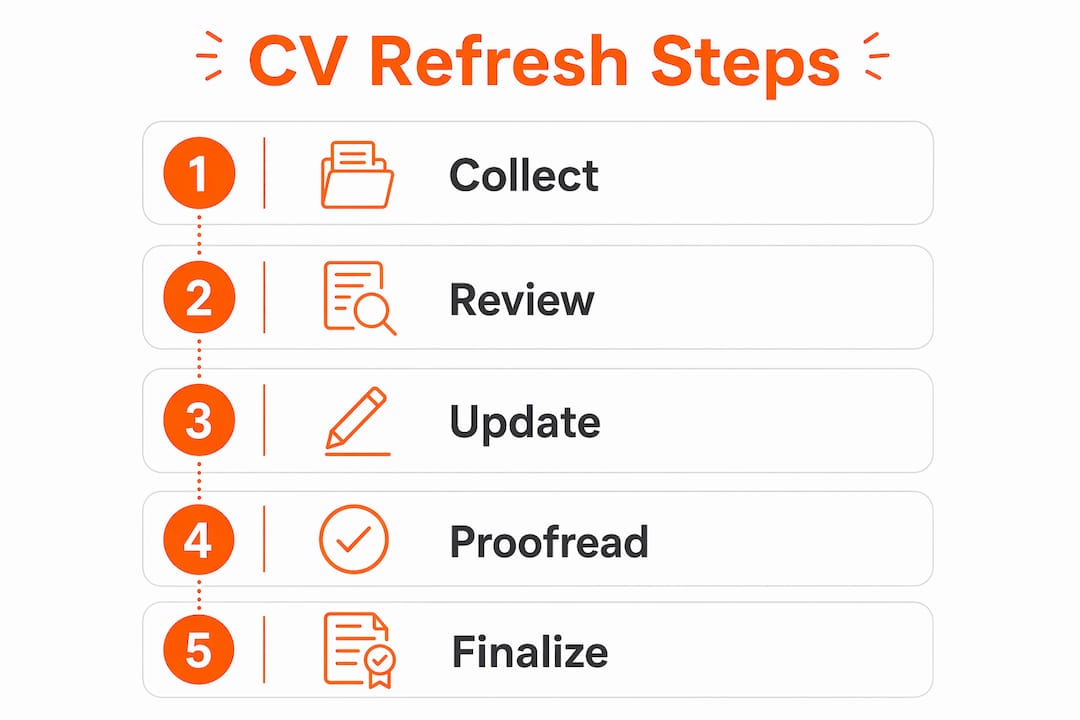
A structured approach produces far better results than editing on the fly. Work through these steps in order:
-
Audit your current CV. Read it as a recruiter would. Note anything that feels vague, outdated, or irrelevant to the roles you are targeting now.
-
Add recent accomplishments with metrics. Recruiters respond to evidence, not descriptions. Use the formula: action verb + task + measurable result. “Led a cross-functional team” becomes “Led a 12-person team to deliver a product launch three weeks ahead of schedule, generating £400k in first-quarter revenue.”
-
Rework bullet points to focus on results. Every bullet should answer the question: so what? If a bullet describes what you did without explaining the outcome, rewrite it.
-
Update your keywords. Pull three to five recent job adverts for your target role and note the terms that appear repeatedly. Integrate those naturally into your CV, particularly in your summary and skills section, to improve ATS compatibility.
-
Trim roles older than 10–15 years. Summarise early-career positions in two to three lines rather than giving them equal weight to recent experience. This sharpens relevance and reduces age bias signals.
-
Modernise your formatting. Fonts and layouts that looked polished five years ago can now appear dated and may not render correctly in ATS software. Clean, single-column layouts with clear section headers and consistent spacing are the current standard.
-
Remove irrelevant or obsolete skills. Skills like “proficient in Microsoft Word” or outdated software versions add clutter without adding value. Replace them with tools and competencies that are genuinely in demand in your field.
-
Tailor focused versions for specific roles. Your master CV is the complete record. For each application, create a focused version that emphasises the most relevant experience and keywords for that particular role. A CV tailoring checklist can help you work through this efficiently.
Pro Tip: Keep a running master CV document and add achievements as they happen, not six months later when the details have faded. A brief note at the time, such as the outcome of a project or a piece of positive feedback, takes two minutes and saves hours when you next refresh.
Common mistakes that undermine a CV refresh
A refresh can backfire if you fall into these traps. Career advisors consistently flag the following as the most damaging errors:
- Outdated contact details. An old email address or a phone number you no longer use will cost you interviews. Check every line of your contact section.
- Clichés and generic self-descriptions. Phrases like “results-driven professional” or “passionate team player” tell a recruiter nothing. Replace them with specific evidence.
- Keyword stuffing. Packing your CV with keywords in an unnatural way reads poorly to human reviewers and can trigger ATS filters. Integrate terms where they fit the context.
- Inconsistent formatting. Mixed fonts, irregular spacing, or different date formats across sections signal carelessness. Recruiters notice.
- Keeping an objective statement. Objective statements are largely obsolete. A concise professional summary that highlights your value to the employer is the current standard.
- Leaving in irrelevant older roles. A position from 20 years ago in an unrelated field adds length without adding relevance. Removing outdated details sharpens the overall impression.
- Neglecting the skills section. Listing skills that no longer reflect your actual capabilities, or omitting skills that are now central to your work, both create problems.
How to tailor your CV for the UK job market and ATS
UK employers and their ATS software have specific expectations that differ from other markets. Aligning your refreshed CV with those expectations directly affects whether it gets read.
- Mirror the language in job adverts. UK job postings use particular terminology that varies by sector. If a role specifies “stakeholder management” rather than “client relations,” use that phrase.
- Use a clean, ATS-friendly format. Avoid tables, text boxes, headers and footers, and graphics. ATS software often cannot parse these correctly, which means your content may not be read at all.
- Lead with measurable achievements. UK hiring managers favour candidates who can demonstrate impact. Quantify wherever possible: budget managed, percentage improvement, team size, revenue generated.
- Keep it to two pages. The UK standard for most professional roles is a two-page CV. Academic or senior executive roles may run longer, but two pages is the default expectation.
- Adapt your terminology. The National Careers Service notes that a CV should reflect your skills, achievements, and experience clearly. Use British English spelling and UK-standard job titles throughout.
- Stay current on hiring trends. Skills assessments and AI-driven screening tools are increasingly common in UK recruitment. Understanding how these systems evaluate candidates helps you present your experience in the most effective way.
How SparkCV can accelerate your CV refresh
AI technology has changed what is possible when updating a CV. SparkCV uses advanced extraction technology to analyse your existing CV alongside a specific job description, then generates a tailored version in minutes. That means you are not manually cross-referencing keywords or reformatting sections by hand for every application.
SparkCV’s capabilities that directly support a professional CV refresh include:
- Keyword matching and gap analysis to identify which terms from a job advert are missing from your current CV
- ATS-friendly formatting applied automatically so your document passes automated screening
- Tailored CV versions generated for specific roles without altering your master document
- Cover letter generation aligned to the same job description, saving additional time
- Answers to application questions drafted from your existing experience, accessible via SparkCV’s application tools
The practical result is that you spend less time on formatting and keyword guesswork, and more time on the substance of your application. For professionals refreshing their CV across multiple roles or sectors, that efficiency adds up quickly.
Before and after: what a CV refresh looks like in practice

The difference between a refreshed CV and an outdated one is most visible at the bullet-point level. Here are two examples of the same experience, before and after a refresh.
Before: “Responsible for managing the marketing team and overseeing campaigns.”
After: “Managed a six-person marketing team, delivering a rebranding campaign that increased website traffic by 34% over three months.”
The before version describes a role. The after version demonstrates an outcome. Recruiters spend seconds on each CV; the second version gives them a reason to keep reading.
A second common transformation involves the professional summary. A generic opening like “Experienced project manager with strong communication skills” becomes “Project manager with eight years in financial services, specialising in regulatory change programmes and cross-functional delivery.” The revised version is specific, searchable, and immediately relevant to a target employer.
Formatting changes are equally visible. A CV with dense paragraphs, multiple font sizes, and a photo (not standard in UK CVs) becomes a clean two-page document with clear section headers, consistent bullet points, and no extraneous design elements. The content is the same; the presentation makes it readable in seconds rather than minutes.
How to proofread and finalise your refreshed CV
Proofreading is the step most professionals rush, and it is where avoidable errors slip through. A single typo in your name, contact details, or a job title can undermine an otherwise strong application.
Work through your CV in this order. First, read it aloud from top to bottom. Your ear catches errors your eye skips. Second, check every date, job title, and employer name for accuracy and consistency. Third, run a spell-check set to British English, not US English, since the two differ on common words. Fourth, ask a trusted colleague or friend to read it cold. A fresh pair of eyes will spot gaps in logic or unclear phrasing that you have become blind to after multiple edits.
Pay particular attention to your contact section. Confirm your email address, phone number, LinkedIn URL, and any portfolio links all work correctly. An unreachable candidate is an ignored candidate.
Finally, save and export your CV as a PDF unless the job advert specifically requests a Word document. PDFs preserve your formatting across devices and operating systems, which matters when your document is opened on a recruiter’s screen.
How to incorporate new skills, achievements, and experiences
The most common reason professionals avoid updating their CV is that they cannot remember what they have done. The solution is a career log: a simple running document where you record wins, completed projects, new skills, and positive feedback as they happen.
When it comes to incorporating new material into your refreshed CV, apply these principles:
Lead with impact, not activity. A new certification is worth including, but only if you frame it in terms of what it enables you to do. “Completed Google Analytics 4 training” is weaker than “Qualified in Google Analytics 4; now leading data reporting for three client accounts.”
Position new skills where they are most visible. If a skill is central to your target role, it belongs in your professional summary and your skills section, not buried in a bullet point from a recent role. Soft skills, often underestimated, can be significant differentiators when framed with evidence.
Be selective. Not every course, project, or responsibility belongs on your CV. Ask whether each addition strengthens your case for the roles you are targeting. If it does not, leave it in your career log for reference but keep it off the document.
Update your education section carefully. Add recent professional development, qualifications, and memberships. Remove or condense older academic qualifications if they are no longer the most relevant part of your profile.
Key takeaways
A professional CV refresh, done regularly and with the right focus on results and keywords, is the most efficient way to stay competitive in the UK job market without starting from scratch each time.
| Point | Details |
|---|---|
| Refresh, do not rewrite | A CV that is 1–3 years old and reflects a consistent career direction needs a refresh, not a full rebuild. |
| Results over responsibilities | Use the formula action verb + task + measurable result to replace vague bullet points with evidence recruiters respond to. |
| ATS compatibility matters | Clean formatting and keyword alignment with current job adverts directly affects whether your CV passes automated screening. |
| Update regularly, not reactively | Annual refreshes are the baseline; quarterly reviews suit professionals in fast-moving sectors or active job searches. |
| SparkCV speeds up the process | SparkCV analyses your CV against a job description and generates a tailored, ATS-friendly version in minutes. |
SparkCV makes your next CV refresh faster and sharper
Refreshing your CV manually across multiple applications takes time you probably do not have. SparkCV gives you a faster route to the same outcome: a tailored, ATS-ready CV that reflects your actual experience and matches what a specific employer is looking for.
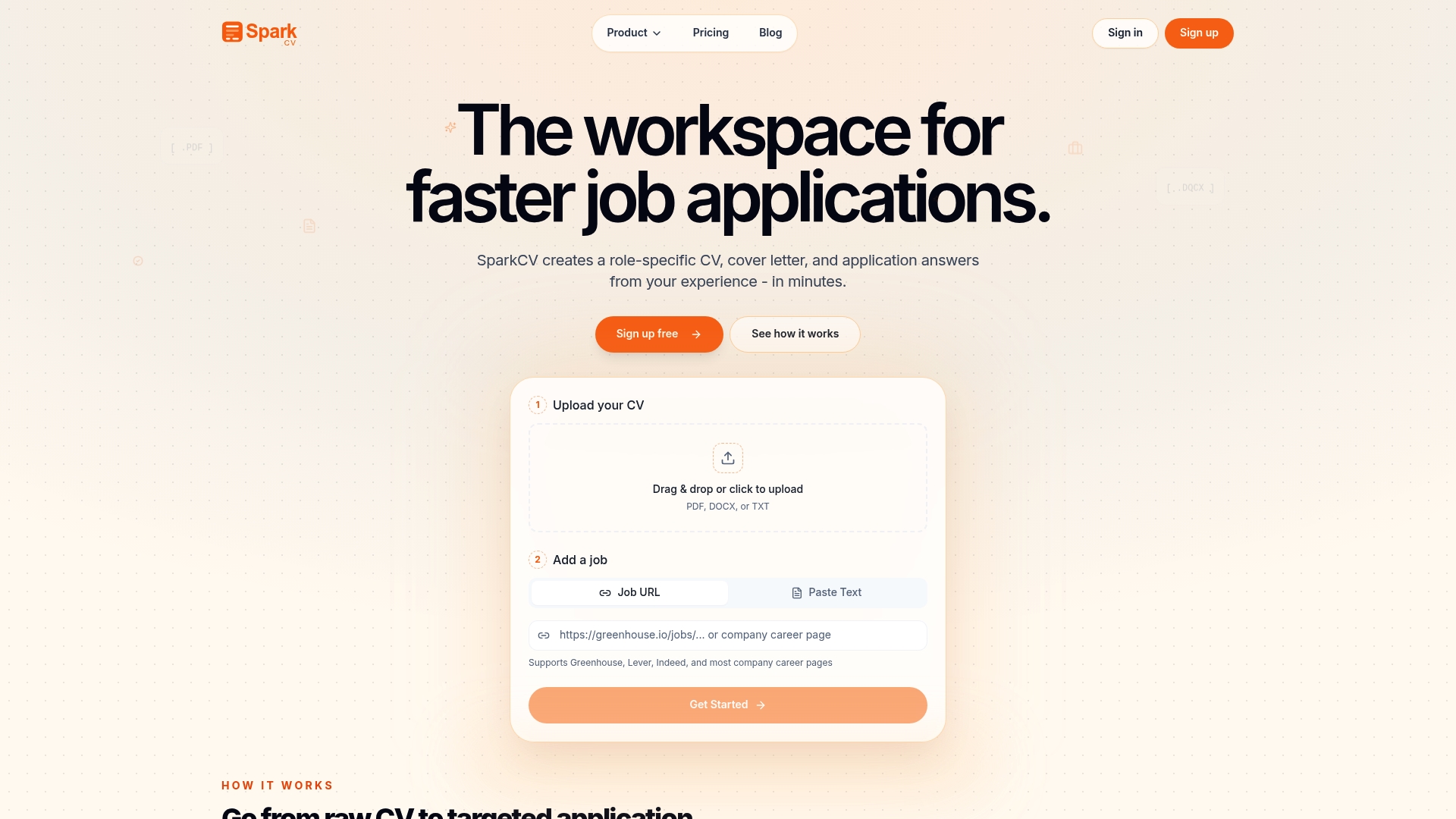
Upload your existing CV to SparkCV, paste in a job description, and the platform identifies the keyword gaps, reformats your content for ATS compatibility, and produces a focused CV version ready to submit. You also get a matched cover letter and tailored answers to application questions, all generated from your own experience. No generic templates, no manual reformatting for every role.
If your CV has not been updated in the past six months, or if you are applying for roles and not getting responses, SparkCV is the practical next step. Get started free and see the difference a properly tailored CV makes to your application rate.
Recommended reads
Keep exploring






Hear more from SparkCV
Leave your email for new articles, onboarding invites, and launch news.
We’ll only use this for SparkCV emails, and you can unsubscribe any time.