
Job application workflow best practices in 2026

Job application workflow best practices are proven systems and habits that help you organise your search, follow up on time, and prepare effectively for every stage of the hiring process. Without a structured approach, applications pile up, deadlines slip, and promising opportunities fall through the cracks. The good news is that an effective workflow turns disorganised effort into a project with defined stages, regular reviews, and the right tools, freeing your energy for relationship building and interview preparation. This guide covers the most practical steps to take right now.
1. Job application workflow best practices: start with a tracking system
A reliable job application tracking system is the foundation of any effective search. Without it, you are relying on memory, and memory fails under pressure. A recommended tracker includes eight fixed columns: Company, Role, Source, Date Applied, Resume Version, Status, Follow-Up, and Notes. This structure gives you a complete picture of every live application at a glance.
The key is consistency. Update statuses and check overdue follow-ups at least twice daily. Whether you use a spreadsheet, a notebook, or a specialised app, the tool matters less than the habit of using it. Operational discipline in recording dates and follow-ups shifts your workflow from relying on memory to following a routine, which is the single biggest win for most candidates.

Pro Tip: Keep your tracker simple. A tracker that tries to capture everything overwhelms you and gets abandoned. Focus only on the fields that solve your biggest challenges.
| Field | Purpose |
|---|---|
| Company and role | Identifies the opportunity at a glance |
| Date applied | Triggers follow-up timing |
| Status | Shows where each application stands |
| Follow-up date | Prevents missed check-ins |
| Notes | Captures interview details and contacts |
2. Build daily and weekly review habits
Tracking only works when you review it regularly. Daily updates prevent a backlog from forming, while weekly reviews help you plan next steps, improve targeting, and manage follow-ups effectively. Think of the weekly review as a brief performance check on your own search strategy.
During your weekly review, look for patterns. Are most of your applications going unanswered? That signals a CV or targeting issue. Are you getting interviews but no offers? That points to interview preparation. Your tracker gives you the data to make these judgements rather than guessing.
3. Communicate promptly and transparently with employers
Speed matters more than most job seekers realise. Rapid acknowledgment is the single most impactful lever to maintain candidate interest, and the same logic applies in reverse. When you respond to employer messages quickly, you signal professionalism and genuine interest. Aim to reply to every message within 24 hours, even if only to confirm receipt.
Use templates for routine messages such as interview confirmations or post-application follow-ups. Personalise at the moments that count, specifically when scheduling interviews or responding to offers. This balance keeps your workload manageable without sacrificing the personal touch that employers notice.
Here is a practical communication checklist:
- Reply to every employer message within 24 hours
- Send a brief follow-up email five to seven business days after submitting an application
- Confirm interview details in writing, including date, time, format, and interviewer names
- Send a thank-you note within 24 hours of every interview
- Personalise key interactions such as offer discussions, while automating routine acknowledgments
Pro Tip: Draft three or four reusable email templates before you start applying. A follow-up template, a thank-you template, and a withdrawal template will save you significant time across a long search.
4. Prepare for structured interviews using evidence-based methods
Structured interviews use standardised questions and scoring rubrics to assess every candidate against the same criteria. Validity coefficients for structured interviews range from 0.44 to 0.51, compared to just 0.20 for unstructured interviews. This means employers who use structured formats are far more likely to hire accurately, and you need to prepare accordingly.
Job seekers who understand structured interviewing prepare examples that precisely match assessment criteria, which significantly improves performance in standardised hiring processes. The STAR method (Situation, Task, Action, Result) is the most widely recognised framework for structuring behavioural answers. Prepare at least one strong STAR example for each core competency listed in the job description.
After each interview, record your answers while they are fresh. Evidence-focused notes capturing specific questions and concrete answers help you prepare for second rounds and write grounded follow-up emails. Avoid vague impressions. Write down what you actually said.
Job seekers can emulate employer use of scorecards by keeping concise, evidence-focused notes during interviews describing their answers and examples, which aids preparation and follow-up.
- Review the job description and identify the five to eight core competencies being assessed
- Prepare one to two STAR examples per competency
- Practise answers aloud, timing yourself to stay within two minutes
- After each interview, log the questions asked and the answers you gave
- Use your notes to refine answers before the next round
5. Tailor every CV to the specific role
Sending a generic CV to every role is one of the most common and costly mistakes in any job search. Applicant tracking systems (ATS) filter applications by keyword match before a human ever reads them. A CV that does not reflect the language of the job description is likely to be filtered out automatically. Use a CV tailoring checklist to make sure each submission mirrors the role’s requirements precisely.
The practical approach is to keep a master CV with all your experience, then create a focused version for each application. Adjust your professional summary, reorder bullet points to prioritise relevant achievements, and incorporate keywords directly from the job posting. This process takes time, but it measurably increases your interview rate.
6. Use technology tools to manage your application workflow
AI-powered tools now handle many of the repetitive tasks that drain job seekers’ time. These tools automate CV tailoring, follow-up email generation, and application tracking, saving time and reducing errors. The result is more applications submitted at higher quality, with fewer missed follow-ups.
The most useful tools for job seekers in 2026 fall into three categories:
- CV tailoring tools: Analyse job descriptions and adjust your CV to match, improving ATS keyword scores
- Application trackers: Dedicated apps that log applications, set reminders, and surface overdue follow-ups automatically
- Calendar and reminder integrations: Pairing your tracker with Google Calendar or Microsoft Outlook ensures you never miss a deadline
Integrating reminders and alerts with your application tracker prevents lost opportunities caused by simple oversight. Set a reminder for every follow-up date you log.
Pro Tip: Do not adopt every tool at once. Pick one tracker and one CV tool, use them consistently for two weeks, and only add more if you identify a genuine gap.
| Tool type | Best for | Example use case |
|---|---|---|
| CV tailoring | ATS keyword matching | Adjusting skills section per role |
| Application tracker | Status and follow-up management | Logging 20+ live applications |
| Calendar integration | Deadline and reminder management | Follow-up alerts five days post-application |
| AI writing assistant | Follow-up and cover letter drafts | Generating personalised thank-you emails |
7. Automate where possible, personalise where it counts
Automation and personalisation are not opposites. The most effective approach combines both. Automate the tasks that are repetitive and low-stakes, such as logging applications, setting follow-up reminders, and generating first drafts of cover letters. Reserve your personal attention for high-stakes moments: tailoring your opening paragraph, writing a post-interview thank-you, or crafting a response to a job offer.
Recruitment professionals note that responsive feedback and efficient workflows significantly improve candidate experience. As a job seeker, mirroring that responsiveness on your end signals that you are organised and serious. Employers notice when candidates follow up promptly and communicate clearly.
Key takeaways
An effective job application workflow combines systematic tracking, prompt communication, structured interview preparation, and targeted CV tailoring to convert more applications into interviews.
| Point | Details |
|---|---|
| Use a fixed-field tracker | Log company, role, dates, status, and follow-up dates for every application. |
| Communicate within 24 hours | Reply to all employer messages promptly to maintain engagement and signal professionalism. |
| Prepare STAR examples | Match your interview answers to the core competencies listed in each job description. |
| Tailor every CV | Adjust keywords and bullet points for each role to pass ATS filters and impress recruiters. |
| Automate routine tasks | Use AI tools for CV drafts and reminders, then personalise at key moments. |
How SparkCV can sharpen your application workflow
SparkCV is built specifically for job seekers who want to apply smarter, not just faster. It analyses your existing CV alongside the job description and generates a tailored, ATS-friendly version in minutes, removing the most time-consuming part of any application workflow.
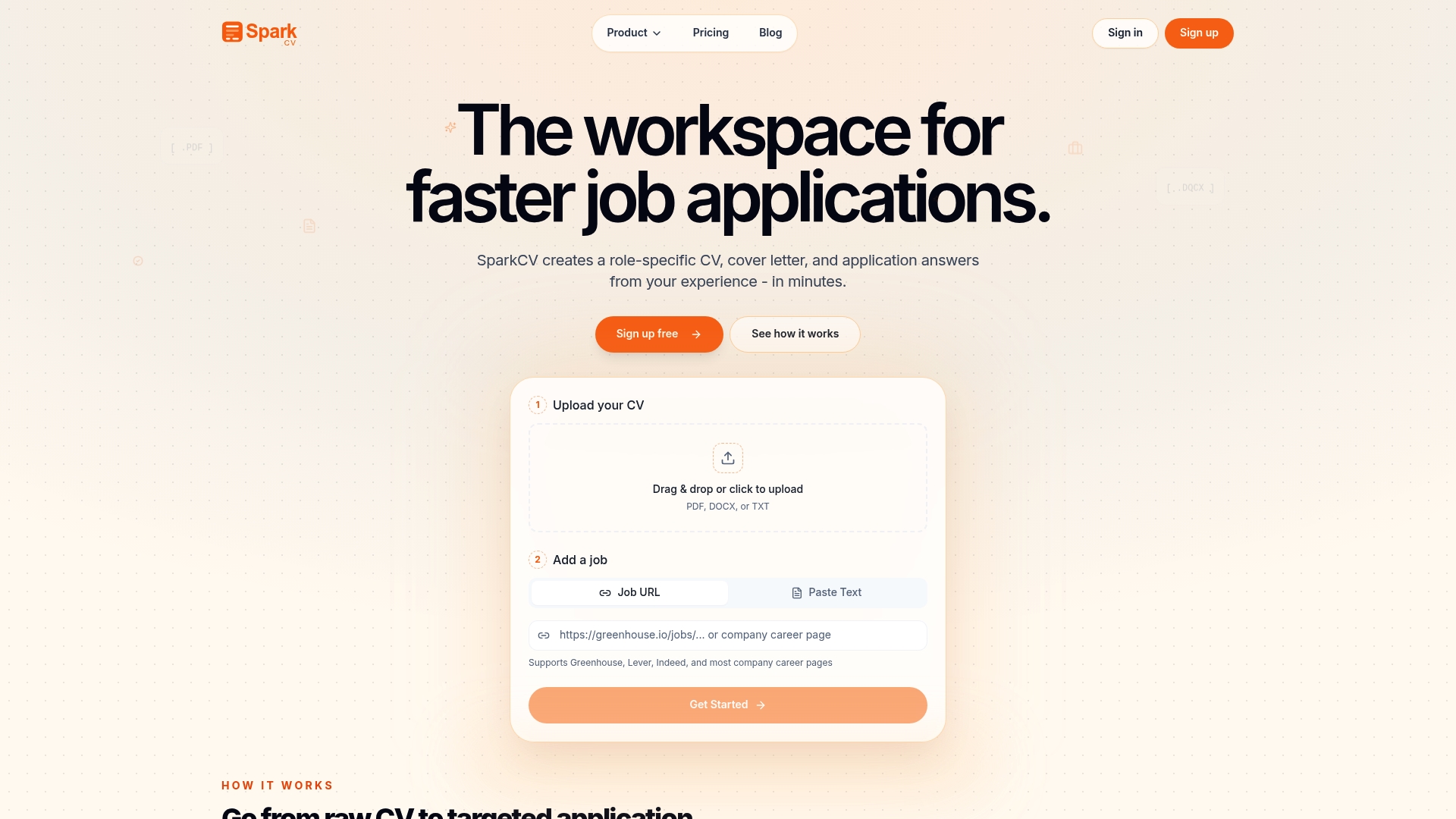
Beyond CV tailoring, SparkCV produces cover letters and tailored application question answers aligned to each role’s requirements. You can also use the SparkCV career log to track your applications and keep your search organised in one place. If you are ready to apply with confidence and consistency, get started with SparkCV today.
FAQ
What is a job application workflow?
A job application workflow is a structured system for managing every stage of your search, from identifying roles and submitting applications to following up and preparing for interviews. It replaces ad hoc effort with a repeatable, organised process.
How many fields should my application tracker include?
A practical tracker needs eight fields: Company, Role, Source, Date Applied, Resume Version, Status, Follow-Up, and Notes. Adding more fields than you will actually use reduces consistency and defeats the purpose.
How do structured interviews affect my preparation?
Structured interviews use standardised questions and scoring rubrics, so preparing specific STAR examples aligned to the job’s core competencies gives you a measurable advantage. Validity coefficients for structured formats reach 0.51, compared to 0.20 for unstructured interviews.
When should I follow up after submitting an application?
Send a brief, professional follow-up email five to seven business days after submitting your application. If you have not heard back after a second follow-up, move your focus to active opportunities and revisit only if the role remains posted.
Can AI tools genuinely improve my application success rate?
Yes. AI tools that tailor CVs to job descriptions improve ATS keyword matching, which increases the likelihood of your application reaching a human reviewer. The key is using them to personalise content, not to generate generic submissions at volume.
Recommended reads
Keep exploring






Hear more from SparkCV
Leave your email for new articles, onboarding invites, and launch news.
We’ll only use this for SparkCV emails, and you can unsubscribe any time.