
How to tailor your CV for short-term contracts

A short-term contract CV is a targeted document built to communicate immediate value, clear availability, and relevant skills within seconds of a recruiter opening it. Unlike a standard CV designed for permanent roles, a contract-focused version must signal speed and delivery from the very first line. When you tailor your CV for short-term contracts correctly, you shift the reader’s attention from your career trajectory to what you can deliver right now. This guide covers exactly how to do that, from structure and content to keyword matching and common mistakes to avoid.
What should a CV for short-term contracts include?
The structure of a contract CV differs from a permanent one in a specific and deliberate way. Recruiters spend around 30 seconds scanning each CV before deciding whether to read further. That means your most valuable information must appear at the top, not buried in the third page of your work history.
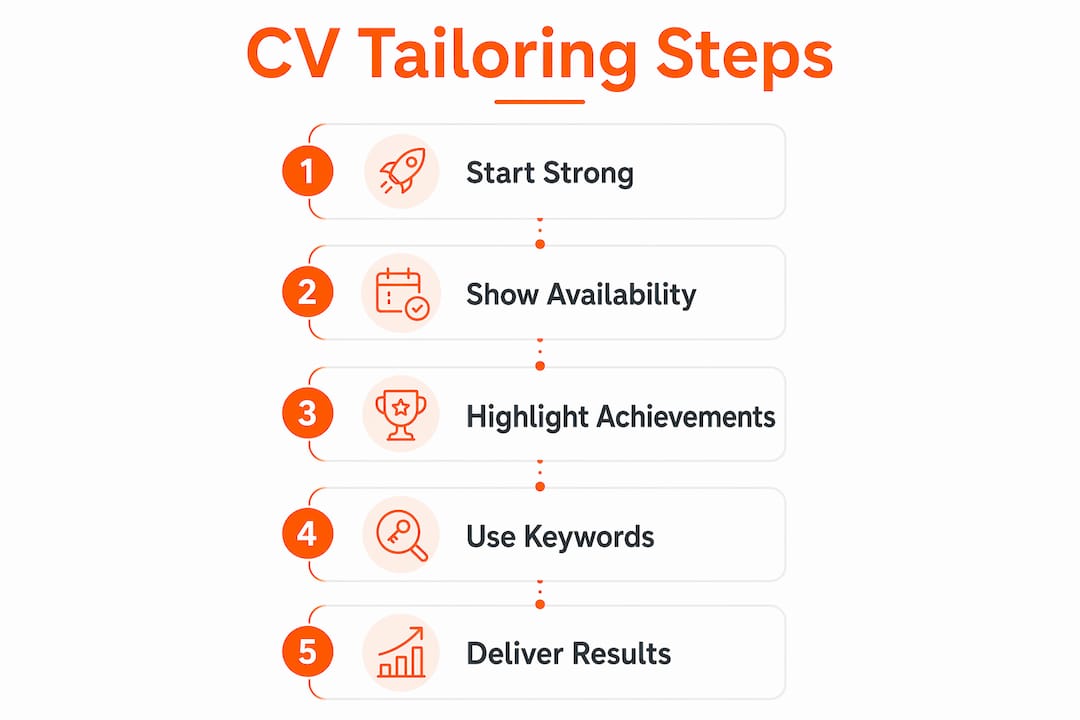
Short-term contract CV best practices point to five non-negotiable elements:
- A targeted profile summary. Write two to three sentences that state your specialism, your typical contract length, and one standout achievement. Avoid vague phrases like “experienced professional.” Instead, write: “Data analyst with five years of contract experience delivering reporting projects within four to eight week timelines.”
- A dedicated availability section. Place this near the top of your CV. Availability details near the top of a CV strongly impact screening success. Include your start date, weekly hours available, and whether you work remotely, on-site, or both.
- A skills section aligned to the role. List skills that directly match the job description. Prioritise technical competencies and tools over soft skills at this stage.
- Quantifiable achievements. Replace duty-based bullet points with outcome-focused ones. “Managed social media accounts” becomes “Grew LinkedIn engagement by 40% over a six-week contract.”
- Concise work history. Keep each role entry brief. Recruiters for contract roles want to see what you delivered, not a paragraph about your responsibilities.
Pro Tip: Use a CV tailoring checklist before submitting each application to confirm your profile, skills, and availability section all reflect the specific role you are applying for.
How should you structure contract experience on your CV?

Organising a history of short-term roles is one of the trickiest parts of writing a contract CV. Done poorly, it reads as job-hopping. Done well, it reads as a specialist with a proven track record of delivery.
Follow these steps to structure your contract experience clearly:
- Label every role as a contract. Write “3 Month Contract” or “Fixed-Term Contract” directly after the job title. This removes ambiguity and tells the recruiter the short tenure was intentional.
- Group similar roles where appropriate. If you have completed five similar data entry contracts across different companies, consider grouping them under a single heading such as “Contract Data Analyst Roles, 2022–2025.” Logical grouping helps recruiters understand your employment history at a glance.
- Lead each entry with your biggest deliverable. The first bullet point under any role should be your strongest result. “Reduced processing time by 20% within the first two weeks” is far more compelling than “Responsible for processing customer orders.”
- Keep entries to two to four bullet points. Contract roles do not need lengthy descriptions. Recruiters want to see impact, not a job specification.
- Use ATS-friendly formatting. Avoid tables, text boxes, and unusual fonts. Plain formatting with clear headings is what applicant tracking systems parse most reliably.
Here is a quick comparison of how to present the same role in two different ways:
| Approach | Example Entry |
|---|---|
| Duty-based (weak) | Responsible for managing client communications and updating CRM records daily. |
| Deliverable-based (strong) | Resolved 150+ client queries weekly, maintaining a 96% satisfaction score across a 10-week contract. |
The deliverable-based approach gives the recruiter a concrete picture of your output. That is what secures the interview.
What tools and tactics help you personalise each application?
Small customisations in your CV, particularly in the summary and skills sections, significantly improve interview callback rates. The key is to treat each job advert as a brief. Read it carefully, extract the language the employer uses, and reflect it back in your CV.
Here is how to do this efficiently:
- Identify repeated keywords. Read the job description twice and note any skills, tools, or phrases that appear more than once. These are the terms the ATS is likely scanning for.
- Mirror the employer’s language. If the advert says “stakeholder management,” use that exact phrase rather than “client liaison.” Mirroring job description keywords improves ATS compatibility and recruiter engagement.
- Rewrite your profile summary for each role. Your summary is the highest-value real estate on your CV. Spend five minutes adjusting it to reflect the specific contract you are applying for.
- Use Grammarly or Hemingway Editor to check your CV reads clearly and concisely before submitting. Errors on a contract CV signal poor attention to detail, which is fatal for short-term roles where there is no time for a learning curve.
- Check your CV against the job description using an ATS preview tool. This shows you which keywords are missing before a recruiter ever sees your application.
Pro Tip: Track your achievements across every contract as you go, not just when you need a new job. Specific metrics are far easier to recall immediately after a contract ends than six months later.
Treating short-term contracts as result-driven business engagements is the mindset shift that separates strong contract CVs from weak ones. Every bullet point should answer the question: “What did I deliver, and how does that benefit this employer?”
What mistakes undermine a short-term contract CV?
Even well-written CVs fail when they contain avoidable errors. These are the most common mistakes that reduce your chances of getting through to interview:
- Not stating availability upfront. Recruiters for flexible roles need immediate clarity on your start date and hours. If they have to guess, they move on.
- Listing responsibilities instead of results. A CV full of “responsible for” phrases tells the recruiter what your job was, not what you achieved. Replace every duty with a measurable outcome.
- Sending a generic CV. A one-size-fits-all document is the single biggest reason contract CVs get rejected before being read. Each application needs at least a tailored summary and skills section.
- Hiding the contract nature of your roles. Failing to disclose the contract nature of your work leads to confusion and reduces trust. Label every short-term role clearly.
- Overcomplicating the format. Graphics, columns, and icons may look attractive but they confuse ATS systems. A clean, single-column layout is the safest choice for contract applications.
Avoiding these errors is as important as getting the positive elements right. A CV that is clear, honest, and results-focused will always outperform a visually impressive one that buries the key information.
Key takeaways
Tailoring your CV for short-term contracts requires placing availability, quantifiable achievements, and role-specific keywords in the first third of your document, where recruiters and ATS systems look first.
| Point | Details |
|---|---|
| State availability upfront | Include your start date, weekly hours, and location preference near the top of your CV. |
| Lead with deliverables | Replace duty-based bullet points with measurable outcomes for every contract role. |
| Label contract roles clearly | Write the contract duration next to each job title to remove ambiguity. |
| Tailor for every application | Rewrite your profile summary and skills section to match each specific job description. |
| Use ATS-friendly formatting | Keep your layout clean and single-column so applicant tracking systems can read it accurately. |
How SparkCV helps you optimise your CV for contract roles
Rewriting your CV for every contract application is time-consuming. SparkCV removes that friction by analysing your existing CV alongside the job description and generating a tailored version in minutes.
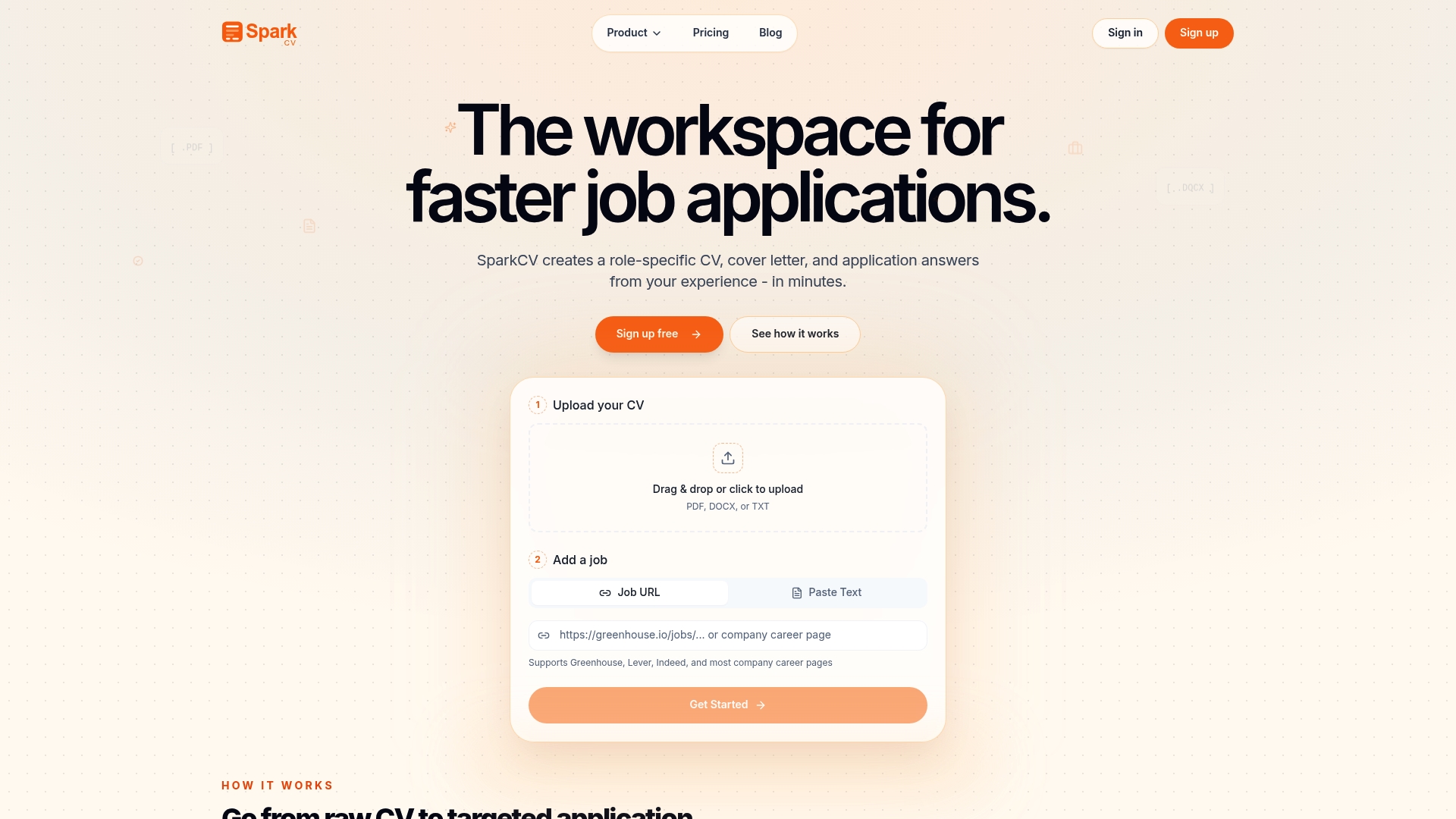
SparkCV’s keyword matching technology identifies the terms recruiters and ATS systems are scanning for, then aligns your skills and achievements accordingly. You get a polished, role-specific CV without spending hours rewriting from scratch. SparkCV also generates cover letters and answers to application questions, so your entire submission is consistent and targeted. If you apply to multiple contracts each week, the time saving alone makes it worth using. Start tailoring your CV with SparkCV today and give every application the best possible chance.
FAQ
What is the most important section on a short-term contract CV?
The availability section and profile summary are the most critical. Recruiters for contract roles need to know immediately when you can start and what you specialise in.
How do i stop multiple short contracts looking like job-hopping?
Label each role explicitly as a contract and group similar engagements together. This shows a deliberate career pattern rather than instability.
Should i send the same CV to every contract role?
No. At minimum, rewrite your profile summary and skills section for each role. Even minor tailoring significantly increases interview callback rates.
How do i show measurable impact in short-term roles?
Focus on quantifiable deliverables such as volume processed, percentage improvements, or timelines met. Even a six-week contract will have at least one outcome you can put a number to.
Does CV format matter for contract applications?
Yes. Use a clean, single-column layout without graphics or text boxes. ATS systems parse plain formatting most reliably, and contract recruiters value clarity over design.
Recommended reads
Keep exploring






Hear more from SparkCV
Leave your email for new articles, onboarding invites, and launch news.
We’ll only use this for SparkCV emails, and you can unsubscribe any time.