
How remote work history is shown on a CV

Showing remote work history on your CV is defined as explicitly labelling each relevant role as remote and demonstrating the behaviours that make distributed work succeed. This is not simply a formatting choice. ATS systems parse and filter remote job experience better when “(Remote)” is clearly tagged in job entries, meaning a missing label can cost you a shortlist position before a human ever reads your application. The standard industry term for this practice is “remote experience presentation,” and getting it right in 2026 requires both structural precision and contextual evidence of your remote competencies.
How to label and format remote work history on your CV
The single most effective formatting decision you can make is to add “(Remote)” directly next to your job title or location field for every relevant role. ATS systems recognise remote experience far more reliably when this tag appears as a structured data field, not buried in a bullet point. Treat it the same way you would treat a city name: it belongs in the location line.

Weak vs strong labelling
| Format | Example |
|---|---|
| Weak (no label) | Senior Designer, London |
| Strong (remote tagged) | Senior Designer (Remote) |
| Strong (hybrid) | Senior Designer (Hybrid, 3 days remote) |
| Strong (with time zone) | Senior Designer (Remote, GMT) |
Including your time zone is particularly useful if you worked across international teams. A recruiter hiring for a US-based remote role needs to know your overlap hours. Consistency matters too. Inconsistent use of “(Remote)” or missing location data reduces ATS parser accuracy across your entire work history.
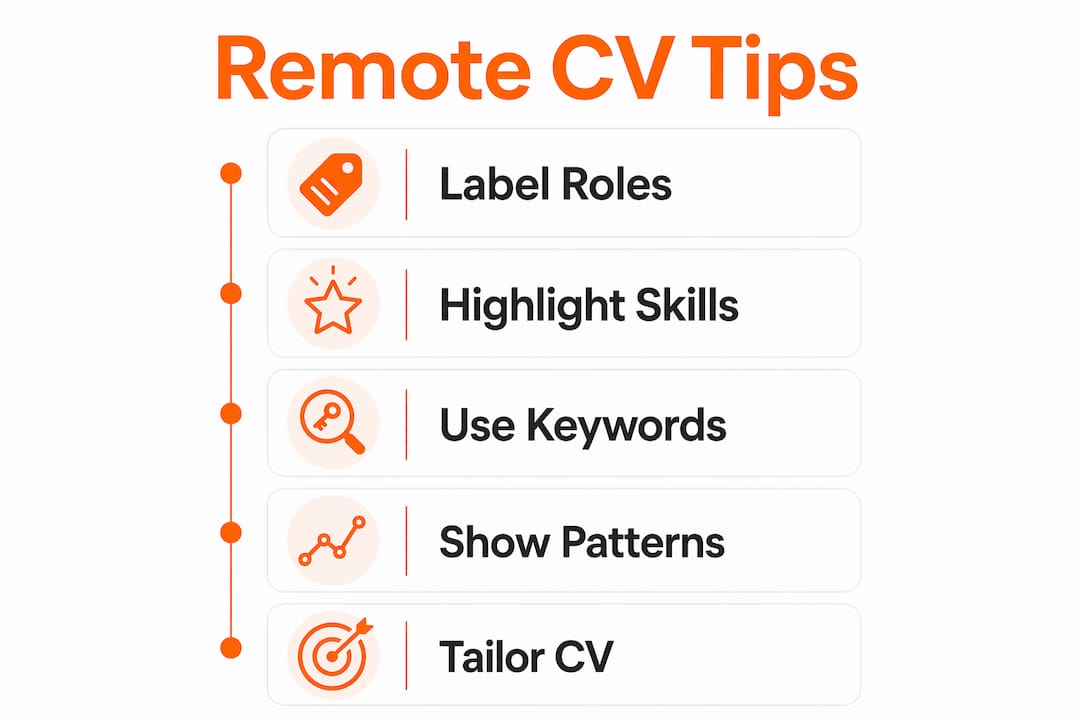
Pro Tip: Apply the “(Remote)” tag to every relevant role, not just your most recent one. Recruiters look for a pattern of remote capability, not a single instance.
What remote behaviours should you highlight beyond job titles?
Listing remote job titles without demonstrating remote behaviours is less effective than showing specific remote competencies. Recruiters want evidence that you can work independently, communicate without prompting, and deliver results without direct oversight. Your bullet points are where this evidence lives.
The behaviours that carry the most weight with hiring managers are:
- Async communication: Show that you wrote clear written updates, documented decisions, and did not rely on real-time meetings to move work forward.
- Self-directed ownership: Use phrases like “independently managed” or “owned end-to-end delivery” to signal you do not need hand-holding.
- Cross-location collaboration: Name the regions or time zones you worked across. “Coordinated with teams in Singapore and Berlin” is concrete and credible.
- Remote tool fluency: Mentioning Slack, Asana, and Notion in your bullet points increases recruiter confidence in your remote skills. These are not just tools; they are signals of a documentation-first mindset.
- Output measurement: Quantify results wherever possible. “Delivered three product launches on schedule across four time zones” is far stronger than “worked remotely on product team.”
Employers expect remote candidates to demonstrate results without direct oversight and proactive communication. Your CV must show both. Soft skills like written clarity and self-motivation are central to remote readiness, and you can read more about why soft skills matter for career progression.
Pro Tip: Scan your bullet points for phrases like “reported daily to manager” or “attended stand-ups.” These suggest oversight dependency and weaken your remote readiness signal.
How to show remote experience when your roles were not formally remote
Not every job seeker has a CV full of formally labelled remote positions. That does not mean you lack remote experience. Reframing roles to surface remote-relevant behaviours is a legitimate and effective approach.
- Identify hybrid days. If you worked from home two or three days per week, note this. “Hybrid (2 days remote)” is honest and relevant.
- Surface distributed team work. Did your office-based role involve collaborating with colleagues in other cities or countries? That counts. Name the locations and describe how you coordinated.
- Include freelance and contract work. Independent projects conducted remotely are strong evidence of remote capability. List them clearly with the “(Remote)” tag and describe how you managed client communication and delivery.
- Reframe independent problem-solving. Roles where you managed your own workload, set your own priorities, or delivered projects without close supervision all demonstrate remote readiness. Rewrite those bullet points to make the independence explicit.
- Avoid overstating COVID-era WFH. Recruiters disregard short-term WFH if the company returned to the office afterwards. Do not present a three-month lockdown period as sustained remote experience. It will not hold up to scrutiny.
For a structured approach to tailoring your CV for specific roles, the CV tailoring checklist from SparkCV walks you through the process step by step.
Common mistakes that undermine your remote work signals
Most CVs that fail to land remote roles make the same errors. Recognising them is the first step to fixing them.
- No explicit label. Leaving “(Remote)” off a role means ATS and recruiters may not register it as remote experience at all.
- Missing tool references. If you used Slack, Notion, or Asana daily but never mention them, you lose a key credibility signal.
- Oversight-dependent language. Phrases like “reported daily” suggest you needed close management, which is the opposite of what remote employers want to see.
- Overstating COVID WFH. Presenting involuntary home working as remote expertise is a red flag for experienced recruiters.
- No ATS keyword alignment. If the job description uses “distributed team” and your CV says “spread-out group,” the ATS may not match them. Mirror the language in the job posting.
A poorly structured CV can be rejected before a human reads it. Remote roles attract high application volumes, so ATS filters are particularly aggressive.
How does ATS handle remote work keywords on your CV?
ATS software reads your CV as structured data. Treating “(Remote)” as a location or role tag is the key to passing these filters. Here is how to structure your remote experience for maximum ATS compatibility:
- Place “(Remote)” in the job title line or location field, not only in bullet points.
- Use the exact keywords from the job description: “remote,” “distributed,” “async,” “virtual collaboration.”
- Standardise formatting across all roles. Mixed formats confuse parsing algorithms.
- Avoid tables, text boxes, or graphics in the main CV body. ATS software often cannot read them.
- Check your CV with AI tools for remote keyword presence and ATS compliance before submitting. These tools highlight missing keywords and weak bullet points.
SparkCV’s AI-powered platform analyses your CV against the job description and flags gaps in keyword matching, including remote-specific terms. You can also explore remote-first networking approaches to complement your CV work, since a multi-channel job search significantly increases your chances beyond CV optimisation alone.
Key takeaways
Showing remote work history on a CV requires explicit role labelling, evidence of remote behaviours, and ATS-aligned keywords across every relevant entry.
| Point | Details |
|---|---|
| Label every remote role | Add “(Remote)” to the job title or location line for each relevant position. |
| Show behaviours, not just titles | Use bullet points to evidence async communication, self-direction, and cross-location delivery. |
| Reframe non-remote roles | Surface hybrid days, distributed team work, and freelance projects to demonstrate remote readiness. |
| Avoid oversight language | Remove phrases like “reported daily” that signal dependency on close management. |
| Align with ATS keywords | Mirror the exact remote-related terms from the job description throughout your CV. |
SparkCV makes remote CV optimisation faster
Tailoring a CV to signal remote competence takes time, especially when you need to align keywords, reframe bullet points, and verify ATS compatibility for every application.
SparkCV analyses your existing CV alongside the job description and generates a tailored version in minutes. The platform flags missing remote keywords, weak bullet points, and formatting issues that reduce ATS compatibility. You also get a matched cover letter and answers to application questions, all aligned to the role. For job seekers targeting remote positions in a competitive market, SparkCV’s AI CV tool removes the guesswork from every submission. Sign up free and get your first tailored CV ready today.
FAQ
How should I label remote roles on my CV?
Add “(Remote)” directly next to your job title or in the location field. This ensures ATS systems and recruiters immediately recognise the role as remote.
Does COVID-era working from home count as remote experience?
Involuntary WFH during the pandemic does not count as sustained remote experience. Only include it if your company maintained a remote or hybrid policy after restrictions ended.
What remote skills should I include in my CV bullet points?
Highlight async communication, self-directed project ownership, cross-location collaboration, and fluency with tools like Slack, Asana, and Notion.
Can I show remote readiness without formally remote roles?
Yes. Reframe hybrid days, distributed team collaboration, and freelance projects to surface the behaviours that remote employers value, such as independence and async delivery.
How do I check if my CV passes ATS filters for remote jobs?
Use an AI-powered CV tool to scan for remote keyword presence, formatting consistency, and missing competency signals before you submit each application.
Recommended reads
Keep exploring






Hear more from SparkCV
Leave your email for new articles, onboarding invites, and launch news.
We’ll only use this for SparkCV emails, and you can unsubscribe any time.