
How AI CV generation works: a clear guide
Most people assume AI simply takes your CV and rewrites it in one go. That mental picture is misleading. How AI CV generation works is far more structured than a single prompt and response. The process involves multiple stages, each designed to compare your experience against a specific job, identify gaps, and make targeted changes. Understanding the mechanics gives you real control over your output, rather than blindly trusting whatever the system produces.
Table of Contents
Key takeaways
| Point | Details |
|---|---|
| AI uses a multi-stage pipeline | The process parses, compares, plans, and rewrites in separate controlled steps, not one single pass. |
| Gap analysis drives tailoring | AI identifies missing skills and keywords by comparing your CV directly to the job description. |
| ATS optimisation is built in | Quality tools produce vector text PDFs that ATS platforms like Workday and Greenhouse can read correctly. |
| Modular rewrites reduce errors | Rewriting one section at a time with schema validation prevents hallucinations and keeps outputs accurate. |
| Human review remains non-negotiable | AI should assist your drafting process, not replace your personal input, to protect authenticity with employers. |
How AI CV generation works: the pipeline
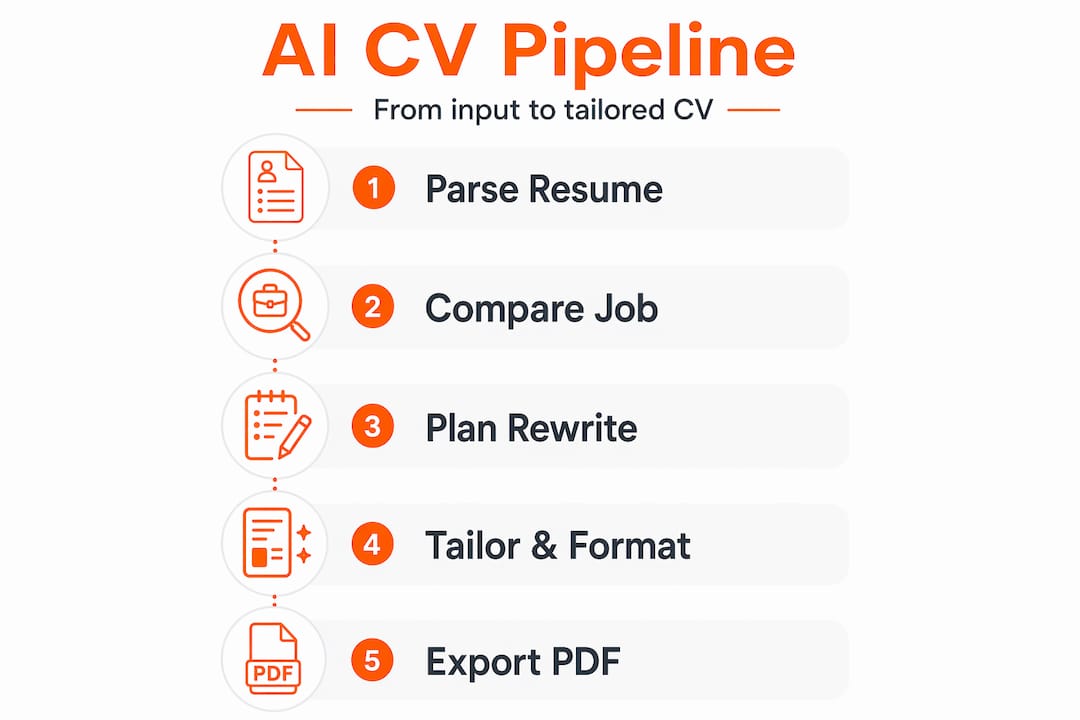
Many people picture AI CV generation as a single button that magically produces a polished document. The reality is a structured multi-stage pipeline that moves through distinct phases, each building on the last.
Here is what that pipeline looks like in practice:
-
Parsing: The system reads your existing CV and breaks it into structured data fields, such as job titles, dates, skills, and responsibilities. For image-based CVs, multi-layered OCR extraction is applied to convert visual content into readable text.
-
Gap analysis: The AI compares your structured CV data against the job description. Automated gap analysis engines identify missing keywords, skills, or experience that the job requires but your CV does not currently address.
-
Rewrite planning: Before changing a single word, the system generates a plan. This plan specifies what needs to change in which section and why, giving the model clear instructions rather than free rein.
-
Modular execution: The AI rewrites each section or bullet point separately, validating each output before moving on. This is a deliberate design choice that keeps errors contained.
Pro Tip: If you are using an AI CV tool and it produces the entire document in seconds with no visible stages or review steps, treat the output with extra caution. Speed without structure often signals less control under the hood.
Tailoring content and ATS optimisation
Once the pipeline has your structured data and a rewrite plan, the real tailoring begins. This is where the benefits of AI in CVs become most visible, and where the technology genuinely outperforms manual editing for speed and precision.
The AI uses semantic matching to align your experience with the language of the job description. Rather than simply hunting for identical words, cosine similarity scoring compares conceptual meaning across segments like skills, roles, and your summary section. A job asking for “stakeholder management” will recognise relevant experience even if your CV uses “client relationship oversight.”
Here is what the AI is optimising for in this stage:
-
Keyword alignment: Matching the specific terms recruiters and ATS platforms are scanning for.
-
Tone and style: Adjusting language to suit the seniority or sector of the role.
-
Format compliance: Producing ATS-friendly layouts that avoid tables, graphics, and unusual fonts.
-
PDF output quality: Generating vector text PDFs so ATS platforms can parse your name, dates, and skills correctly, rather than reading a flattened image.
The table below shows the difference between a generic CV and an AI-tailored one:
| Feature | Generic CV | AI-tailored CV |
|---|---|---|
| Keyword match | Low, broad language | High, role-specific terminology |
| ATS readability | Variable | Optimised vector text output |
| Tone consistency | Inconsistent across roles | Adjusted to sector and seniority |
| Gap coverage | Not addressed | Missing skills highlighted and filled |
Pro Tip: Always export your AI-generated CV as a PDF that preserves real selectable text. Open it in a browser and try to highlight words. If you cannot, the ATS cannot read it either.
Technical safeguards that keep outputs reliable
Here is where the automated CV generation process separates serious tools from basic chatbot wrappers. Quality and reliability depend entirely on the controls built around the AI model itself.
-
Schema validation at every stage. After each AI output, the system checks the result against a defined structure. If the output is malformed or incomplete, the step retries with schema validation rather than passing bad data to the next stage.
-
Micro rewrites instead of monolithic generation. Rewriting one bullet at a time means a single error does not corrupt the whole document. Each small change is validated independently before the system proceeds.
-
Explainability and user approval. Well-designed systems show you what changed and why, giving you the ability to accept or reject suggestions. This keeps you in control of your own professional narrative.
-
Fallback OCR for image-based CVs. If standard parsing fails, the system applies optical character recognition to extract text from scanned documents, preventing the entire pipeline from breaking on an imperfect source file.
-
Iterative scoring loops. Some tools re-run rewrites until ATS scores meet a quality threshold, rather than accepting the first acceptable output. This iterative approach produces more consistently strong results.
These controls are what separate a trustworthy AI resume creation process from one that produces plausible-sounding but factually unreliable output.
Pitfalls and ethical considerations
Understanding how AI works for CVs also means knowing where it can go wrong. The risks are real, and they deserve honest attention.
-
Hallucination: AI can fabricate experience or credentials that do not exist in your original CV. This is not a theoretical risk. It happens when models are given too much freedom without validation controls.
-
AI-detection tools: Recruiters increasingly use detection software that flags patterns common in AI-generated text. A CV that reads like it was written by a language model can actively damage your application.
-
Loss of personal voice: Over-reliance on automated generation produces applications that sound generic. Hiring managers notice when every bullet follows the same syntactic pattern.
-
Interview credibility: If your CV claims capabilities your AI tool inserted without your input, you will struggle to support those claims in an interview.
AI-generated resumes should be used as a drafting aid, not to fully replace personal input, to maintain credibility with employers.
The CV rejection risk from over-automated applications is just as real as the risk from a poorly written one.
Getting the most from AI CV tools
Knowing the mechanics puts you in a far stronger position. Here is how to use artificial intelligence resume tools effectively without losing authenticity.
Pro Tip: Treat the AI output as a strong first draft. Your job is to review it as if you were a hiring manager who knows you personally. Remove anything that does not sound like you.
-
Start with your real data. The quality of AI output depends entirely on what you feed in. A thorough, up-to-date CV produces far better tailored results than a sparse one.
-
Review every suggested change. Do not approve rewrites you do not understand or cannot speak to in an interview.
-
Tailor per application. The core benefit of AI in CVs is speed per application, not a single generic document. Use it to create a focused version for each role.
-
Choose ATS-friendly templates. Select tools that export clean, readable PDFs. Avoid templates heavy with graphics or columns that confuse parsing software.
-
Update regularly. Use AI to help you track career progression and capture new achievements in language that lands well.
If you are wondering whether AI tools are right for your situation, the impact on job seekers is worth reading before you commit to a workflow.
Try AI-powered CV optimisation with SparkCV
Understanding how AI CV generation works is the first step. Putting it to work is the next one.
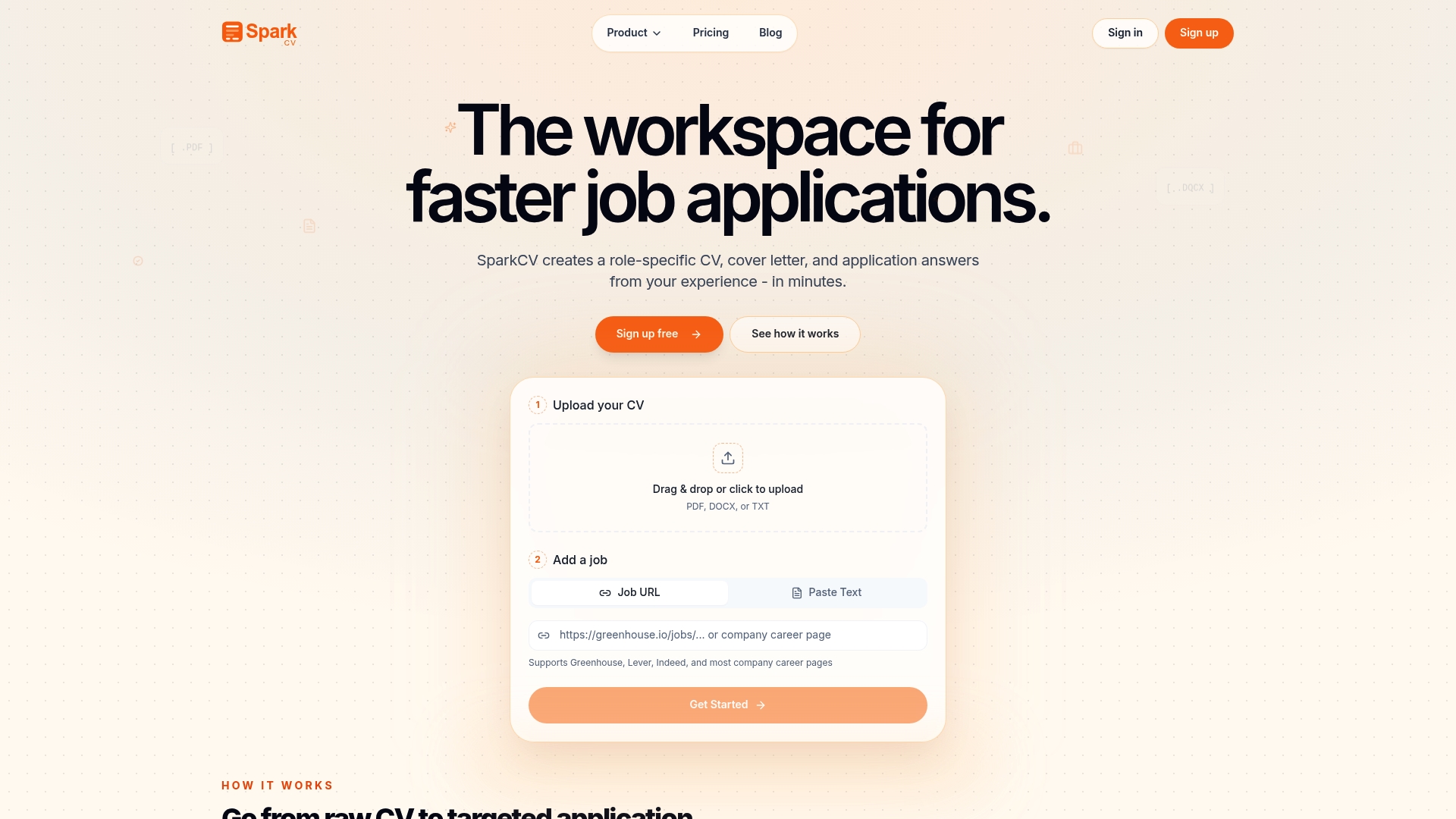
SparkCV uses advanced extraction technology to analyse your existing CV alongside any job description, then generates a tailored, ATS-friendly version in minutes. You stay in control throughout, reviewing and approving changes before anything is exported. SparkCV also produces cover letters and tailored answers to application questions, so your entire submission is aligned to the role. If you are ready to apply smarter and save hours per application, start with SparkCV today.
FAQ
What does AI actually do when generating a CV?
AI CV generation follows a structured pipeline: it parses your existing CV into structured fields, compares it to the job description, creates a rewrite plan, and then executes modular rewrites section by section with validation at each step.
How does AI make a CV ATS-friendly?
AI tools match your language to the keywords and terminology in the job description, apply clean formatting, and produce vector text PDFs that ATS platforms like Workday and Greenhouse can parse correctly.
Can AI hallucinate information on my CV?
Yes. Without proper schema validation and modular controls, AI can generate experience or credentials not present in your original document. Always review AI output carefully before submitting any application.
Will recruiters know my CV was written by AI?
Recruiters increasingly use detection tools that identify AI-generated text patterns. Editing the output in your own voice and reviewing every section significantly reduces this risk.
How is AI CV generation different from using a basic CV template?
A template provides structure only. AI CV generation actively analyses the job description, identifies gaps in your experience, and rewrites your content to improve alignment, keyword matching, and ATS compatibility.
Recommended reads
Keep exploring






Hear more from SparkCV
Leave your email for new articles, onboarding invites, and launch news.
We’ll only use this for SparkCV emails, and you can unsubscribe any time.