
Examples of targeted CV summaries: 2026 guide

A targeted CV summary is a concise, customised introduction at the top of your CV that speaks directly to the requirements of a specific role. Recruitment experts describe the summary as “prime real estate” for your most job-relevant skills and outcomes. Done well, it tells a recruiter within seconds that you are the right fit. The examples of targeted CV summaries in this guide cover every experience level, from recent graduates to senior professionals, and reflect 2026 best practices for ATS compatibility and recruiter engagement.
1. What makes a CV summary effective in 2026?
An effective CV summary replaces vague adjectives with specific, measurable outcomes. High-impact summaries avoid empty buzzwords like “results-driven,” “team player,” and “passionate professional.” Those phrases appear on thousands of CVs and tell a recruiter nothing concrete about you.
The four criteria that define a strong summary in 2026 are:
- Quantified achievements. State outcomes with numbers where possible. “Reduced customer complaints by 30%” beats “improved customer satisfaction” every time.
- Relevant keywords. Pull key terms directly from the job description and place them naturally in your summary. This satisfies ATS screening without reading as forced.
- Role-specific skills. List only the skills the employer actually asked for. Relevance outweighs quantity.
- No first-person pronouns. Avoid “I” and “me” to keep the tone professional and direct. Start with your job title or a strong descriptor instead.
Pro Tip: Read the job description three times before writing a single word of your summary. Highlight every skill, qualification, and outcome the employer mentions. Your summary should mirror that language.
2. Targeted CV summary examples for entry-level job seekers
Entry-level summaries work best when they highlight academic credentials and transferable skills rather than trying to fake experience that does not exist. Quantifying volunteer work and internships adds credibility fast.
Here are three examples you can adapt:
-
Recent graduate, marketing: “Marketing graduate with a 2:1 from the University of Leeds and six months’ internship experience at a digital agency. Managed three social media accounts, growing combined follower count by 1,200 in one quarter. Proficient in Google Analytics, Canva, and Meta Ads Manager.”
-
Career starter, customer service: “Motivated customer service professional with 18 months of part-time retail experience and a distinction in a Level 3 Business qualification. Resolved an average of 40 customer queries per shift with a 95% satisfaction rating. Confident communicator with strong problem-solving skills.”
-
Graduate, data analysis: “Data analysis graduate with hands-on Python and SQL experience gained through a university dissertation project analysing 50,000 rows of NHS appointment data. Completed a three-month data internship at a regional consultancy. Seeking a junior analyst role in the financial services sector.”
Each example names a specific institution, tool, or metric. That specificity is what separates a targeted summary from a generic one. For advice on demonstrating soft skills in your summary, concrete examples always outperform adjectives.
3. Targeted CV summary examples for experienced professionals

Experienced professionals should lead with their most impressive measurable success, then follow with their area of expertise and the value they bring to a new employer. Summaries that cite clear percentages and project completions consistently attract more recruiter attention than those that simply list job titles.
Strong examples across different fields:
-
Senior project manager: “Chartered project manager with 12 years’ experience delivering infrastructure projects up to £8m. Led a cross-functional team of 22 to complete a national rail upgrade six weeks ahead of schedule. PMP and PRINCE2 Practitioner certified.”
-
Finance director: “Finance director with 15 years in the manufacturing sector. Reduced annual operating costs by £1.2m through supplier renegotiation and process restructuring. Experienced in IFRS reporting, board-level presentation, and leading teams of up to 30 staff.”
-
Social media manager: “Social media manager with eight years’ experience across B2B and B2C brands. Grew a LinkedIn company page from 4,000 to 62,000 followers in 18 months. Skilled in paid social, content strategy, and analytics reporting.” For further social media manager examples, role-specific metrics are the defining factor.
-
NHS nurse, band 6: “Registered nurse with nine years’ experience in acute medical wards. Mentored 14 student nurses over three years and contributed to a ward initiative that cut medication errors by 22%. Competent in electronic patient records and clinical audit.”
Each summary names a sector, quantifies a result, and lists a relevant credential. That combination is what makes a professional summary genuinely targeted.
4. How to tailor your CV summary for different roles and industries
Tailoring your summary starts with a close reading of the job description. Relevant keywords placed thoughtfully in your summary improve both ATS screening outcomes and recruiter engagement. The goal is to match the employer’s language without copying it word for word.
Follow this process for each application:
- Identify the three to five skills or qualifications the employer mentions most often.
- Check which of those you genuinely possess and can evidence.
- Rewrite your summary opening to reflect those exact priorities.
- Adjust your job title descriptor to match the role title where accurate.
Overloading your summary with keywords makes statements sound unnatural and can actually flag your application as low quality in some ATS systems. Balance is the standard. One or two well-placed keywords per sentence is enough.
A useful CV tailoring checklist can help you track which elements you have adapted for each role, particularly when you are applying to multiple positions at once.
Pro Tip: Save a master version of your CV summary with all your achievements listed. For each application, select only the achievements most relevant to that specific role and build your targeted summary from those.
5. Common mistakes to avoid in targeted CV summaries
The most common mistake is writing one generic summary and sending it to every employer. That approach fails both ATS screening and human review. The second most common mistake is keyword stuffing, which makes your summary read as unnatural and reduces its impact.
Avoid these specific errors:
- Vague openers. “Hardworking professional with a passion for excellence” says nothing. Replace it with your job title and a specific achievement.
- Overlong summaries. Three to five sentences is the standard length. Anything longer loses the recruiter’s attention before they reach your experience section.
- Listing responsibilities instead of outcomes. “Responsible for managing a team” is weak. “Managed a team of eight, reducing project delivery time by 15%” is strong.
- Using first-person pronouns. Starting with “I am a dedicated nurse” is less professional than “Registered nurse with seven years’ experience in paediatric care.”
The table below contrasts weak and strong summary language:
| Weak phrasing | Strong alternative |
|---|---|
| “Results-driven professional” | “Operations manager who cut costs by £400k in 12 months” |
| “Excellent communicator” | “Presented quarterly reports to a board of 12 directors” |
| “Team player” | “Led a cross-functional team of 15 to deliver a £2m project on time” |
| “Passionate about marketing” | “Digital marketer with three years’ paid social experience and a 4x ROAS average” |
Quantifying achievements with concrete data points is the single most reliable way to move from the weak column to the strong one.
SparkCV: build your targeted CV summary faster
Writing a different summary for every application takes time. SparkCV analyses your existing CV and the job description, then generates a customised summary with the right keywords and structure in minutes.
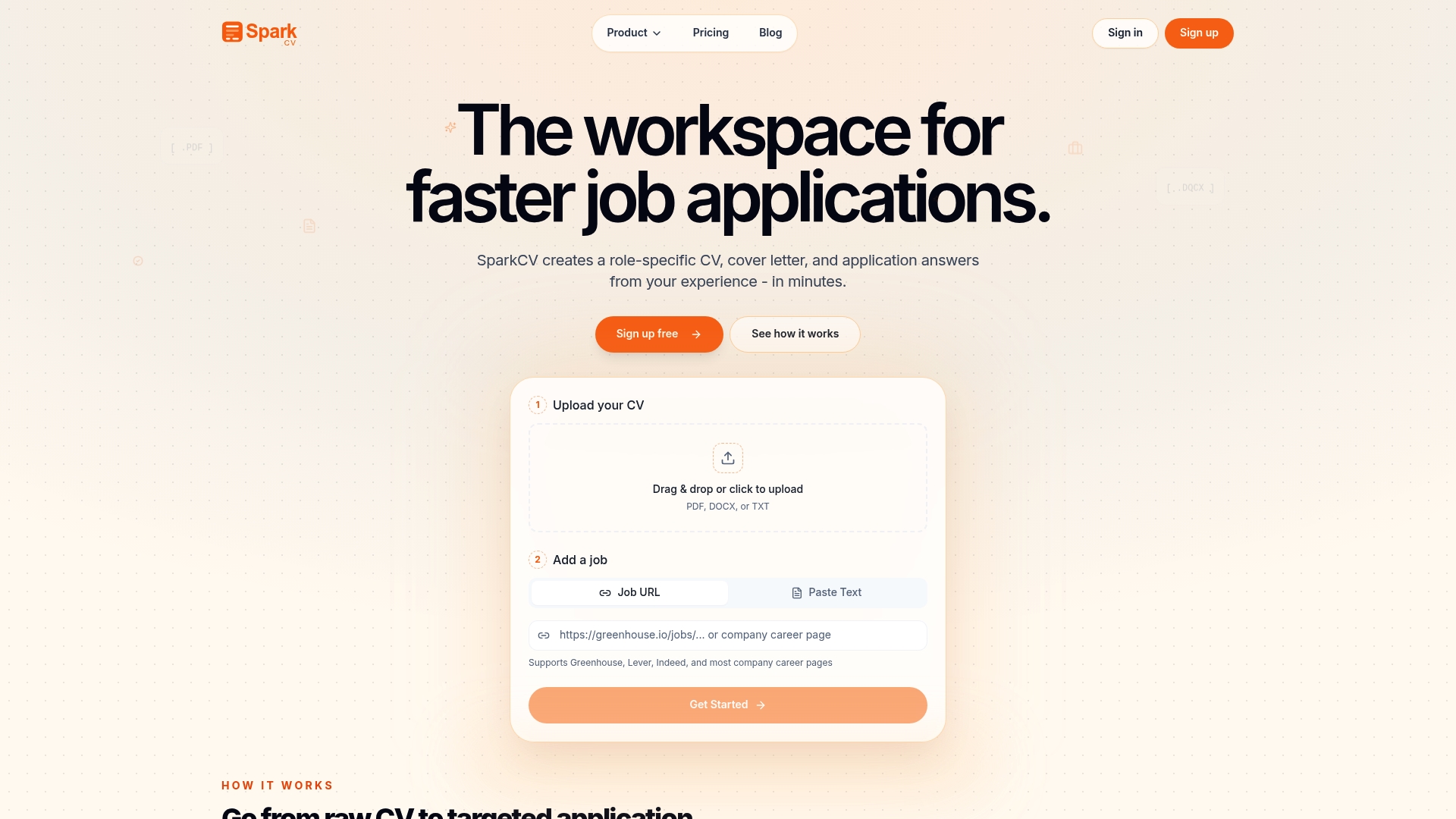
SparkCV’s keyword matching technology aligns your summary with ATS requirements, so your application clears automated screening before a recruiter ever reads it. The platform also generates tailored application answers alongside your CV, giving you a complete, consistent application in one place. If you want a polished, job-specific CV summary without spending an hour rewriting from scratch, try SparkCV free and see the difference a targeted summary makes.
FAQ
What is a targeted CV summary?
A targeted CV summary is a two-to-five sentence introduction written specifically for one job application. It highlights the skills, achievements, and keywords most relevant to that role.
How long should a CV summary be?
Three to five sentences is the standard. Longer summaries lose recruiter attention before they reach your experience section.
Should I use keywords from the job description in my summary?
Yes. Placing relevant keywords naturally in your summary improves ATS screening outcomes and signals to recruiters that you match their requirements.
Can entry-level job seekers write a strong targeted summary?
Yes. Focus on academic credentials, transferable skills, and quantified volunteer or internship experience. Specific numbers and named tools make an entry-level summary credible.
Should I avoid first-person pronouns in my CV summary?
Yes. Omitting “I” and “me” keeps the tone professional and direct, which is the standard expected by UK recruiters in 2026.
Key takeaways
A targeted CV summary is the most effective way to pass ATS screening and capture recruiter attention, because it mirrors the job description with specific achievements and relevant keywords.
| Point | Details |
|---|---|
| Specificity beats generality | Replace buzzwords with quantified outcomes tied to the role you are applying for. |
| Keywords must feel natural | Match job description language without overloading sentences, to satisfy ATS and human readers alike. |
| Entry-level summaries need metrics | Quantify internships, volunteer work, and academic projects to add credibility without experience. |
| Experienced professionals lead with results | Open with your strongest measurable achievement, then follow with credentials and sector expertise. |
| One summary per application | A generic summary fails both ATS screening and recruiter review. Tailor it every time. |
Recommended reads
Keep exploring






Hear more from SparkCV
Leave your email for new articles, onboarding invites, and launch news.
We’ll only use this for SparkCV emails, and you can unsubscribe any time.