
How to apply for promotion with an internal CV

To apply for promotion with an internal CV, submit a focused, role-specific CV alongside a short tailored application email. Lead with a professional profile that names the target role and your years at the company, then back it with six to ten quantifiable achievements drawn from your internal work. That combination gives hiring panels the explicit evidence they need, because internal roles attract around X internal applicants per posting on top of external candidates.
Before you hit submit, confirm you have:
- A role-focused professional profile naming the position you want
- Six to ten achievement bullets with numbers, scope, and outcomes
- Internal language, project names, and company metrics throughout
- Evidence of stakeholder influence or cross-team impact
- Line manager notification completed (where your company policy requires it)
- A short tailored application email or cover letter attached
CV profile opener you can copy:
“Results-driven [Job Title] with [X] years at [Company], applying for the role of [Target Role]. Proven track record in [key skill 1], [key skill 2], and [key skill 3], with measurable impact across [relevant team/function].”
Application email opener:
“I am writing to formally apply for the [Target Role] position advertised internally on [date]. Having spent [X] years contributing to [team/department], I am confident my record of [specific achievement area] makes me a strong candidate.”
Table of Contents
- How do internal applications differ from external ones?
- Do you actually need a CV for an internal promotion?
- How to tailor your CV for an internal promotion, step by step
- UK-ready internal CV example: before and after
- How to write an internal cover letter or application email
- Step-by-step internal application checklist
- What do internal interviewers actually want to see?
- How to show prior promotions and role changes on your CV
- Common mistakes to avoid when applying internally
- Key takeaways
- SparkCV makes tailoring your internal CV faster
- Useful UK sources and further reading
How do internal applications differ from external ones?
The mechanics look similar — CV, cover letter, interview — but the dynamics are quite different. Hiring panels for internal roles often assume they already know you, which cuts both ways. On one hand, you have a track record they can verify. On the other, they may underestimate your full contribution because they only see the slice of your work that touches their team.
Talent-acquisition teams are increasingly formalising internal mobility processes, which means internal candidates are now evaluated against structured competency frameworks rather than informal reputation. That shift makes a polished, evidence-led CV more important than ever.
There are also process rules that do not apply to external candidates. Many UK employers require you to notify your line manager before applying, post the role on an internal portal first, or complete a specific internal application form rather than a standard CV submission. Skipping these steps can damage professional relationships even if your application is strong. Check your employee handbook or speak to HR before you do anything else.
The tone of your CV should also shift. External CVs often lead with industry-wide achievements. An internal CV should prioritise company-specific impact: internal KPIs, named projects, cross-department collaborations, and outcomes your employer can verify directly.
Do you actually need a CV for an internal promotion?
Not always, but you should prepare one regardless. The decision depends on what the internal advert specifies.
When a CV is required: The job posting explicitly asks for one, or the role is being advertised externally at the same time. In these cases, treat it as a full application and tailor your CV to the brief.
When an internal form may suffice: Some organisations use a structured internal application form that covers competencies, experience, and a personal statement. If the advert directs you to a portal form, complete it fully and treat each text box as a mini CV section. Do not paste in a generic profile.
When to include both: If the form has a CV upload option, attach a tailored CV even when it is not mandatory. Recruitment guidance consistently recommends including a tailored note or CV unless you are explicitly told not to, because it signals preparation and seriousness.
If you are unsure what to submit, ask HR or the hiring manager directly. A brief, professional email asking for clarification is never a mark against you. What does count against you is submitting an untailored document because you assumed the process was informal.
Quick rules of thumb:
- Always tailor evidence to the specific role, whatever format you use
- Include a CV unless the advert or HR explicitly says not to
- Keep a short, promotion-focused CV ready so you can move quickly when a role opens
How to tailor your CV for an internal promotion, step by step
Starting from a fresh template rather than editing an old CV is often the better move. It forces you to think about what actually belongs, rather than carrying forward outdated or irrelevant content.
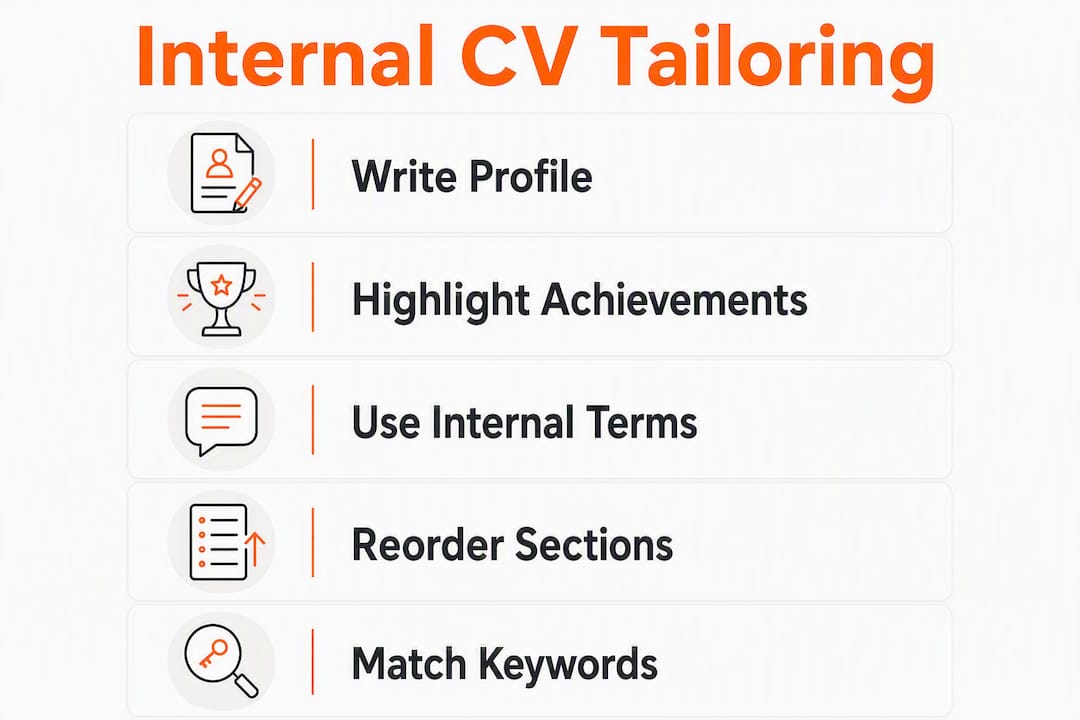
Step 1: Write a role-focused professional profile
Open with a two-to-three sentence profile that names the role you are applying for, states your years at the company, and summarises the skills most relevant to the promotion. This is not a generic summary — it is a direct pitch.

Step 2: Select and expand your six to ten best achievements
Use the CAR structure (Challenge, Action, Result) or STAR (Situation, Task, Action, Result) for each bullet. Career guidance recommends focusing on a concise set of high-impact accomplishments rather than a long chronological list. Every bullet should answer: what was the scope, what did you do, and what changed as a result?
Sample achievement bullets:
- Led the migration of the company’s CRM system across three departments, reducing data-entry errors by 34% and cutting reporting time from five days to two.
- Managed a cross-functional team of eight during the Q3 product launch, delivering the project two weeks ahead of schedule and £15,000 under budget.
- Introduced a weekly stakeholder briefing that improved sign-off turnaround from 12 days to four, directly accelerating two major client deliverables.
Step 3: Use internal language and metrics
Replace generic phrases with the terminology your company actually uses. If your organisation calls it a “client success score” rather than NPS, use that term. Reference internal project names, team names, and KPIs. This signals cultural fit and makes your achievements immediately legible to the panel.
Step 4: Reorder sections for relevance
Put the most relevant experience first. If you led a cross-department project that directly relates to the promoted role, that goes near the top, not buried under a list of older responsibilities. Add a short “Internal Projects” or “Key Initiatives” section if you have significant cross-team work to highlight.
Step 5: Keyword-match to the job description
Read the internal job brief carefully and mirror its language in your CV. If the brief mentions “stakeholder management”, “budget ownership”, or “people leadership”, those phrases should appear in your profile and achievement bullets where they are genuinely supported by evidence.

Pro Tip: To surface hidden impact, review your sent emails, project sign-off documents, and any internal performance data from the past 12–18 months. Stakeholder thank-you messages, before/after metrics from process changes, and internal KPI reports are all sources of quantifiable evidence you may have forgotten.
UK-ready internal CV example: before and after
The difference between a weak and strong internal CV usually comes down to specificity. Here is a before/after comparison for a Marketing Executive applying for a Marketing Manager role.
| Section | Before (weak) | After (promotion-focused) |
|---|---|---|
| Profile | “Experienced marketing professional with a background in digital and content.” | “Marketing Executive with four years at Acme Ltd, applying for Marketing Manager. Proven record in campaign delivery, agency management, and cross-channel performance reporting.” |
| Achievement bullet 1 | “Managed social media accounts and grew followers.” | “Grew LinkedIn following from 4,200 to 11,800 in 12 months by introducing a weekly thought-leadership series, contributing to a 22% increase in inbound leads.” |
| Achievement bullet 2 | “Worked on the product launch campaign.” | “Co-led the Spring 2025 product launch across paid, organic, and email channels; campaign exceeded MQL target by 31% and generated £180,000 in pipeline within 60 days.” |
| Internal projects note | Not included. | “Seconded to the Brand Refresh Steering Group (Q2 2025), contributing to tone-of-voice guidelines now adopted company-wide.” |
Template notes:
- Add a dedicated “Internal Projects & Secondments” section if you have cross-department experience — it shows breadth beyond your day-to-day role.
- Compress older external roles to two lines each; the panel cares most about what you have done at this company.
- Use the same section headings as the internal job brief where possible.
How to write an internal cover letter or application email
A tailored cover letter or email strengthens your application even when it is not required. Structure it in three parts: a direct opener, three evidence-backed points, and a professional close.
Numbered structure for an internal cover letter or email
- Opener: State the role, your current position, and your years at the company. One or two sentences only.
- Evidence paragraph 1: Name your most relevant achievement and quantify the outcome. Tie it directly to a requirement in the job brief.
- Evidence paragraph 2: Highlight a second achievement that shows a different skill — ideally stakeholder management, leadership, or cross-team impact.
- Evidence paragraph 3: Briefly address your readiness for the broader scope of the new role. Reference a specific challenge the promoted role faces and how your experience prepares you for it.
- Close: State your availability for interview, confirm you have spoken with your line manager (if applicable), and thank the panel for their consideration.
Sample opening lines
“I am pleased to submit my application for the [Target Role] position, advertised internally on [date]. In my [X] years as [Current Role] at [Company], I have [key achievement in one clause].”
“Having led [specific project or initiative] over the past [timeframe], I believe I am well placed to take on the responsibilities of [Target Role] and contribute to [team/company goal].”
When to copy in your manager or HR
If your company policy requires manager notification before applying, send a brief, professional message before you submit. Keep it factual: name the role, confirm you are applying, and thank them for their support. You do not need their permission, but informing them first protects the working relationship. Internal application guidance is clear that failing to follow notification policies can harm professional relationships regardless of application quality.
Step-by-step internal application checklist
Work through this list before you submit. A CV tailoring checklist reduces errors and speeds up the process considerably.
- Confirm the role details. Read the full job brief, note the closing date, and check whether the role is also being advertised externally.
- Review your employee handbook. Confirm the internal application policy: notification requirements, portal submission rules, and any eligibility criteria (e.g. minimum tenure in current role).
- Speak to your line manager. If policy requires it, notify them before applying. If it does not, consider whether a conversation would be professionally appropriate given your relationship.
- Tailor your CV. Follow the step-by-step edits above. Keyword-match to the brief and remove irrelevant content.
- Write your cover letter or application email. Use the three-part structure above. Keep it to one page or under 400 words for an email.
- Get feedback from two reviewers. Ask a trusted colleague or mentor to read both documents. One reviewer who knows your work internally and one who does not will give you the most balanced perspective.
- Prepare supporting documents. Gather any portfolio items, project summaries, or data reports that support your achievement claims. Have them ready to share if requested.
- Prepare your application question answers. Many internal portals include competency questions. Draft answers using the CAR structure before you open the form.
- Align your timing. Where possible, submit close to a performance review cycle or after a visible win. Panels are more receptive when your recent contributions are fresh.
- Submit and confirm receipt. Check the portal or email for a confirmation. Note the expected timeline for feedback and set a calendar reminder to follow up if you have not heard within that window.
Following up after submission: If the advert stated a decision date and it passes without contact, a single brief email to HR is appropriate. Keep it short: confirm your continued interest, ask whether the timeline has changed, and offer to provide any additional information.
What do internal interviewers actually want to see?
Treat the internal interview as if the panel has never read your personnel file. Career experts advise framing an internal application as if the panel were external, to avoid the familiarity trap. Lead every answer with evidence and outcomes, not assumptions about shared context.
What panels typically look for:
- Concrete examples of impact in your current role, with numbers and named projects
- Evidence that you can operate at the next level, not just perform your current role well
- Stakeholder management: can you influence, negotiate, and communicate across teams?
- Self-awareness: how do you discuss a mistake or a project that did not go to plan?
- Forward thinking: what will you prioritise in the first 30, 60, and 90 days?
A short 30/60/90 plan demonstrates that you have thought beyond the interview and are ready to contribute immediately. Internal hires are expected to onboard faster than external candidates, so showing a clear plan of early priorities is a genuine differentiator.
Compact 30/60/90 template:
- Days 1–30: Meet key stakeholders in the new scope; audit current processes and team priorities; identify quick wins.
- Days 31–60: Deliver one visible early win; establish regular reporting or communication cadence; identify any skill or resource gaps.
- Days 61–90: Present a short-term plan for the team or function; set measurable targets for the next quarter; confirm alignment with senior leadership.
When discussing a failure or a difficult project, be direct and constructive. Name what happened, what you did to address it, and what you changed as a result. Panels value honesty and learning far more than a polished story with no rough edges.
How to show prior promotions and role changes on your CV
Formatting internal moves clearly is one of the most overlooked parts of an internal CV. Done well, it tells a story of growing scope and trust. Done poorly, it looks like job-hopping or a confusing timeline.
| Scenario | Recommended format | Sample line |
|---|---|---|
| Promotion within same team | Two separate role entries under the same employer | Marketing Executive → Marketing Manager, Acme Ltd (2022–2024 / 2024–present) |
| Secondment to another department | Sub-entry under current role, or a brief separate entry | Seconded to Operations (Jan–Jun 2025): led process review across three sites |
| Lateral move with expanded scope | Single entry with a scope note | Account Manager (expanded to include enterprise accounts from March 2024) |
| Multiple promotions, same employer | Stacked sub-roles under one employer header | List each role title and date range; use one achievement bullet per role |
On older external roles: Keep them if they show a skill or qualification the promoted role requires. Compress each to two lines: job title, employer, dates, and one achievement. Remove roles older than ten years unless they are directly relevant. The panel cares most about what you have contributed at this company.
Common mistakes to avoid when applying internally
The single most damaging error is the familiarity trap: assuming that because your colleagues know you, the hiring panel will fill in the gaps. Internal applicants routinely lose out because they submit CVs that read like a job description rather than a case for promotion. Treat every reviewer as if they have never seen your work, and state your outcomes explicitly.
Other mistakes that cost candidates the role:
- Overloading with irrelevant history. A ten-year-old role from a different industry does not strengthen your case for a promotion. Cut it or compress it to one line.
- Weak or missing quantification. “Improved team performance” is not an achievement. “Reduced average ticket resolution time from 48 hours to 19 hours over six months” is.
- Poor formatting for internal systems. Some internal portals strip formatting or have character limits. Test your CV in plain text before submission and check that it reads clearly without tables or columns.
- Failing to follow internal protocol. Not notifying your manager, submitting to the wrong portal, or missing the internal closing date all signal a lack of attention to detail.
- Neglecting the cover letter. Many internal applicants skip it. That is an opportunity for you to stand out.
Pro Tip: Before you submit, ask one reviewer who does not work closely with you to read your CV cold and tell you what role they think you are applying for. If they cannot answer immediately, your profile and achievement bullets need more specificity.
Key takeaways
A strong internal promotion application combines a role-focused CV with six to ten quantified achievements, explicit stakeholder evidence, and a tailored cover letter — submitted after confirming your company’s notification and portal requirements.
| Point | Details |
|---|---|
| Lead with explicit evidence | State outcomes, scope, and numbers — never assume the panel knows your contributions. |
| Six to ten achievement bullets | Focus on high-impact, quantified accomplishments from your time at the company. |
| Follow internal protocol | Check your handbook, notify your manager if required, and submit via the correct portal. |
| Get two reviewers | One internal, one external — both perspectives improve clarity and catch the familiarity trap. |
| SparkCV for faster tailoring | SparkCV extracts your achievements and keyword-matches them to the internal brief, generating a polished CV and cover letter quickly. |
SparkCV makes tailoring your internal CV faster
Pulling together a promotion-focused CV from scratch takes time you may not have, especially when you are managing your current role at the same time. SparkCV is built for exactly this situation: upload your existing CV and the internal job description, and the platform extracts your most relevant achievements, keyword-matches them to the brief, and generates an ATS-friendly CV and cover letter in minutes.
The career log feature lets you capture wins as they happen, so when a promotion opportunity opens, you already have a bank of quantified achievements ready to pull from. SparkCV also generates answers to application questions using your own experience, which is particularly useful for internal portals that include competency-based questions alongside the CV upload.
If you want a tailored internal CV ready to submit today, get started with SparkCV and have a polished, role-specific application in your hands within the hour.
Useful UK sources and further reading
- Indeed UK: Applying for an internal position — Practical tips on the internal application process, including the familiarity trap and how to frame your experience for an internal panel.
- Indeed: Internal resume definition, tips and examples — Guidance on building a promotion-focused CV from a fresh template, with profile and achievement examples.
- HBR: Applying for a job internally — Research-backed advice on standing out when competition includes both internal and external candidates, including the 30/60/90 approach.
- iHire: Applying for an internal position FAQs — Covers notification policies, cover letter guidance, and common process questions for internal applicants.
- YES Writing: Resume for internal promotion — Focused how-to on structuring achievement bullets and selecting the right accomplishments for a promotion CV.
- SparkCV: CV tailoring checklist — Step-by-step checklist for tailoring a CV to any job brief, including internal roles and competency frameworks.
- SparkCV: Why rewriting your CV is the real problem — Explains why targeted tailoring outperforms a full rewrite, with practical guidance on what to keep and what to cut.
- Internal mobility vs. external recruiting: 2026 guide — Industry commentary on how talent-acquisition teams are formalising internal mobility, and what that means for internal candidates.
Recommended reads
Keep exploring






Hear more from SparkCV
Leave your email for new articles, onboarding invites, and launch news.
We’ll only use this for SparkCV emails, and you can unsubscribe any time.