
What is a career narrative CV? Your 2026 guide

A career narrative CV is a storytelling document that shows not just what roles you have held, but how your experiences, decisions, and contributions have shaped your professional growth and suitability for a new position. Unlike a traditional CV, which lists jobs and qualifications in reverse chronological order, a narrative CV explains the why and how behind your achievements. The Cambridge Careers Service describes this format as one that demonstrates how skills and experiences have shaped the individual, with an emphasis on broader impact beyond a simple list of outputs. For job seekers and career changers, this distinction matters enormously.
What is a career narrative CV and what does it contain?
A career narrative CV is structured around themed contributions rather than a timeline of job titles. The most widely cited framework comes from UKRI’s R4RI format, which organises the document into four areas: knowledge generation, development of others, wider community engagement, and broader societal impact. While this model was designed for research funding applications, its logic applies directly to job seekers. Each module answers a specific question about your professional contribution, giving recruiters a fuller picture of who you are.
The core components you will typically find in a narrative CV include:
- Personal statement. A concise opening that captures your professional identity, motivations, and the direction you are heading. According to Catherine Pope’s STEM narrative CV example, this section unifies your expertise and leadership style in a few focused sentences.
- Contributions to knowledge or results. The outcomes you have produced, explained with specific evidence. The University of Alberta recommends focusing on outcomes and impact supported by concrete examples rather than vague claims.
- Development of others. Mentoring, coaching, training, and team leadership. These contributions are often invisible on a traditional CV.
- Wider community or sector impact. Voluntary work, professional body involvement, public engagement, or cross-organisational collaboration.
On length, two pages is the standard for most applications. Tailoring is non-negotiable. No single correct format exists, and the structure should always reflect the specific role or funder’s requirements.
Pro Tip: Before you write a single word, read the job description carefully and identify the three or four contribution areas the employer values most. Build your narrative modules around those priorities.

How does a narrative CV differ from a traditional CV?
The structural difference between the two formats is significant, but the deeper difference is philosophical. A traditional CV is a record. A narrative CV is an argument.
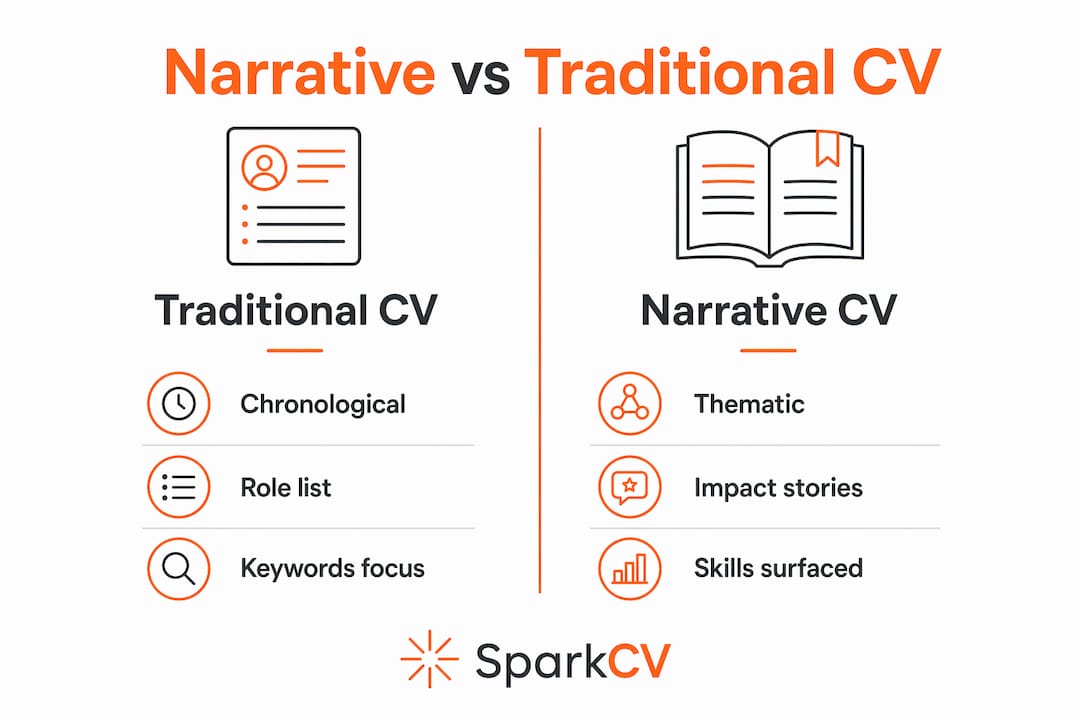
| Feature | Traditional CV | Narrative CV |
|---|---|---|
| Structure | Chronological list of roles | Thematic modules by contribution type |
| Focus | What you did and when | How you did it and what changed as a result |
| Invisible contributions | Rarely captured | Explicitly included (mentoring, collaboration) |
| Length guidance | One to two pages | Typically two pages, modular |
| Tailoring | Often generic | Adapted per role or application context |
| Tone | Factual, third-person implied | First-person, evidence-based narrative |
A Heriot-Watt expert notes that narrative CVs surface unrecognised skills such as mentoring, public engagement, and cross-sector collaboration that never appear on a conventional document. This matters for career changers in particular, because transferable skills are often the strongest part of their case and the part most likely to be buried in a list-based format.
The narrative format also shifts how recruiters evaluate candidates. Rather than scanning for keywords and job titles, they read for coherence, judgement, and impact. This is a meaningful advantage if your career path is non-linear or if your most valuable work happened outside your formal job description.
Why use a narrative CV as a job seeker or career changer?
The benefits of a narrative CV are most pronounced when your story does not fit neatly into a standard template. Career changers, returners to work, and professionals with portfolio careers all benefit from a format that lets them present a coherent career story rather than a fragmented list of roles that appears inconsistent at first glance.
Here is why this format works in competitive job markets:
- It highlights transferable skills. You can draw a direct line between past experience and future contribution, even across industries. Highlighting transferable soft skills becomes far easier when you have narrative space to explain the connection.
- It demonstrates growth, not just activity. Employers want to see that you learn, adapt, and improve. A narrative structure makes that arc visible.
- It captures the full scope of your contribution. Voluntary leadership, informal mentoring, and cross-team projects all have a natural home in a narrative CV.
- It supports consistency across your application. Indeed notes that career narratives enhance internal consistency across your CV, cover letter, and interview answers, which strengthens your overall candidacy.
Pro Tip: If you are changing careers, use the narrative format to reframe your previous roles in the language of your target sector. A project manager moving into operations does not need a new career. They need a new story about the same career.
How to write a successful career narrative CV
Writing a narrative CV is a disciplined process. Success depends on clarity, specificity, and alignment to the application context, not on literary flair or length. Follow these steps:
- Write your personal statement first. Summarise your professional identity, your core expertise, and the direction you are heading. Keep it to three or four sentences. This frames everything that follows.
- Identify your contribution themes. Review the job description and map your experience to the employer’s priorities. Group your achievements into two or three thematic areas rather than listing every role.
- Lead with outcomes, not tasks. For each contribution, state what changed as a result of your work. “Led a team” is a task. “Led a team that reduced onboarding time by six weeks” is an outcome.
- Use first-person, active language. Write as yourself, not as a job title. “I designed and delivered” is clearer and more credible than “Responsible for the design and delivery of.”
- Tailor every version. The University of Alberta is explicit that tailoring to the proposal or role is not optional. A generic narrative CV is a contradiction in terms.
- Edit for evidence discipline. Cut anything that does not support a specific claim. Vague statements like “strong communicator” without evidence weaken the document. Use tools like Grammarly or an AI CV optimiser to tighten your prose and check for clarity.
A useful internal check before you submit: does every paragraph answer the question “so what?” If not, revise it until it does. You can also use a CV tailoring checklist to verify your narrative aligns with the specific role before you apply.
Narrative CV examples and storytelling techniques
The most effective narrative CVs follow a simple storytelling structure within each contribution module: context, action, and result. This is not a creative writing exercise. It is a disciplined way of presenting evidence.
| Storytelling element | What it covers | Example language |
|---|---|---|
| Context | The situation or challenge you faced | “Following a restructure, the team lacked a clear development pathway…” |
| Action | What you specifically did | “I designed and piloted a six-month mentoring programme…” |
| Result | The measurable or observable outcome | “…which led to three internal promotions within twelve months.” |
This structure works across sectors. A nurse applying for a clinical lead role, a software developer moving into product management, and a teacher transitioning into learning and development can all use it. The key is adapting the language and evidence to the priorities of the target role, not copying a generic template.
Key takeaways
A career narrative CV works because it gives recruiters evidence of impact, not just a record of activity, making it the strongest format for career changers and non-linear career paths.
| Point | Details |
|---|---|
| Core definition | A narrative CV explains how your contributions shaped outcomes, not just what roles you held. |
| Essential structure | Organise content into thematic modules: personal statement, contributions, development of others, wider impact. |
| Key differentiator | Narrative CVs surface invisible contributions like mentoring and collaboration that traditional CVs miss. |
| Writing discipline | Lead every module with a specific outcome and cut anything that does not answer “so what?” |
| Tailoring is mandatory | Adapt your narrative to each role. A single generic version defeats the purpose of the format. |
The honest case for narrative CVs
I have reviewed hundreds of CVs across sectors, and the most common failure is not poor formatting or weak language. It is the absence of a coherent argument. Most CVs are lists dressed up as documents. They tell you what someone did, but give you no reason to believe they understood why it mattered or what they would do next.
The narrative CV format forces you to answer those questions. That process is uncomfortable for many people, particularly those who have spent careers in roles where self-promotion felt inappropriate. But the discomfort is the point. Writing a narrative CV requires you to articulate your own value clearly, which is exactly what a hiring manager needs you to do in an interview.
The format is not perfect. It demands more time, more thought, and more honest self-assessment than a traditional CV. Career changers sometimes struggle to know which contributions to prioritise when everything feels relevant. My advice is to start with the job description and work backwards. The employer has already told you what they value. Your job is to show them you have it, with evidence.
— Max
How SparkCV helps you build a stronger narrative CV
Crafting a narrative CV that genuinely reflects your impact takes time, and tailoring it for every application takes even more. SparkCV removes that friction.
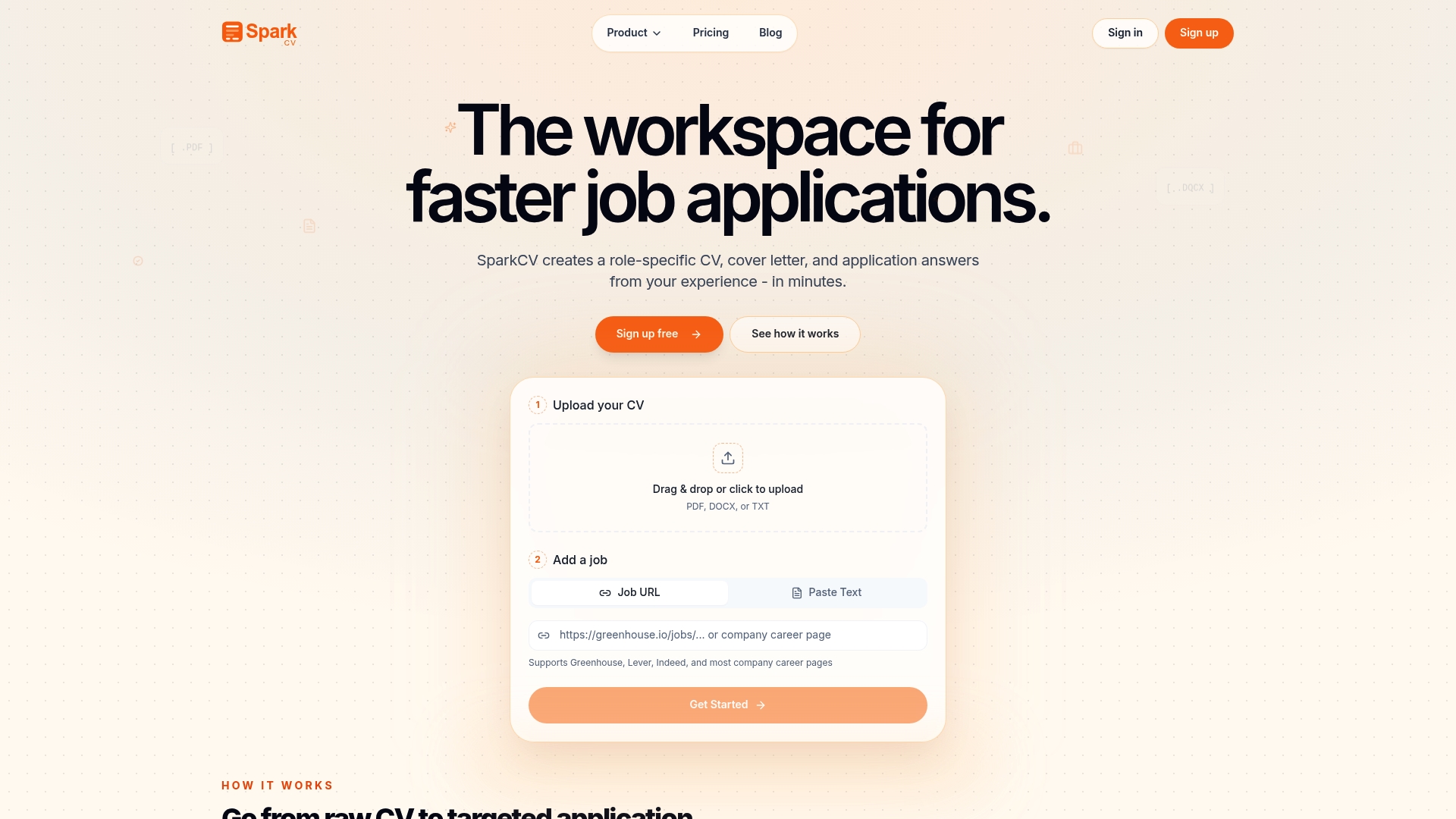
SparkCV analyses your existing CV alongside the job description and generates a tailored version in minutes, aligned to the role’s specific requirements. Its AI-driven tools help you identify the strongest evidence for each contribution area, match your language to what the employer is looking for, and produce ATS-friendly output that stands out at the shortlisting stage. Whether you are writing your first narrative CV or refining one for a career change, SparkCV’s optimisation platform gives you a faster, smarter starting point. You can also use SparkCV to generate tailored answers to application questions that align directly with your narrative.
FAQ
What is the difference between a narrative CV and a traditional CV?
A traditional CV lists roles and qualifications in chronological order. A narrative CV organises your experience into thematic contribution modules that explain the impact and context of your work, not just the timeline.
How long should a narrative CV be?
Two pages is the standard length for most narrative CVs. The UKRI R4RI format, one of the most widely referenced frameworks, uses a two-page modular structure covering four contribution areas.
Can career changers use a narrative CV format?
A narrative CV is particularly well suited to career changers. It allows you to present transferable skills and achievements as a coherent story, rather than a list of roles that may appear unrelated to the target position.
What should the personal statement in a narrative CV include?
Your personal statement should summarise your professional identity, core expertise, motivations, and career direction in three to four sentences. It frames the rest of the document and signals to the reader what kind of professional you are.
Do I need a different narrative CV for every application?
Yes. Narrative CV formats vary by role and employer, and a generic version undermines the format’s core purpose. Tailor each version to the specific priorities and language of the application you are submitting.
Recommended reads
Keep exploring






Hear more from SparkCV
Leave your email for new articles, onboarding invites, and launch news.
We’ll only use this for SparkCV emails, and you can unsubscribe any time.