
What is a two-page CV standard? Your 2026 guide

Most job seekers either cram everything onto one page or pad their CV across three pages and wonder why they hear nothing back. Understanding what is a two-page CV standard, the accepted professional benchmark in the UK, cuts through that confusion. Two pages is not a suggestion; for many roles it is the expected norm. This guide explains exactly what belongs on each page, how to format your CV to fit the standard, and how to avoid the common mistakes that send applications straight to the rejection pile.
Table of Contents
Key takeaways
| Point | Details |
|---|---|
| Two pages is the UK norm | In the UK, two pages is standard CV length; three pages is too long regardless of experience. |
| Structure matters as much as length | Follow a clear section order: contact details, personal statement, work experience, education, skills, then references. |
| Page two needs your contact info | Repeat your name and contact details on page two for professional continuity and recruiter convenience. |
| Filler damages your application | Recruiters prefer substantive two-page CVs; adding content just to fill space actively harms your chances. |
| Tailor every submission | Aligning your CV to each job description removes irrelevant content and keeps you within the two-page limit naturally. |
What the two-page CV standard actually means
The two-page CV standard refers to the widely accepted professional expectation that a CV should span no more than two A4 pages. In the United Kingdom, this is the default. Three pages is generally too long regardless of how much experience you have.
The accepted section order looks like this:
-
Contact information (name, phone, email, LinkedIn, location)
-
Personal statement or professional profile
-
Work experience (reverse chronological order)
-
Education and qualifications
-
Skills and competencies
-
References (or “available on request”)
Each section has a natural length. Your personal statement should run around 50 to 80 words. Education needs only three to six lines unless you are a recent graduate with limited work experience. Work experience should take up the bulk of your space, with bullet points describing results rather than duties.
Formatting choices also determine whether you land on two pages or drift onto three. Use a font between 10pt and 12pt, set margins at no less than 1.5 cm on each side, and keep section headings consistent and compact. Avoid boxes, graphics, or columns that complicate ATS parsing.
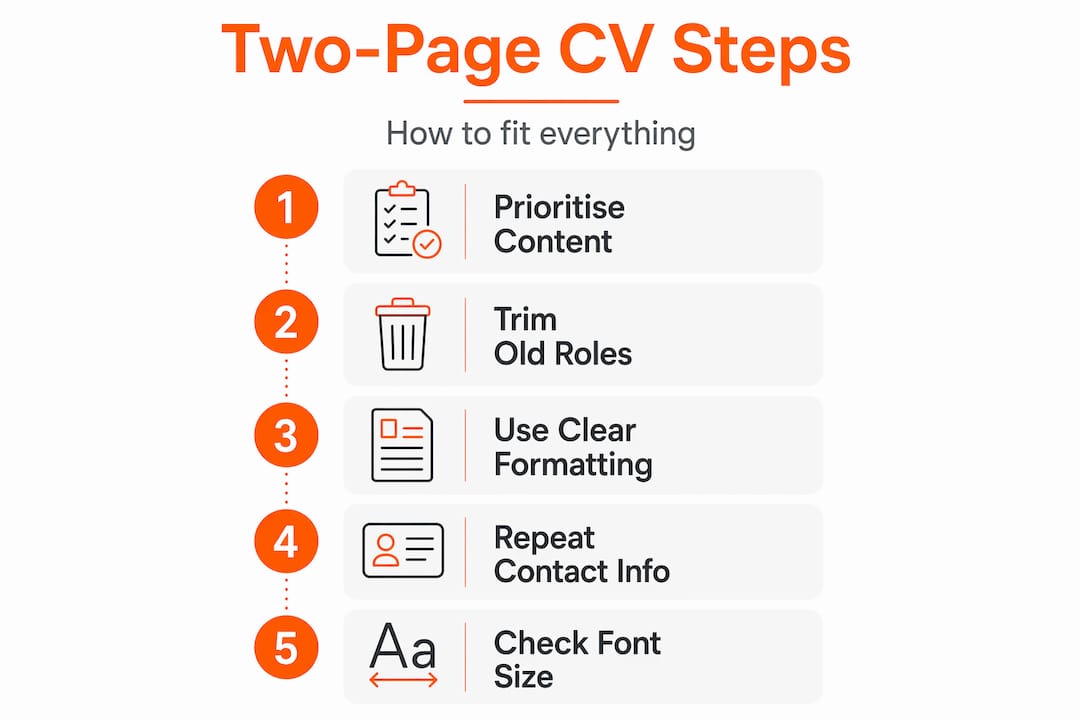
One detail many candidates overlook: repeat your contact details on page two. If a recruiter prints your CV and the pages separate, page two becomes anonymous without it.
Pro Tip: A CV is not a resume. Resumes follow different length conventions, often one page in the United States. UK employers expect a CV, and the two-page standard applies to that document specifically.
When two pages works better than one
There is a persistent myth that shorter is always smarter. That is not true. Recruiters favour two-page CVs when the second page adds meaningful, job-relevant content. What harms your application is filler, not length.
The following candidates benefit most from two pages:
-
Professionals with three or more years of relevant experience across multiple roles
-
Graduates who have completed placements, research projects, or significant extracurricular activity
-
Career changers who need space to show transferable skills alongside prior experience
-
Candidates applying for technical or specialist roles where competencies need demonstrating in detail
For very recent graduates with limited work history, one well-crafted page may serve you better than a second page padded with volunteering from secondary school.
The public sector reinforces this point sharply. USAJOBS now enforces a strict two-page limit for many federal applications, and CVs exceeding two pages are not reviewed. UK public sector roles increasingly follow similar expectations.
Recruiters focus their review on the first two pages. Content beyond that threshold risks being ignored entirely, even when it is included in the document.
The practical implication is straightforward. Your strongest, most recent achievements must land within two pages. Anything beyond that point may never be read.
Common mistakes that undermine two-page CVs
Getting to two pages is not the goal. Getting to the right two pages is. These are the most frequent errors that waste space and weaken applications.
-
Overloading page two with outdated roles. A position from fifteen years ago rarely needs more than one line. Detail belongs in your recent experience, not your early career.
-
Writing a personal statement that runs too long. Many candidates treat the profile as an essay. Keep it to three or four sentences that directly address what the employer is looking for.
-
Repeating information across sections. If your personal statement says you managed a team of twelve, you do not need to repeat that figure in three separate bullet points under work experience.
-
Ignoring ATS requirements. Poor formatting, tables within tables, and unusual fonts can cause your CV to be rejected before a human reads it at all.
-
Failing to tailor the content. A generic CV wastes space on irrelevant experience. Every section should earn its place by matching the job description.
Pro Tip: Read the job description carefully before editing your CV. Highlight the three to five skills or experiences the employer emphasises most, then check that each of those appears clearly on page one.
Practical ways to fit your CV into two pages
Editing a CV down to two pages feels uncomfortable because it requires cutting content you worked hard to produce. The key is recognising that less relevant content, cut cleanly, makes your strongest content louder.
Start with these moves:
-
Remove roles older than ten to fifteen years unless they are directly relevant to the position
-
Replace duty-focused bullet points with results. “Managed social media accounts” becomes “Grew Instagram engagement by 40% in six months through weekly content planning”
-
Cut any line that could appear on almost anyone else’s CV. Generic phrases like “excellent communicator” or “team player” add nothing
-
Check your education section. Unless you graduated within the last three years, you likely need only institution, qualification, and year
-
Align your terminology with the job description. This also improves keyword matching for ATS screening, which means you are editing for space and relevance simultaneously
A useful comparison when reviewing your draft:
| Content type | Keep or cut? |
|---|---|
| Recent role with measurable results | Keep |
| Role from twelve years ago with no clear relevance | Cut or reduce to one line |
| Generic skills everyone lists | Cut |
| Specific technical competencies matching the job description | Keep |
| Three-paragraph personal statement | Reduce to 60 to 80 words |
| Education from ten years ago listed in detail | Condense to one line per qualification |
Trimming older, less relevant roles is consistently the fastest route to two pages without losing impact. Your recent experience is what hiring managers care about most.
If you find yourself rewriting your CV from scratch for every application, that is a sign your base document needs restructuring, not just trimming.
A perspective on two-page CVs that most guides miss
I have reviewed hundreds of CVs over the years, and the ones that cause the most frustration are not the ones that are too long. They are the ones where the candidate has clearly tried to hit two pages rather than communicate two pages of genuinely relevant information.
In my experience, the two-page standard is less about a physical limit and more about a discipline of prioritisation. Recruiters scan the first two pages and move on. They are not looking for your full career history. They are looking for signals that you understand the role and have done it, or something close to it, before.
For early-career candidates, my honest advice is this: do not force two pages. A tight, confident one-page CV beats a stretched two-page document every time. As your experience grows, the second page fills itself.
The shift to skills-based hiring across both public and private sectors means the two-page limit is becoming less about tradition and more about function. Hiring managers need to assess quickly. Your job is to make that as easy as possible.
Get your CV to two pages faster with SparkCV
Knowing the standard is one thing. Applying it to your own CV is where most people get stuck.
SparkCV analyses your existing CV and the job description together, then identifies what to keep, what to cut, and what to reframe. The platform generates a tailored, ATS-friendly version in minutes, so you are not spending an hour second-guessing every bullet point. Whether you need to condense a bloated three-page document or sharpen a one-pager into a confident two-page CV, SparkCV’s AI tools do the heavy lifting. You get a polished submission that fits the two-page standard and speaks directly to what the employer is looking for. Sign up free and see the difference a properly tailored CV makes.
FAQ
What is the standard length for a CV in the UK?
In the UK, two pages is the accepted standard for most CVs. Three pages is generally considered too long, regardless of experience level.
Should I repeat my contact details on page two of my CV?
Yes. Including your name and contact information on page two maintains professional continuity and helps recruiters if pages become separated.
When is a one-page CV better than two pages?
A one-page CV suits recent graduates or candidates with limited work history. Recruiters prefer two-page CVs only when the second page contains substantive, job-relevant content.
Does the two-page limit apply to public sector applications?
It applies in many cases. USAJOBS enforces a strict two-page limit for federal roles, and UK public sector employers increasingly follow similar CV length recommendations.
What should I cut first when reducing my CV to two pages?
Start by trimming your personal statement and condensing detail on older or less relevant roles. Your recent experience and measurable achievements should always be preserved in full.
Recommended reads
Keep exploring






Hear more from SparkCV
Leave your email for new articles, onboarding invites, and launch news.
We’ll only use this for SparkCV emails, and you can unsubscribe any time.