
How to write a CV with limited work history

Starting your job search with a thin work history feels like being asked to prove yourself without being given the chance to do so. Yet when you know how to write a CV with limited work history the right way, the absence of a long employment timeline stops being a weakness. This guide walks you through every stage: understanding what recruiters actually look for, gathering the right content, writing each section with precision, and tailoring your CV for each application. By the end, you will have a clear, practical plan to produce a CV that gets noticed.
Table of Contents
Key takeaways
| Point | Details |
|---|---|
| Skills beat job titles | A functional CV format emphasising skills and projects outperforms a blank employment timeline. |
| Specificity wins | Vague claims like “good communicator” are ignored; measurable, evidence-backed statements get read. |
| ATS comes first | Use standard headings and clean formatting so your CV passes automated screening before a human sees it. |
| Tailor every application | Matching your CV’s keywords to each job description directly increases your chances of reaching an interview. |
| Portfolio links matter | Graduates who include a working portfolio URL receive 2.3x more interviews than those who do not. |
What recruiters and ATS systems really look for
Most job seekers assume a recruiter reads every CV carefully. In reality, your application first passes through an Applicant Tracking System (ATS), which scans for keywords, standard section headings, and formatting compatibility. If the ATS cannot parse your CV, a human never sees it. Understanding this changes how you approach the whole document.
ATS systems do not care whether your experience came from a paid role or a university project. They scan for relevance. That means the words you use must mirror the language in the job description. If the posting says “data analysis” and your CV says “working with numbers,” the system may not make the connection.
What recruiters want to see when experience is scarce is evidence of potential, initiative, and the ability to learn. They are not expecting a five-year track record from a recent graduate. They are looking for signs that you can do the job. That evidence can come from coursework, volunteer roles, freelance work, or personal projects.
Common pitfalls to avoid:
-
Generic phrases such as “hard worker” or “team player” with no supporting context
-
Keyword stuffing, which reads as unnatural and can trigger ATS filters
-
Inconsistent formatting that confuses automated parsing tools
-
Unexplained gaps where a brief note would have provided useful context
-
Copying job description language verbatim without adapting it to your own experience
Pro Tip: Read the job description three times before writing a single word of your CV. Highlight the skills and tools mentioned most frequently. Those are your priority keywords.
Knowing why CVs get rejected early before a recruiter even reads them is one of the most useful things you can learn at this stage.
Preparing your CV content
Before you write anything, you need to take stock of what you actually have. Many candidates underestimate how much relevant material they are sitting on. The goal here is to catalogue everything, then select what is most relevant for each application.

Start with transferable skills. These are abilities that apply across roles and industries: written communication, problem-solving, project coordination, data interpretation. Cross-reference these against the job descriptions you are targeting. If a skill appears in the posting and you genuinely have it, it belongs on your CV.
Next, consider your non-traditional experience. This includes:
-
Volunteer work (event coordination, fundraising, community outreach)
-
Internships and work placements, even short ones
-
Freelance or self-directed projects (building a website, managing social media for a local business)
-
University or college coursework with practical outputs
-
Extracurricular leadership roles such as society president or sports captain
Relevant coursework and academic projects can demonstrate job-related skills just as effectively as formal employment when described with clear outcomes.
Use this table to organise your content before you start writing:
| Content type | Example | Relevant skill demonstrated |
|---|---|---|
| Academic project | Built a data dashboard for a marketing module | Data analysis, presentation |
| Volunteer role | Coordinated 50-person charity event | Project management, communication |
| Freelance work | Designed logo and brand kit for local café | Graphic design, client management |
| Extracurricular | Treasurer of university film society | Financial management, accountability |
| Online course | Completed Google Analytics certification | Digital marketing, self-directed learning |
Pro Tip: Use SparkCV’s Career Log to document your skills and experiences as you go. Having a running record makes it far easier to pull relevant content when tailoring your CV for each application.
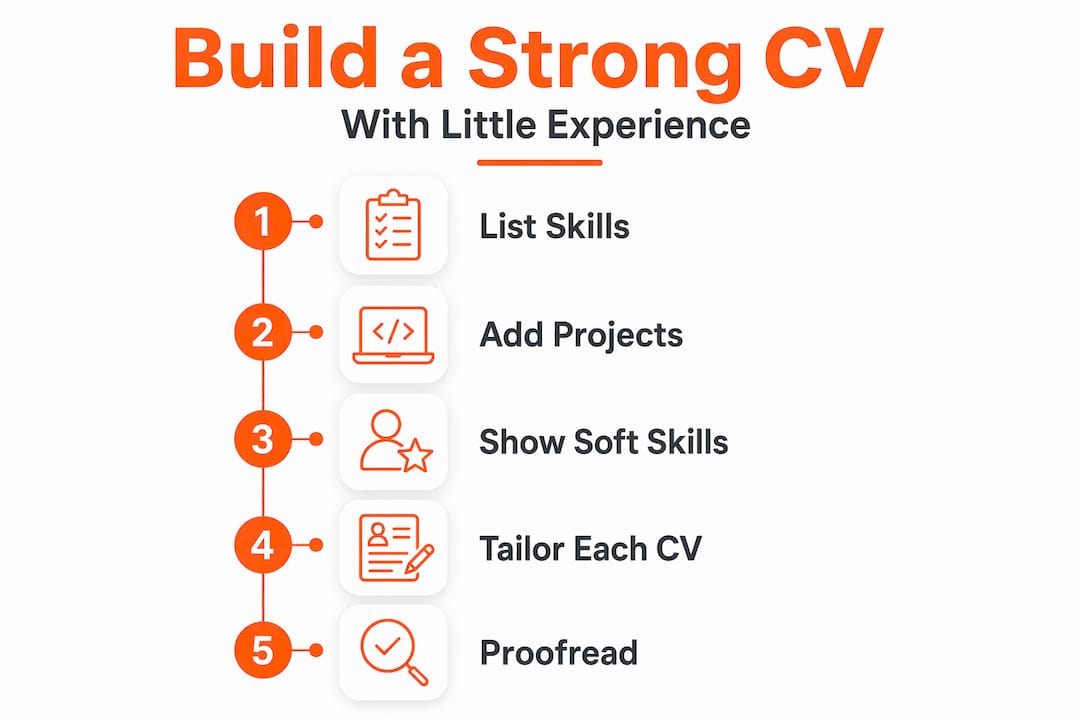
Soft skills deserve particular attention. They are often the deciding factor at entry level, and highlighting soft skills effectively can set you apart from candidates with similar academic backgrounds.
Writing each CV section step by step
With your content organised, you can now write each section with purpose. Here is a clear framework for how to write a CV for entry level roles when your work history is thin.
-
Personal profile. Write two to three sentences that state who you are, what you know, and what you are looking for. Well-crafted summaries that communicate purpose and fit clearly improve recruiter engagement. Avoid vague openers like “I am a motivated individual.” Instead, try: “Recent marketing graduate with hands-on experience in social media strategy and content creation, seeking a junior digital marketing role where I can apply data-driven thinking to grow brand engagement.”
-
Skills section. Divide your skills into two categories: technical and soft. List technical skills with the specific tools or platforms you have used (e.g. “Python, Excel, Tableau” rather than “data tools”). For soft skills, pair each one with a brief context. “Cross-functional communication: coordinated a five-person student project team across three departments” is far stronger than simply writing “communication.”
-
Projects and freelance experience. This is where candidates with limited formal history can make the biggest impact. Use the action-tool-scale-outcome formula for each entry. For example: “Developed a customer survey tool (Google Forms, Excel) for a 200-person university cohort, producing a report that informed three departmental policy changes.” Precise, measurable project descriptions are far more persuasive than generic claims.
-
Education. Keep this section concise. Include your degree, institution, graduation year, and grade if strong. Below that, list two or three relevant modules or academic projects with a one-line outcome for each. Do not list every module you ever studied.
-
Work experience (if any). Even part-time retail or hospitality work counts. Frame it around transferable skills. “Managed customer queries during peak trading periods, maintaining a 95% satisfaction score across 200 weekly interactions” is a strong entry regardless of the industry.
-
Section order. For a CV with limited work history, place your profile first, then skills, then projects or education, then any work experience. This puts your strengths at the top where they get read first.
Pro Tip: One user shifted their CV format to lead with projects and skills rather than employment history, and increased their interview callbacks from 2 in 40 applications to 8 in 20. Format is not cosmetic. It is strategic.
Common mistakes to avoid
Even a well-prepared CV can fall flat because of avoidable errors. These are the most common ones seen in CVs from candidates with limited experience.
-
Inflated language with no evidence. Describing yourself as “highly experienced in leadership” when your only leadership role was a group assignment undermines your credibility. Be honest and specific.
-
Irrelevant filler content. Listing every GCSE subject or a primary school award wastes space and signals poor judgement about what matters.
-
Non-standard formatting. Tables, text boxes, and columns look polished in Word but often break when parsed by ATS software. Use a clean, single-column layout with standard headings: Profile, Skills, Education, Experience.
-
Vague bullet points. Generic skills listings such as “communication, teamwork, leadership” with no context are among the most common reasons entry-level CVs get overlooked.
-
Spelling and grammar errors. One typo in a personal profile signals carelessness. Proofread twice, then ask someone else to read it.
“Recruiters prefer precise, evidence-based descriptions that link specific tools, project scope, and outcomes over inflated language. Clear, action-focused bullet points with measurable results show execution depth.”
Pro Tip: Read your CV out loud. If a sentence sounds awkward when spoken, it will read awkwardly too. This simple check catches more errors than a silent proofread.
If you are unsure whether your formatting is ATS-compatible, the article on CV formatting pitfalls covers the most common structural errors in detail.
Verifying and tailoring your CV
Writing a strong CV is only half the work. The other half is making sure it is correctly matched to each role before you submit it.
Start with keyword alignment. Take the job description and identify the five to eight most important skills and tools mentioned. Check your CV against this list. If a relevant keyword is missing and you genuinely have that skill, add it. This is not manipulation. It is accurate communication.
| Method | What it does | Best used for |
|---|---|---|
| AI CV optimisation tool | Compares your CV to the job description and flags gaps | Quick keyword and structure review |
| Career centre feedback | Human review from a career adviser | Tone, clarity, and overall impression |
| Peer review | Fresh eyes from someone in your target industry | Catching jargon and unclear phrasing |
| Portfolio link | Provides evidence beyond the CV text | Creative, technical, or project-based roles |
Graduates with a portfolio URL in their CV header receive significantly more interview invitations. If you have work samples, host them somewhere accessible and include the link prominently.
On timing: applying in the second week after a job is posted is often more effective than applying on day one. The initial flood of AI-generated applications tends to be processed first. Applying slightly later puts you in front of a human reviewer at a quieter moment.
And do not rely solely on application portals. Direct outreach to hiring managers yields a 1 in 8 interview rate, compared to 1 in 300 for generic portal submissions. A brief, personalised message referencing the role and one specific reason you are a good fit can make a genuine difference.
Pro Tip: Do not send the same CV to every job. Create a master CV with all your content, then produce a tailored version for each application by selecting and reordering the most relevant sections.
How SparkCV helps you put your best CV forward
If you have worked through this guide and still feel uncertain about whether your CV is hitting the mark, SparkCV can help you close the gap quickly.
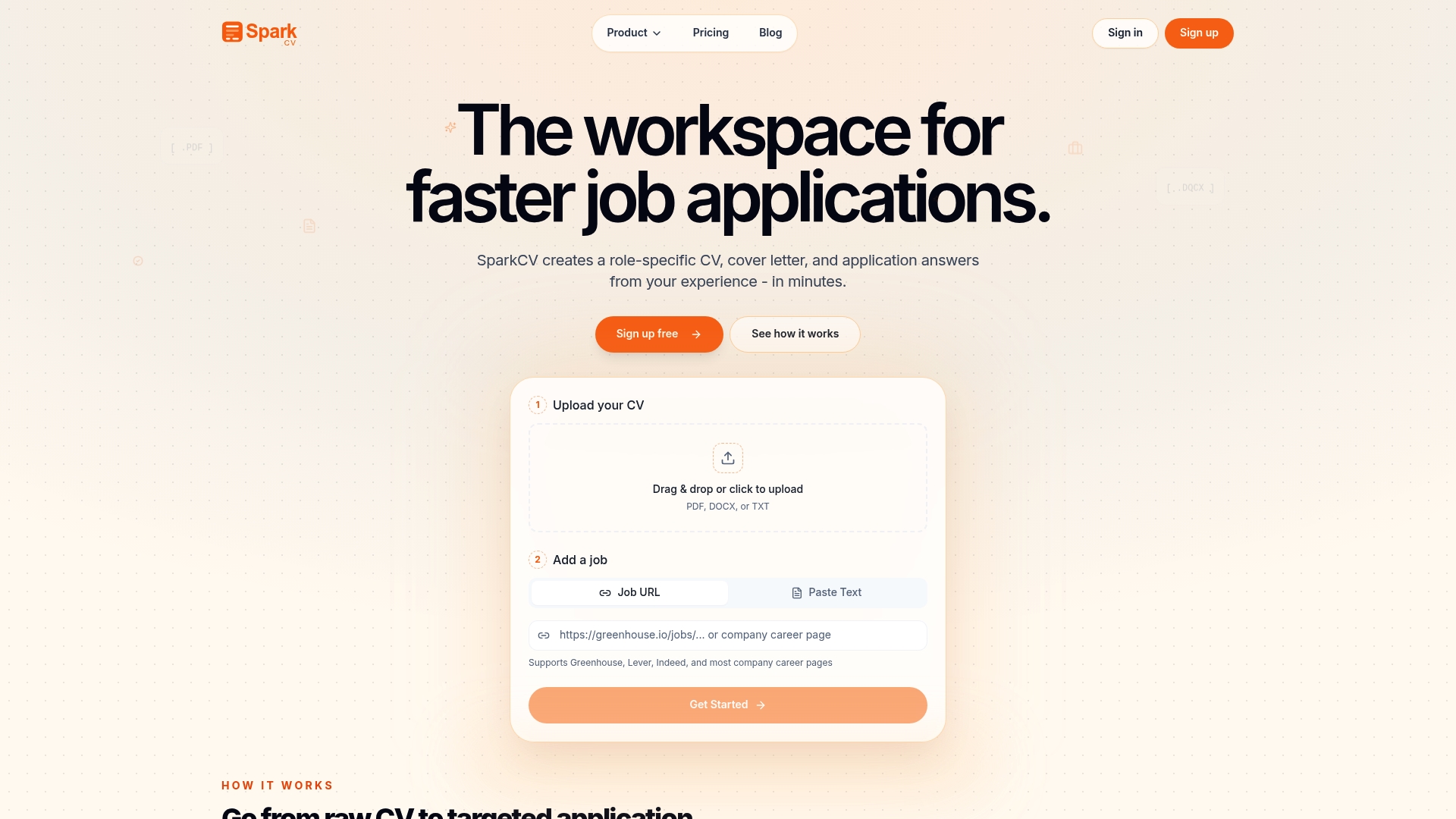
SparkCV uses advanced AI to analyse your existing CV alongside the job description you are targeting. It identifies missing keywords, flags weak sections, and generates a tailored version aligned to what that specific employer is looking for. For candidates with limited work history, this kind of gap analysis is particularly useful because it surfaces the skills and experiences you already have but may not be presenting effectively. You can optimise your CV with SparkCV in minutes, without starting from scratch. Try it free and see exactly where your CV stands before your next application.
FAQ
What should I put on a CV if I have no work experience?
Include your education, relevant coursework, academic projects, volunteer work, freelance projects, and extracurricular roles. A functional CV format that leads with skills and projects is more effective than a blank employment section.
How long should a CV be for an entry-level role?
One page is the standard for candidates with limited work history. Keep every entry relevant and specific, and remove anything that does not directly support your application for the role in question.
How do I make my CV pass ATS screening?
Use a clean, single-column layout with standard section headings such as Skills, Education, and Experience. Match your language to the keywords in the job description, and avoid tables or text boxes that ATS software cannot read reliably.
Should I include university projects on my CV?
Yes. Academic projects with clear outcomes demonstrate practical skills and knowledge. Describe each project using the action-tool-scale-outcome format to show what you did, how you did it, and what the result was.
How do I tailor my CV for different jobs?
Build a master CV containing all your experience and skills, then create a targeted version for each application. Prioritise the skills and projects most relevant to that role, and adjust your keywords to match the language used in the job description.
Recommended reads
Keep exploring






Hear more from SparkCV
Leave your email for new articles, onboarding invites, and launch news.
We’ll only use this for SparkCV emails, and you can unsubscribe any time.